Contemplating coming to America and being a mother-in-law and someday a grandmother

Toward the end of the war, Helene, who was considered a Turkish citizen, was part of a prisoner trade. She and a number of other Turkish women were taken from Ravensbruck and put on a ship that eventually left them in Istanbul. She had to stay in Istanbul until papers and money were arranged to allow for her passage to the US. While there, she wrote letters to her children and nephews. Her daughter Eva got married in January 1945 while her mother Helene was in Ravensbruck and her brother Harry was in the American army, stationed in the South Pacific.

In Istanbul, Helene began receiving word from the outside world and learned of the changes in her children’s lives.

In a letter dated March 2, 1946, Helene includes a P.S. to her son-in-law:

Many thanks for your kind lines and the courage you have given to me. The very thought to be able to live with and for you makes me happy and I hope never to be a stumbling-stone in your happiness. You quoted a sentence by Voltaire I had not known and I found it very true. I remember another from him about Rousseau: “Poor Rousseau should have a blood transfusion, for his own blood is a mixture of arsenic and vitriol. He is the most unhappy human being because he is the most evil.” Does this quotation not much more fit to Hitler? By and by I feel reconciled with my fate. What it took away from me, it gave to my children: Eva her husband, Harry his independence. I thank you for your effort to look out for a bigger place and I assure you to endeavor to keep your home well as long as you want it. Although I am only a shadow of my own self I wish to be helpful if not even to you but to your children. I am the fairy tale grandmother devoured by the greedy world. Do you know another grandmother who can tell her grandchild this adventure with more authority? Just now I am not afraid by the big bad wolf and you must not fear I will amuse your little son or daughter with the description of the bad digestion of the poor voracious animal.

My dear Ludwig, you have taken from us one of the two most valuable things we possess and still I am not cross with you. It is funny, is it not? Please ask your wife to translate my first little letter into a correct English. I hope to hear from you very soon, but I should prefer to see you personally much sooner. 

Across the seas and across the years

I recently looked at these three photos which seem a snapshot of the immigrant experience. The oldest photo from 1937 is of my mother at her “Sweet 16” party (although I don’t know if they had such a thing in Vienna) - she is seated on the right. On the wall behind the girls is a portrait of my grandmother. Then there’s a photo of the three generations of women in my family - my grandmother, my mother, and me - all together in San Francisco. Finally, there’s a photo with my mother, uncle, and my mother’s caregiver sitting in my mother’s apartment just a few months before she died. Behind them is the same portrait that appears in the photo in Vienna more than 70 years earlier. The portrait and the people all survived such amazing odds to create a life and a family in San Francisco. While my mother was alive, I loved the idea of her mother watching over her.

Eva’s “Sweet 16”

Eva’s “Sweet 16”

Three generations

Three generations

Across the years and across the seas

Across the years and across the seas


Gifts from my grandmother

This project seems to me both a gift from me to my grandmother - giving her the platform and voice she always wanted - but perhaps an even greater gift from her to me. Through her papers, photos, stories, and letters I am learning all about her life - all the stories I thought were lost after my mother and Harry died.

Perhaps because I share her name, I always felt close to my grandmother. I remember her as a sweet, kind woman who made me feel safe and loved when she was my babysitter.

While we were together, she would call me sweet pet names and talk to me for hours, sometimes unknowningly switching from English to German along the way. These days I imagine that the stories she told me are those I have (re)discovered among all her papers and letters.  

My grandmother loved to bake, especially cookies to give to important people in her life at holiday time. My mother carried on that tradition, as do I. This year I found myself making Pfeffernusse - a German spice cookie my grandmother made every year. I haven’t made them in decades, but being immersed in my grandmother’s life inspired me to revisit the scent and taste of her kitchen.

Pfeffernusse

Pfeffernusse

I don’t have very many memories of my grandmother after I was about ten years old. At that point she broke her hip. As often happens with elderly people (she was in her 80s at the time), her life was never the same. She lost most of her English and retreated into memories of pre-war Vienna. She could no longer live on her own and moved into what was then known as the Jewish Home for the Aged.

My last memory of my grandmother was visiting her at the Jewish Home a few months before she died. I had taken a course in German in college hoping it would help if my mother ever retreated to German as her mother did at the end of her life. During my visit, I was able to understand some of what my grandmother told me. She asked me if I had met her children and pointed to where she imagined them playing in the park. She was so happy in her reality. I have returned to that memory several times over the past few years - in letters my grandmother wrote several times about her happiest memories being the days when her children were young and she went with them to Stadtpark in Vienna. I feel honored to have “visited” with her there.

Young Eva and Harry in Vienna

Young Eva and Harry in Vienna


Fantastic Voyage

I am speechless when I consider all that has happened over the past few years. I would never have believed that sorting through Harry’s closet filled with a treasure trove of papers, letters, and photos would teach me so much about my family’s past while opening unimagined doors into my future.

Perhaps because they had to leave almost all of their belongings behind, my mother and Harry spent the rest of their lives keeping almost everything, always assuming that the most innocuous little thing would come in handy someday. My favorite scene in the movie “Crossing Delancey” is where Bubbie carefully folds up and stores away the brown paper and string that a package was wrapped in, as if it were something extremely valuable - my family treasured worthless items at least as much as Bubbie did. However, unlike Bubbie, Harry and my mother didn’t necessarily keep things in a neat orderly way. Both of them would fill boxes with a mish-mash of unrelated items so you never knew when you might come across a treasure or junk, most often both stored in the same place. I’m guessing I inadvertently disposed of some important things my mother had kept when we hurriedly packed up her belongings after she sold her house. Many of her treasures were carted away by 1-800-GOT-JUNK. Thankfully, I learned my lesson and didn’t let that happen to the things Harry kept. I combed through each box and leafed through each book, making sure not to toss something worth saving. Each time I thought I’d found everything, suddenly I’d stumble on something that I’d missed.

The most important example of buried treasure was a small envelope stuffed with old letters. I found it several months after I thought I’d unearthed everything in Harry’s closet. I can’t even recall where I found it.

I’m pretty sure I found the letters in this envelope.

I’m pretty sure I found the letters in this envelope.

The envelope was perhaps an inch thick. It turned out to be stuffed with letters my grandmother had written from Vienna to my mother, Harry, and other relatives in San Francisco between November 1939 and October 1941 - there were about 100 letters written on thin air mail paper and crammed into that small envelope. When my mother and Harry first got to San Francisco, my grandmother wrote almost daily, trying to maintain a connection to her children who were thousands of miles away. I’m guessing no one had looked at those letters since they were stored in that envelope back in 1946 or earlier. Roslyn finished translating them recently and I understand so much more about both my mother’s early years in America, as well as the ultimately unsuccessful efforts by so many people to bring my grandparents to San Francisco to reunite them with their children.

My mother had told me the names and shown me photos of seemingly distant family members but never told me much about them. Now that so many letters have been translated, I feel like I know some of these relatives intimately and I realize how integral they were to my mother’s and grandmother’s stories.

Over the past few years, thanks to this treasure hunt, I have met dozens of new people, some of them related to me. I have discovered a fascinating new pastime (hobby? calling? who knows what it will turn out to be?). All because I opened a closet door and looked inside.

Young Helene

Helene was a precocious and voracious reader and an aspiring writer from an early age. She hung around her father’s print shop and wanted to write for his weekly newspaper, the Biela-Zeitung. After coming to the United States, Helene wrote down some of her childhood memories.

An early issue of Adolf Löwy’s weekly newspaper.

An early issue of Adolf Löwy’s weekly newspaper.

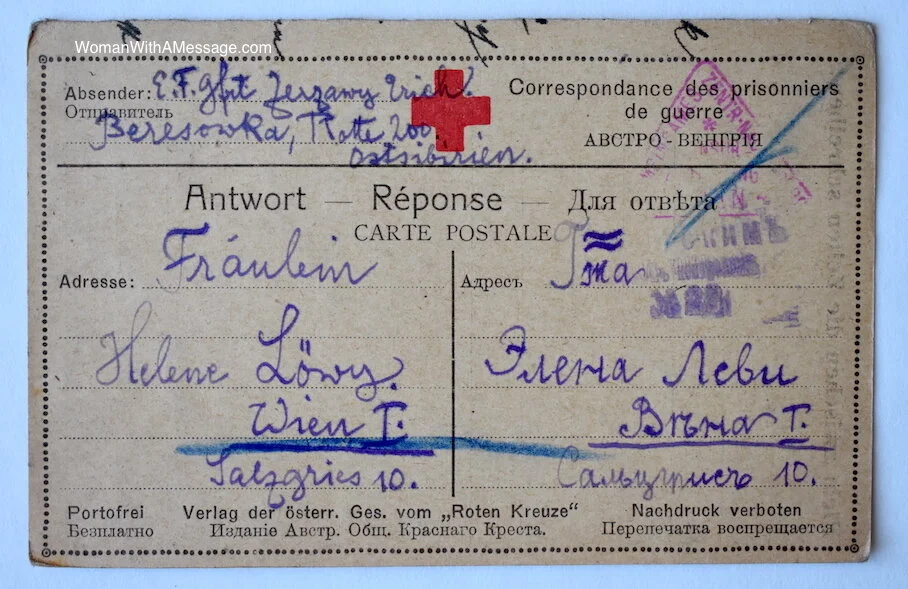
Helene was the youngest of a large family and seems to have been her father’s pet. Her sister Ida was much older and her eldest son Paul was born when Helene was 9. Although her nephews were closer to siblings in age to her, Helene thought of them throughout their lives as contemporaries of her own children (who were decades younger than their cousins!). Three of her nephews were soldiers in World War I and wrote many letters home to their family, even as prisoners of war. By then, Helene was living in Vienna.

Postcard from Helene’s nephew Erich from Russian prisoner of war camp in 1917.

Postcard from Helene’s nephew Erich from Russian prisoner of war camp in 1917.

80 years ago

My mother and her brother arrived in San Francisco in October 1939. Here is a translation of some of her first thoughts on being here from a letter dated October 23, 1939:

Since the exposition is going to close at the end of this week, we went on the first day. I like it better than the one in New York. It is quite similar in character but it is not so big. The external impression is much sweeter and more romantic. The emphasis is on fountains, lakes, and flowers. It is similar to the impression the city makes.

What I have seen up to now, the layout of this reminds me quite a bit of Istanbul. The city is rather scary and has many streets which are so steep that you can’t really walk without slipping. Yesterday and the day before yesterday, it was hot weather like in the middle of summer, but now suddenly it is made place for fall weather. Bertha says that the climate here is usually like that.

Eva at the Golden Gate International Exposition on Treasure Island in 1939:

 
Photo Photo069.jpg