April 15

Link to Family Tree to understand family relationships.

LT.0961.1943 (1.2) front.JPG
LT.0961.1943 (2.2) back.JPG

U.S. Army Service Clubs

Fort Francis E. Warren
Wyoming
April 15, 1943

Hello,

This camp is a quartermaster training post; I don’t like the idea of being a quartermaster. They don’t ask you whether you want to go, they just put you where they want to. Letter soon to follow.

Harry


I always thought it was odd that Harry ended up being stationed in the south pacific – why would you send a native German speaker to Asia? When I did an oral interview with Harry, he spoke of how he was a fatalist like his parents and how fortunate he had been throughout his life. One instance of good fortune was that indeed his company was supposed to be sent to Europe. He and a fellow soldier were on a train to get back to base when they were about to get shipped out, but the train was delayed and the company left without them. Harry was then posted to the South Pacific. According to Harry, almost the entire unit that was sent to Europe perished.

When last we heard from Harry, he was in Monterey, CA, beginning his army service. In 10 days he found himself in Wyoming for training. According to the F.E. Warren Air Force Base website, “During World War II, Fort Warren was the training center for up to 20,000 of the Quartermaster Corps. More than 280 wooden buildings were constructed without insulation and interior walls to temporarily house the increased number of troops. In the harsh Wyoming winter, waking up in these barracks often meant shaking snow from one's blanket before heading for the just-as-cold communal showers.” Hopefully Harry was long gone by the time winter set in.

Harry waiting for a Greyhound bus. Date unknown.

Harry waiting for a Greyhound bus. Date unknown.

April 14

Link to Family Tree to understand family relationships.

Today we have another letter from soldier Harry Lowell to sister Eva Lowell in San Francisco.

LT.0940.1944 (1.6) P1 front.JPG
LT.0940.1944 (5.6) P3 front.JPG


New Guinea
April 14, 1944

Dear Eva,

Thank you for the letters of March 4th, 21st, 25th, and April 1st. My apologies for not having written you sooner; I shall be prompter in answering your letters from now on. The trouble seems to be that whenever I put writing off for another day it takes a few more days until I get in a correspondence mood again; that’s bad.

Judging from your letters I can see that you are entangled in domestic affairs. Get ready to receive a lecture from your brother; here goes. All the years of education, both academic and medical, have failed to teach you fundamental psychology or any sense of diplomacy applicable to peaceful relations with one’s relatives. Or is it patience you lack? Have you ever tried to see both sides of an argument? Learn to control your tongue and get rid of your stubbornness; then you will have reached successfully the first stage of the art of getting along with your relatives. (Editor’s note: Are you interested in learning the next nine stages of it? Then write for Prof. Lowell’s outstanding books; “Towards Harmonious Dealings With One’s Kin”, “Why, and Why the Hell Not?” and “Cheerful Psychology For Everyday Use.” These three volumes can be obtained either from the author himself or from your neighborhood second-hand bookstore.)

Now that I have given you a paternal sermon, I’ll turn to nicer subjects. (I guess you could imagine your brother, father of a little brood, giving lectures before and after dinner; what a holy terror I’d be!)

As to that Standard Oil deal, my suggestion is still the same; stay away from it. If you have a desire to get away from S.F., try to get some good job in a different location. About four hundred miles distance should be enough to give you plenty of independence without any interference. Of course, should you get a good job offered anywhere far from S.F., you’ll have to approach Tillie diplomatically, etc. Just use your head and follow my advice in the three aforementioned books.

No, I haven’t heard of Julius being in the hospital; I hope it’s nothing serious.

How are you getting along otherwise? What’s the name of the turtle at your house? I would like to send to Ursula’s mother a couple of dozen of those beasts that serenade us every night with their “whaaaat, whaaat, whaaat”; they are the New Guinea frogs. (They need tuning.)

I got a hold of a trigonometry book and I’m having a lot of fun with it. How is Ursula getting along with her French lessons or has her tutor given up teaching?

Well, old girl, that’s about all I have to write about. Special Service finished our company with a little library, consisting of a cabinet and about a hundred books; it’s very nice I think.

Right now we’re in the mosquito hunting season and we take preventive measures to keep the anopheles away from us; we keep a net over our cot, here is a poem about it:

FRUSTRATION

G’wan and buzz, you son of a B---,
I’m under a net and you can’t bite me.
You can rant and rave and tear your hair,
But I’m in here and you’re out there.

You can call your friends to bring you aid,
You can call the spawn of the eggs you laid.
But not one whit will they help you out,
For the cords of this net are strong and stout.

 Your buzzing rasps upon my ears,
But this bar of mine quells all my fears.
Even a blind man’s eyes could see,
Your evil proboscis won’t stick in me.

I settle me down for a night’s repose,
My physique is bare, devoid of clothes.
But something starts to gnaw on my hide.
One of the bastards has snuck inside!

New Guinea                --S/Sgt. R.W. WAR…


 Well, this is absolutely the last page.

Love,
Harry. Prof of Psycholgy,
Physiology, and Philosophy

P.S. Give my best regards to the folks (2266-22 Ave) and to the Travers!


It’s wonderful to hear “Professor” Harry give his sister Eva advice, following up on the advice he gave her against taking a job with Standard Oil in the letter posted on March 9. Here, he is the ripe old age of 20 and his sister is almost 23. They had very different personalities. Harry was easy-going and charmed everyone, not letting others know what he was thinking. Eva had strict rules for herself and others, and was incapable of telling a lie or of stretching the truth even a bit. With no news of their parents, relatives in San Francisco took on the parental role, much to Harry and Eva’s displeasure. They needed to quickly find a way to make a living and become independent. That was much easier for Harry as a boy. Eva felt constricted by the rules and expectations for girls and it is clear from this letter that she wanted to get as far away from the expectations and judgments of family members.

Ursula was a friend of Eva’s from nursing school. Although Eva apparently complained to Harry about Ursula’s mother, I only heard my mother say good things about her. For many years she was Eva’s landlady. I remember her as a sweet old lady who sometimes took me to the zoo.

April 13

Link to Family Tree to understand family relationships.

Today we have a letter from Helene in frigid Vienna to her children in San Francisco. Although she typed without paragraph breaks on both sides of a half-sheet of paper to save money on postage, I have breaks for ease of reading.

LT.0133.1940 (1.2) front.jpg
LT.0133.1940 (2.2) back.jpg

 26th Clipper letter, on 13th April 1940

My golden children!

I was about to write a complaint letter because I thought I’d been forgotten, but then the postman’s ring prevented me from doing that. He didn’t keep me from writing, but he stopped my bad mood and the barometer went from changeable lousy weather to cheerful. It was the birthday letter to Papa (which I answer quickly) which made the April weather on Seidlgasse better. In actuality, the thermometer was -1 degree today and our oven is fed with all sorts of goodies. It is currently eating the ruins of an armchair which I found when I was cleaning out our basement. The latter I had to clean out because it’s going to be commissioned as an air raid shelter.

I was particularly happy about the contents of this letter because you spent the Easter holidays pleasantly, as we wished you would. Eva may continue writing such “shocking” letters; we enjoy all the descriptions of the comforts that our only relatives over there give you. Harry said in his last letter similar self-torturing comments regarding a ham sandwich. A song occurs to me: “Where is my Christian, in Hamburg or Bremen? I look at our cows and I think of Christian.” In another verse of the song, “I hear our donkey braying and I think of Christian right away.” I really have to be happy that you think of us when you are thinking about happy things and not domestic animals.

I’m not writing anything in paragraphs because I am just writing how I think. Please don’t tell my German teacher about that. The clipper post is such that it’s quite expensive and I’m looking to get my full money’s worth out of the postage. So I ask your forgiveness. There are a few lines in here for Sol Goldberg and Robert. By the way, I don’t know the address for either of those people. I also don’t know the address for Aunt Tillie.

I have nothing to say new about us, except that this week I “consolidated” a lot of plates, to use Eva’s technical term. This week I was a little more nervous than otherwise because I didn’t get any mail, but I don’t cry over spilt milk [in German: broken dishes]. It hurt more that we lost our beautiful Copenhagen vase which Papa broke. He promised to replace it but there is really no way. We have lost a beautiful thing from earlier times that always reminded me of “at home.” That’s just too bad!

While I’m writing, spring is rushing by me and winter storms are not thinking about giving way to the blissful moon, as little Harry used to naively believe. By the way, what happened to my “pickled herring”? [perhaps a play on the name Harry?] Did it become an eel? We were always such a respectable family - how did we come up with an eel in our honorable family? After my son has a “brain-storm,” I can think of all sorts of things and go back to something else.

Was it Aunt Hedwig who invited you, my Eva-child to the movies? The noblesse of Aunt Tillie and Bertha who always feed your eternal hunger for stockings made me very happy. Thinking of your stockings, I mainly wear the ones Harry left behind; I think I’m going to have to go to a blacksmith soon. On my birthday and Christmas, I got from Papa some stockings as well. He used the points he had available and I think a friend of his may have helped him out with additional points. I am not wearing them however, I am saving them for my daughter.

We got a call from the gallery. Papa wishes to get all the phone numbers. I believe I asked for Zentners’ telegram address. Olga wrote to me. She was happy to get a letter from Eva, but she was sorry she could not send me the original.

Many, many kisses. I greet you all. Your insatiably letter-hungry Helene-Mutti

April 12

Link to Family Tree to understand family relationships.

Today we have the first letter Helene writes to her nephew Paul Zerzawy as he is en route to America. In the post of April 10, we learned about the logistics of his travel.

LT.0381.1939.JPG

 Vienna, 12 April 1939 [answered from Southampton 13 April]

Dear Paul! Your greeting from London was both a pleasure and a surprise.

The point of writing today is only to reach you while you’re still in Europe and wish you a good trip and to express my hope that I hear from you very, very soon and I will be using your New York address in a short amount of time. Please greet Arthur and his family from me and tell them how much I would be happy to see them again. I have already told you that our eviction was rejected. We have taken care of this worry. We have not heard anything yet about the children and the waiting around is demoralizing for me.

Paul, I wish you all the best for the future!

I believe Goethe said ‘“Do the best, throw it into the sea, if the fish doesn’t see it, then God will see it.”

Throw all your dark thoughts into the sea and keep only the most beautiful and good ones in your memory. We have much in common. We have many common experiences and into the ocean, maybe we really will not be separated.

Many, many kisses from me to all of you
Helen


I was struck by the sweetness of this bon voyage letter. Like in letters to her children, Helene talks about their common bond and history, which for them goes back more 40 years. For once, she is not actually quoting Goethe. He wrote a poem called Der Fischer but this quotation comes from elsewhere.

As I searched for the quotation, I discovered that many cultures take credit for it. Is it German? Turkish? Greek? Arabic? Other?

I found it as a German song (Tue das Gute und wirf es ins Meer, sieht es der Fisch nicht, so sieht es der Herr.: Do what is good and throw it into the sea, if the fish doesn't see it, the Lord sees it.), as a German aphorism from the Turkish (!) (Tu' Gutes und wirf das Brot ins Meer! Sieht es der Fisch nicht, so sieht's doch der Herr!: Do good and throw the bread into the sea! If the fish doesn't see it, the Lord will see it!), and as a Turkish proverb (İyilik yap denize at, balık bilmezse halik bilir.: Do good and throw it into the sea; if the fish don’t know it, God will.)

April 11

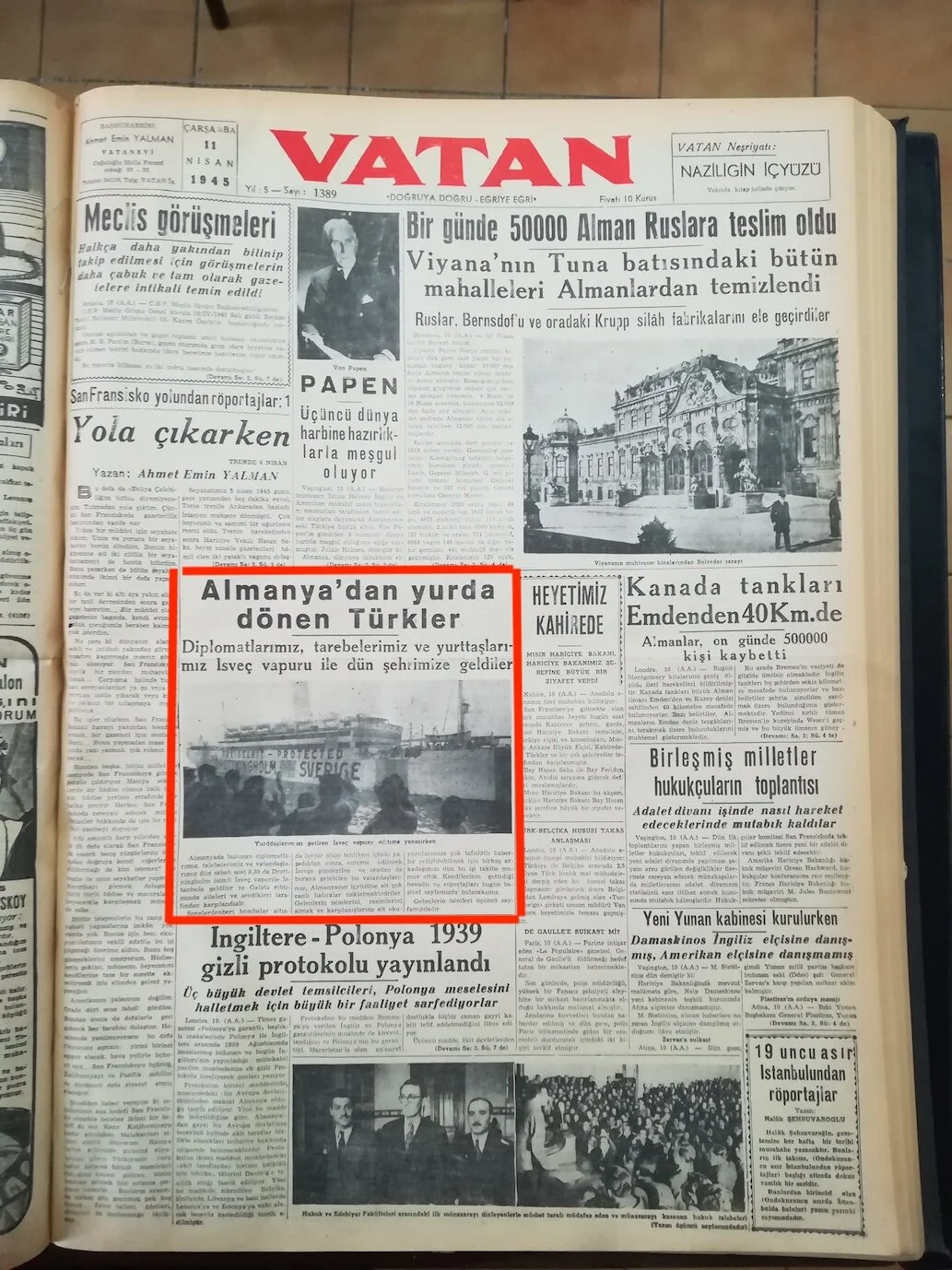
Historian Corry Guttstadt sent me a copy of this newspaper article, which she came across when doing research in Istanbul a few years ago. The paper announces the arrival of the Drottningholm the previous day. We read about the ship in the March 15 post. A rough translation below using Google Translate. After almost a month of travel, Helene must have been thrilled to arrive at her destination, even though she had no idea what would lie ahead. She probably thought she would soon have the paperwork and money needed to be able to join her children in San Francisco. Although this eventually happened, it took much longer than she could have imagined. More months of waiting were in store.

Vatan_11.4.1945_Titel_page 1.jpg

VATAN newspaper
11 April 1945


Turks Returning From Germany
Our diplomats, students and citizens came to our city yesterday on the Swedish ferry

Photo caption: Swedish Ferry bringing fellow countrymen home

Our diplomats, students and citizens in Germany came to Istanbul yesterday morning at 9.30 am on the Swedish ferry named Drottningholm and they were welcomed by the allergy and their loved ones ...

After living under bombs for years under the danger of death, these citizens, who were sent only to be interned, transmit very vivid memories of Germany's long time, to receive the names and pictures of the arrivals and to meet our readers with much detailed news. You will find the news and interviews brought by them on our fifth page today.

The names of the arrivals are on our third page.


A copy of the 3rd page is below. The list of arrivals is arranged by students, embassy staff, diplomats and “other”. Under Other at the bottom of the page you can see Helen Kohen listed.

Vatan_11.4.1945_S.3-Liste Turkish newspaper w Helens name_Page 2.jpg


April 10

Link to Family Tree to understand family relationships. 

In addition to family letters and photographs, Paul Zerzawy saved a number of bank ledgers and letters about transfers of funds from April of 1939. While preparing the April 3 post about assistance for refugees, it occurred to me that the money referred to in the letters and bank ledgers pertained to the assistance Paul was given to emigrate. Today’s letter is a copy of one Paul sent to a bank in Amsterdam explaining how funds should be distributed.

LT.0493.1939 (1.2) front.JPG

Dr. Paul Zerzawy
Currently at 8, Belsize Grove,
Hampstead, London N.W.3

London, 10 April 1939.

To: Amsterdamsche Bank
Amsterdam.

Regarding: Deposit Account 41987.

You have probably received in the meantime my letter of the 6th of this month in which I requested that you transfer money of 300 to Marjorie Shaw in London and I also asked that you notify Robert Zerzawy in London.

Today I am writing to tell you that I did not make use of the credit that you established for me with Cook Amsterdam for a ticket from Bentheim-London-New York because I traveled to London in a different way and I will also travel to New York in another way. Therefore I ask that you reverse the regulations regarding this and to charge me the appropriate fees.

Further I would ask that you liquidate my entire remaining amount in my account in the following way:

1.) I politely request that the amount of $100 (one hundred USA Dollar) is sent in the same way as the $300 I mentioned in the letter of the 6th of this month - in a cashiers check in Pounds to London or English Pounds in cash to Mrs. Marjorie Shaw, 21, Hampstead Hill Gardens, London, N.W.3 and please make that transfer and send a notice to my brother Robert Zerzawy, 8, Belsize Grove, Hampstead, London NW.3.

2.) For the amount remaining after the transfers have been made and after all fees have been covered, I ask you to establish a credit in US dollars for me at a New York Bank of your choosing or to issue me a cashiers check so that I may make a withdrawal there personally by showing my passport or possibly I could also do this in writing by mail. In the latter case, the number of my passport 1358 could be agreed upon as a code.

3.) The notice of transaction, the final reckoning of the amount, and the names of the New York bank which you have chosen I ask that you send to me as an official copy to the following two addresses:

a) “Herr Robert Zerzawy, 8, Belsize Grove, Hampstead, London N.W.3.”
b) “Mr. Louis Weisglass, 408 East 23rd Street, New York, for Dr. Paul Zerzawy”.

The transfers to Shaw, London and the transfer to New York are both urgent. I would therefore be very thankful for your prompt execution of this.

Very truly yours


Below is the bank’s response from April 13, indicating how the money was transferred and that the account was now settled and closed.

DOC.0491.1939 (1.2) front.JPG

At this point, Paul is in England, a stopping off point on his way to the United States. This may be the last time the brothers spent much time together, since Robert lived the rest of his life in London. Paul’s law degree must have come in handy — in the midst of uprooting his life with no resources, he at least knew how to deal and communicate with bureaucracies.  

Ship’s manifest from Southampton to New York. Paul Zerzawy’s name is underlined. Note: he gives his profession as “Merchant.” Found through Ancestry.com.

Ship’s manifest from Southampton to New York. Paul Zerzawy’s name is underlined. Note: he gives his profession as “Merchant.” Found through Ancestry.com.

April 9

Today we have a newspaper clipping from the April 9, 1965 edition of the San Francisco Examiner.

From the April 9, 1965 edition of the San Francisco Examiner

From the April 9, 1965 edition of the San Francisco Examiner

A Widow’s $1,000 SS Jackpot

Mrs. V. Cohen, 1408 8th Ave., wins $1,000 in the Examiner’s Social Security Game. A 78 year old widow, Mrs. Cohen is a long time player in the game and her first win is the top prize.

“When I saw my social security number at the head of the list all I could think is ‘this must be crazy.’ I’m dreaming. I’ve often thought how wonderful it would be to win the big prize but I honestly never thought it could happen to me.”

Well, it happened to Mrs. Cohen and it could happen to you when you join in this simple, easy-to-play game. All you do is write out your social security number on a postcard or put it in a letter and mail it to: The Examiner, P.O. Box 3634 Rincon Annex, San Francisco 19.

Once your entry is received at this address, you are in the game. Step number two is to check The Examiner each day to see if your number appears.

Daily, Monday through Friday, The Examiner publishes 30 winning social security numbers with a total cash value of $2,000. This is the way the cash divides: 1st prize, $1,000. 2nd prize, $200. 3rd prize, $100. 4th prize, $50. twenty-six additional prizes pay off $25 each.

Any person holding a social security number can play. It doesn’t matter where you live, how old you are, or whether or not you subscribe to The Examiner.

However, the point of the game is for you to find your own social security number. No person associated with the Social Security Game either phones, writes or contacts winners.


How nice to see some happy news for a change! Helene’s nephew Robert Zerzawy mentioned this article in his letter in the March 23 post. Times have certainly changed – imagine a newspaper publishing your Social Security Number these days. $1,000 in 1965 would be worth about $8,300 in 2021. It must have felt like a fortune.

April 8

Link to Family Tree to understand family relationships. 

Today we have a copy of a telegram sent from Paul Zerzawy to Vitali regarding the San Francisco relatives’ attempts to help him and Helene leave Vienna and come to San Francisco. Things are looking hopeful.

LT.0539.1941 (1.3) front.JPG

Western Union

Postmarked: San Francisco April 8, 1941

To NLT Haim Seneor Cohen
Seidlgasse 14
Vienna-40 Germany

Affidavit Erwin Fulda for you
Both Consulate of Vienna sent
Tillie Albert will take care of
the travel costs Probably
Joint next week

Paul

Over the past few weeks we have seen letters from Helene asking for financial assistance as well as a March 25 letter from Paul Zerzawy to Erwin Fulda regarding such assistance.

We have seen documents from 1945-1946 in Istanbul regarding the Joint’s work to help Helene. From the telegram we see that the family was working with the Joint as far back as 1941 to help the relatives get to America. 

April 7

Link to Family Tree to understand family relationships. 

It wasn’t until near the end of his life that Harry decided to share with his sons and me some of the more difficult memories of his childhood. One day, newspaper articles and documents magically emerged from the depths of his closet. The article below is from a Viennese newspaper dated April 7, 1939. We will see a much different article later in the year written 1934, where Vitali and the shop are painted in a much more positive light. Just a few weeks after this article was published, Eva and Harry made their way to Istanbul in order to obtain passports to go to the U.S.

Vitali kept the article and had it translated. It became part of the packet of documents he hoped would prove that he would be able to earn a living in the U.S. We have seen a few letters from Paul Zerzawy where he tries to disabuse Vitali of this notion. The translation below was made by someone in Vienna in 1939. For some reason, the 1939 translation did not include the first paragraph.

I could not find much information on this newspaper – as evidenced from the tone of the article, it appears to be a work of Nazi propaganda. Although the article says he has been in Vienna “a few years”, he had lived in Vienna since 1919. Nowhere in the article does it mention that the stationery store had been in existence for decades. Helene worked there long before she met Vitali.

NP.0255.1939 1.2 front.JPG
1939 translation

1939 translation

THE DARK AGES ON THE STUBENRING.
HOCUS-POKUS AND QUACKERY FROM
TORAH AND TALMUD.

It is unbelievable which sums flow, even still today, into the pockets of those beneficiaries of delusion who know how to play themselves up as experts on the so-called fourth dimension and lure weak-willed people. The business of spiritists, alchemists and occultists, even down to the quack on the corner, is doing famously. Every week, thousands of reichsmarks are poured down the insatiable throats of Egyptian hill dream interpreters. Money that would truly be worth spending on something better.

“ABANDON NOT HOPE - TURN TO ME!” There is one Jew who goes to work with an almost incredible amount of cynicism. He is cleverly camouflaged as a paper and stationery dealer on the Stubenring, opposite the former Ministry for War…..and he exploits his victims - and that in broad daylight - in the most unbelievable fashion. This Jew who boasts the typical name of Cohen (Kohn) has come to Vienna but a few years ago. Shortly after his arrival, he sets himself up as a stationer on the Stubenring. But the business did not go well. Then some time later, the Jew had a new brain-wave, which helped his business. He divided the shop in two halves; he had a part closed away in the background and papered with black paper. Egyptian and Turkish, as well as Assyrian hieroglyphs were painted - as uncannily as possible - and in gilt, on the walls. In this dark chamber there is a rickety table, on which he placed a worm-eaten magic folio. Two chairs complete the room, in which the spirits are called upon, and which is reminiscent of the witches’ kitchen in the scenic railway in the Prater. A few “letters of thanks” from clients, plastered in the shop-window, completed the outfit, and the business-like Jew had a few packages of booklets entitled “ABANDON NOT HOPE - TURN TO ME!” printed. And the swindle could start at full speed.

H.S.M. Cohen was soon well-known among women: known as clairvoyant, palm-reader, soothsayer, astrologer and magic healer. Daily did H.S.M. Cohen “heal” persons suffering from kidney-diseases, as well as diabetes or intestinal diseases by his healing hands, ay, he even managed to bring broken and stiff legs to move again…… Even to this day, the Jew is giving out regular “diagnoses”, and he hypnotizes his pitiful victims into feeling pains, which they do not have at all. For all this, the “doctor with the magic baton” requests twenty marks for every “session.” A certain type of strolling smear [sic] Jewish physicians even have written complementary letters to this public injurer. One of them says: “Mr. Cohen has predicted an abscess in the teeth to a patient, who never actually had a toothache. This abscess was now stated by way of an x-ray, but it has never caused any discomforts. Dr. R.W. assistant at the polyclinic”

GHOST AS CURRENCY AGENTS. Now, how should this man, who is so powerful in the world of the spirits, who can Nero and Napoleon and Ahasver’s father-in-law talk at will, who can heal imaginary diseases, fail to be an A1 lawyer also? Thus a Jew states the fact (reprinted among his complementary letters) that “his money which has been confiscated in Germany had been given back to him, without his having asked for it. F.S. October 2, 1935.” Or, another example: “you have given me an amulet, and I have, right after, seen my mother again in a dream, and she has given me the necessary inspiration to make new connections (new business) which have, up to the present, proved successful. R.K.”

This wizard also interferes in matters of law, and predicts the result of lawsuits at 20 marks apiece. And in order to keep his business from suffering any standstill, he has added the trade with mandrakes to his assets.

How much disaster must this Jew, who sails under the flag of Turkish citizenship, already have brought upon weak-willed people in our own city! Like a vulture waiting for a victim, he walks, slowly, up and down in his shop, until some curious soul gets enabled in his “letters of thanks.” Then the Jew comes slowly nearer, and bores his eyes into the passer-by. If this happens to be a weak-willed individual, he will be intimidated, and follow into the shop, where the Jew will predict an illness for him, but, at the same time, call his attention to the fact that he might, in the course of the afternoon, pay a visit to his “cabinet of spirits” where, against 20 marks, and by way of his healing hands, he will on the spot, free him from the lurking disease.

How much longer will the ghost haunt the “chamber of spirits of H.S.M. Cohen? And how much longer are poor individuals going to be bled there?

Saturday, April 8th 1939
“VOLKSZEITUNG”, Vienna.
(“People’s Paper)


My mother and Harry spoke of their father with awe and respect. They always mentioned the many languages he could speak. Although they never talked about their father’s metaphysical activities, they told us that many people, some of them quite influential, came to seek his advice. The subheading “Abandon not hope – turn to me!” is taken from the front of Vitali’s “business card,” a folded sheet with dozens of testimonials from satisfied customers – sort of Yelp reviews of the time. Although the article talks of Vitali taking in unsuspecting women, the majority of the testimonials are by men.

DOC.0383.1939 (1.3) front.JPG
Vitali working at the back of the stationery shop

Vitali working at the back of the stationery shop


April 6

This postcard of Pacific Grove appears to be the first mail that 19-year old soldier Harry Lowell sent from Monterey Presidio (now home to the Defense Language Institute) to his sister Eva, was living and studying at Mt. Zion nursing school in San Francisco. The card is postmarked April 6, 1943 and postage was free.

Description on back: Pacific Grove is a delightful resort community that offers much in recreation to entertain the visitor. It is famous as the Home of the Butterflies and for its floral and marine gardens, beaches, weird coastal rock formations an…

Description on back: Pacific Grove is a delightful resort community that offers much in recreation to entertain the visitor. It is famous as the Home of the Butterflies and for its floral and marine gardens, beaches, weird coastal rock formations and renowned municipal museum.

LT.0962.1943 (2.2) back.JPG

Dear Sis,

Having lots of fun getting shots in my arm and my ears lowered considerably. You would not recognize me. S’long!

HARRY
U.S. Army

P.S. Do not write me yet.


Perhaps a photo of the newly-shorn and vaccinated Harry? Date unknown.

Perhaps a photo of the newly-shorn and vaccinated Harry? Date unknown.

April 5

Link to Family Tree to understand family relationships. 

LT.0082.1917 (1.2) front.JPG
LT.0082.1917 (2.2) back.JPG

Easter Sunday 8./IV.17.

My dear ones!

I am happy that I have received mail from you again, even if it was sent to me from Trojikorawsk, 2 letters and 3 cards. I am very concerned that Robert is not well and that the economy is weighing on you. Now I should be fine until the end, don’t worry about me. I am also very pleased that Grandmother at least wrote me a few lines. She used to worry that I could not read her handwriting. In these circumstances of mine, I’d do my best to decipher hieroglyphics if she wrote me in those. Robertl should not hesitate to write whatever is on his mind. I am curious to know everything. One thousand kisses. Your

Erich


We have today another letter from Paul and Robert’s brother, a POW in Siberia. At this point, Erich is almost 19 years old. Paul’s letters are usually all business, with little or no humor – he was trained as a lawyer and is very precise in his descriptions, even when they’re about the wonderful time he had on leave in Vienna in his March 19 letter. Even as a prisoner of war, Erich’s sense of humor shines through – much more like his Aunt Helene.

Erich alludes to economic problems. From the WWI letters, it appears that the adult men in the Zerzawy family have been soldiers. Remaining at home in Brüx was Robert, who at the beginning of the war would have been 14 or 15, and his half-sister Käthl who would have been 10. Their grandmother (Helene’s mother) was taking care of them while her son-in-law Julius and his older sons were in the army. Paul and Julius sent money and packages when possible; Erich of course was in no position to do so.

April 4

Link to Family Tree to understand family relationships.

LT.0521.1940.JPG

Vienna, 4 April 1940

To Paul, the reporter! You can certainly keep on with this system. It is entirely enough for me to hear from you even just a few lines and to find out from you how you’re doing acclimatizing yourself to life there. I think it’s easier for the children. You can believe me that it’s easier for you to do that than to deal with all the changes here which wouldn’t be even possible anymore with your profession. If I only knew if the separation we are now experiencing is payment for the happy family life we have had or if it’s some sort of test for even further things. I will try think of myself worthy of the latter interpretation and try to do better at being patient and virtuous. It’s really hard to be virtuous - it would be unthinkable for me if I did not admit that the postal harvest this month has been particularly satisfactory. We received almost every week about a piece and a half of mail, although sometimes of course it was three letters in one week and then totally quiet for 14 days. Then we just get out the folder where we keep these things and we read the old letters again. This flight from reality has become a cult with us and is an excellent way of not losing contact. With the intensity with which all this happens, the other person must feel how one is with him in thought. Are you laughing? Well let me have this delusion, but it is not a delusion. Sometimes I feel as if the children had stayed just a little longer at school. The few weeks which children went to summer camp during school vacation seemed longer to me than the current separation. But back then, one had the wish or at least the possibility to amuse oneself. But this is not always the case. Then there are days, usually when there is no mail, when everything seems twice as hard and one thinks of the difficulty about 3 times as often. A heavy sleep is like a narcotic. Then, after such a nirvana, when the mailman rings the bell and actually does bring a letter from you, then I take a deep breath and my limbs firm themselves up. It becomes a delight to do the dishes, and my fantasy has received new wings during cleaning. Thank God there is no more room for any further outpouring. Please greet all of our dear relatives from me and kisses from

Helen


After almost a year of living in the U.S., Helene’s nephew Paul Zerzawy is still trying to acclimate himself to his new environment. As we have seen in earlier letters, he found it difficult to make a living, particularly since his English wasn’t very fluent. I don’t know whether it was much of a comfort when Helene points out that he would not have been able to continue in his profession as a lawyer in Vienna or Prague. No matter where he was, life would have been hard.

Helene says that she thinks her children have found the transition easier than Paul. I have been thinking lately about what it’s like to be a refugee or immigrant depending on your stage of life. Landing in a new environment could be freeing or terrifying or something in between.

My mother and Harry were teenagers when they arrived in San Francisco and became fluent in English very quickly. They completed high school in the U.S. and had their first jobs here. Although they came with nothing, their whole lives were ahead of them. Their cousin Paul was 45 years old. He had been a successful professional in Europe, but also had nothing when he arrived in the U.S. He found it much more difficult to learn English than did his young cousins, and his European legal training was worthless. The little money he could make was by giving piano lessons and being an accompanist. It must have been very depressing and demoralizing to imagine the years ahead.  Helene arrived in San Francisco at the age of 60, having lived through atrocities and lost her husband. She too had to figure out how to start anew. Unlike her children who looked forward to their futures with hope, she clung to past happy times, knowing she would not see them again. All of them landed in the same place and yet all of them saw life in the U.S. through different lenses.

April 3

Today we have a newspaper article that Helene’s nephew Paul Zerzawy kept in his files. Earlier this year after my translator Roslyn had finished translating all the letters she could read, we began looking at other items in the archive that were in German. This article is one of the only items that Paul Zerzawy kept that was not specific to him or his family.

NP.1518.nd p1.jpg

5 March 1939 Prager Tagblatt Nr. 55

[This article must have been from one of the last issues published of this paper since it ceased publication after the German occupation on March 15. Although you can see issues in the Austrian National Library, 1939 is not included.]

England’s Help for Emigrants
The implementation of the English-Czech-Slovak agreement

Who is considered a refugee?

Prague. In the last days, the agreements were made which the delegates of the English government, Mr. Robert Stopford about the conditions for implementation of the English-Czech-Slovak refugee agreement in Prague.

According to this pact, the following people are considered refugees:

1)    People, regardless of their religious persuasion, also not considering their political leanings or their race, those who had their official place of residence in the annexed region and then found in Czechoslovakia then or now a place of refuge, and who either could not opt for Czechoslovakia or if they were entitled to this option were not in a position to make a living in Czechoslovakia. All of these people fall in the category of refugees from the annexed region.
2)    Those people are considered refugees who are foreigners who had or have German or Austrian citizenship before 30 September 1938 found temporary residence in Czechoslovakia.
3)    Considered under this pact are people who in the future reach the Czecho-Slovak region and are declared to be refugees by the British government.

Execution of money orders from the English refugee bond.

First, the parceling out of such monies to people who have the cash money to purchase their quota for 30,000k and in the second instance to those who have no such means and for whom the quota will be provided without remuneration. They must prove their lack of funds through an official document, such as a certificate of poverty or their last tax return. The money is not paid in cash to any refugee. He only will get the ticket to his destination, which will be bought by the refugee office and will get a check to be paid to a bank at the destination. The necessary transactions are taken care of by the London branch of the Anglo bank and the [Czech] bank. The money orders themselves will be taken care of by London, and where the bonds are deposited. The distribution process is set up to make sure there is no governmental or technical complication. If the emigrant should die during the trip, his family will get the money order.

Anyone who applies for a cash distribution will have to arrive at the refugee office where in the next instance it will be determined in the sense of this pact he is actually a refugee and is eligible under this agreement. Only after that point will the further arrangements for the purchase of the ticket be carried out. If the transport company has made the price of the ticket available to the refugee office, the transfer of funds to the appropriate bank will be made for the release of the funds for the ticket. The travel agency will transmit the ticket to the refugee, but there will have to be confirmation of the situation. He will also get some pocket money for travel. The emigrant will have to arrive at the refugee office twice: 1. for the acceptance of his particulars, 2. after the amount of the cost of the trip is determined, he needs to report to arrange for the emigrant quota (either free or for purchase). The British government is in each case to provide the invoice.

A part of the refugee amount was reserved for the emigrant group of the former German social democrats and German democrats who were under the direction of Deputies Jasich and Taub. 

From this group, there are about 800 family groups who are supposed to go to Canada and the rest are going to other overseas destinations. The Canadian government is in this case not insisting that immigrants must be only farmers, but it has declared itself willing to accept immigrants and retrain them. Therefore, the distribution of the normally determined quote of $1000 in this case will be 50% higher. For the normal emigration to Canada from Slovakia or from the Bohemian lands, the amount of $1000 will be demanded in Canada for the purchase of a farm. Immigrants from the group Jasich-Taub will be able to form a collective. These families will be able to found their own town.  

In this group of emigrants, we also include former Hungarian social democrats from the annexed region, especially farmers, and 1300 people of whom 500 are non-Aryan. This group is going to be under the direction of the former Senator Balla.

Over 40 million

Up till now, there have been over 40 million crowns distributed to refugees separate from the large amounts reserved for the large group of people who are emigrating to Palestine. In the sense of the separate Palestine pact, for the legal emigration to this country, a half million pounds are reserved. That means 500 emigration certificates for 1000 pounds each. Considered in this group exclusively are Jewish families who with this amount as capital are emigrating to the land of destination, because 1000 pounds at today’s exchange rate are the equivalent of 140,000 crowns. Several hundred people have already left on this trip. This amount of money is however deposited in a bank in London and will be sent directly via the national bank in Prague for payment at the destination. Of the target amounts from the refugee loan in the total amount of 4,000,000 pounds there is therefore a half million attached to the needs of the Palestine group and a further amount for the emigrants in the German Democratic group. Prague wishes that this amount will also be increased to a half million pounds. The further 3 million are also to be used exclusively for the purpose of emigrants.

Where?

The question where the emigrants will be directed to has generally not been decided yet. Especially the negotiations with the south American states have not led to any positive results yet, because the states in the first instance are only willing to allow farmers to immigrate and in the second instance they are putting up some oppositions to the immigration of non-Aryan people. The Jewish emigrant problem is therefore especially difficult to solve.


Paul Zerzawy left Europe just a month or so after this article was written. I imagine that he fell under the quotas mentioned. I do not know whether he received any monetary assistance. The work of Robert Stopford was mentioned in the January 25 and March 21 posts.

Yesterday I was looking at the JewishGen site and found the following reference to him (with his birthday off by a year) saying that his German citizenship had been revoked and property seized, so at this point he probably had few personal resources. At this point Paul was considered German because Germany had annexed Austria and Czechoslovakia.

PaulZrevokedCitizenshipJewishGen.png

April 2

Link to Family Tree to understand family relationships. 

LT.0023.1944 (1.3) P1 front.JPG

April 1, 1944

Dear Bertha and George,

I just received your letter of February 11th and I was very happy to hear from you. The reason for the delay must have been the fact that you forgot to include my APO number in the address.

So you are working on your garden again; I wish I were there helping you. Once in a while I get a chance to work with vegetables and salads – opening cans of them when my time for KP comes.

It has been raining quite a bit lately and the jungle has a nice fresh color and smell to it. If it weren’t for the mosquitoes and other pests, I would get to like this place even. The mud that’s around here is rather a nuisance; in some spots it is so hard that, unless one laces his shoes well, he is apt to slip out of them, leaving the shoes stuck in the mud. My worst habits come to light when I have to change a flat tire in the mud, because then I cuss like a whole division of cavalry men.

I have met a lot of Aussies, and they are very nice and square unless you have business dealings with them; they like to soak the Yanks.

Well, there isn’t much to tell, except that I am well and in pretty good spirits.

I was glad to hear of George’s progress and I think he’ll be able to promenade Market Street again. I hope you both are well.

Fondly,
Harry

P.S. Give my best regards to all our friends.


Harry must have had a lot of time on his hands to have written so many letters home over the last few days.

Although I do not have a photo of him working on a truck in the mud, here is a photo of him working on a car. On the back he wrote: “Christmas Day 1943; Harry giving Chevy a face-lifting.”

PH.1574.1943 (1.2) front.JPG

April 1

Link to Family Tree to understand family relationships.

LT.0132.1940.jpg

My dear Robert!

Love makes us inventive and since you have not come up with this great idea, I must assume that these feelings are only on one side. Please don’t make any belated declarations of love! But you can make up for this. How? Well, I’ll let you figure that out. We are fine. We live like fishes in the wind and birds in the water and we have no other troubles except for those about you. Our only pleasure is getting mail. But really you have not contributed much to this joy, so you have to make up for that! Now you don’t need to strain your mind, I already told you how you can make this up to me. Although the children write regularly and conscientiously, which lets me know what Paul is up to with his attempt to become independent, there are occasional breaks with no letters, which require of me much patience and cause me a lot of nerves. But those days pass by as well. They go by more slowly than others however. There’s only a saying from Goethe which I don’t think is right: “Nothing is harder to take than a whole bunch of good days in a row.” I don’t think that’s true - I could put up with that very nicely. What do you think, little Robert? If maybe you sit down for a quarter hour and have a little chat with me, an answer is guaranteed right away, because I don’t do much else these days. Housework just happens. I think of this as my part-time job, most of my time is devoted to correspondence. How is Hedl Waldek? Say hi to her from me. In the next letter I will write a few lines to her. It’s late today. Vitali, who greets you warmly, is hurrying because he wants to go to the post office. Mila wrote to me that your health is satisfactory but I would like to hear that from you.

Dearest kisses
Helen


Today’s letter from Helene is to her nephew Robert in London. He has lived there for about a year. Her playful tone is like that in her letters to her children rather than the more business-like or scolding tone she sometimes takes in her letters to his older brother Paul. She is counting on Paul to figure out the logistics of getting her and Vitali out of Vienna. She depends on Robert for his love and emotional support. Perhaps it is the age difference. Although Helene babysat both nephews when they were children, Paul was only 9 years younger. Robert was a student during World War I, Paul was a soldier. After losing their mother at a young age, Paul as the oldest child seems to have taken responsibility for the well-being of his siblings, and ultimately also of his aunt.

Helene had just one word wrong in the Goethe quote: she used the word “beautiful” instead of “good”.

I realize that I need to educate myself on the works of Goethe. Helene quotes him in almost every letter; her world view, and therefore my mother’s (and unbeknownst to me, my own!), was influenced by his words and philosophy. I could easily imagine my mother saying the above quote. It seems familiar in spirit to me too: whenever things are going particularly well, my husband or I will say to the other: “Nothing could go wrong now!”

March 31

Link to Family Tree to understand family relationships.

LT.0941.1944 (1.5) P1.JPG

New Guinea
March 31, 1944

Dear Eva,

Thank you for your letters of Feb. 28, March 12, and 17; it’s odd that you haven’t received any of mine yet. Your switching from typewriter to longhand makes the V-letters twice as interesting inasfar as I have to reread them in order to get an idea of what’s in them. The army misclassified me at the induction center; I should have been placed in “intelligence” – department of deciphering and decoding. (No reflection on your handwriting, mind you. People have asked me where in the hell I learned to write; most of them can’t read mine, either.)

Do you remember the famous painting of Holbein’s, “The Poor Poet” I think it is called, wherein a starved poet sits in his bed, doing his writing while he holds an open umbrella to keep the rain that’s coming through a leak in the ceiling from pouring down his bed? Well, it’s raining cats and dogs right now and my tent is full of leaks; I’ve tried everything to keep my cot dry, without avail.

While I’m writing this, water keeps dripping down my back; when I move the leak moves with me. If I were in a playful mood I’d make a game out of dodging raindrops, but I’m too wet to be playful.

We had a few spring-like days already, especially after rain which cleans air and plants the freshness of which gives one the impression of Spring tra la la. Spring here isn’t Spring in the States; when it’s Spring in the States it’s Autumn here, you see. (Simple, isn’t it?) It won’t be long before Winter will set in. (Jingle bells, jingle bells…..)

Otherwise everything is about the same as before. I’m getting kind of sick of this place, I’m allergic to too much mud and there is definitely too much much around here. The other night I got stuck up to my knees trying to find out whether I had a flat tire. I felt like a young fly stuck on fly paper (I had an advantage over the fly, being able to cuss like nobody’s business).

Well sis, that’s about all there is to say at present.

I trust you are well and in good spirits, etc. Have you become used to the surroundings of your new job yet?

Well, this is all and their ain’t no more.

Love,
Your one and only
brother,
Harry

P.S. Give my regards to Paul, Ursula and family, the Travises [?], and Mayor Rossi (Has he been elected mayor again?)


This letter was written the same day as the V-mail letter to Hilda which was posted yesterday. I don’t know why he would choose to send some letters by snail mail and others by V-mail. Perhaps when he wanted to include an enclosure like a photo?

In all the letters we’ve seen from both World War I and II, a huge amount of time and space is spent on the mail - how long it takes, whether it arrives, how it was sent (Clipper, ship, V-mail, etc.), which letters were shared among relatives. Even in the best of times, hearing from relatives and friends was precious. And these were not the best of times.

The painting Harry refers to in his letter appears not to have been painted by Holbein, but instead was The Poor Poet by Carl Spitzweg. The link to the painting includes a link to a video “tour” of the work. Like his mother Helene, Harry paints vivid pictures in words describing his experience and surroundings. Like her, he refers to their shared artistic and musical knowledge to make his letters even more vivid for his sister, and to acknowledge their shared language and experience.

March 30

Link to Family Tree to understand family relationships.

Today we have another example of a V-mail letter.

LT.0942.1944 (1.3) P1.JPG

 March 31, 1944

Dear Hilda,

Well, here I am again with a complete report of New Guinea news and gossip.

On March 21st was the first day of Autumn, the seasons being the opposite of those in the States. Despite the fact that it is autumn, the weather has been rather on the spring side; if I only were a poet I could describe to you the beauty of this place during this season – not forgetting the deep mud, our pets the mosquitoes, ad few boa constrictors, a leaky tent, etc.

In your last letter I received you wrote that you hoped I am having fun at least once in a while; I am hoping, too, but my hopes and wishes won’t come true here in New Guinea. This is an island made up of mud, coconut trees, bananas, and a lot of American and Australian soldiers. There are no bars, clubs, or bowling alleys. When I first arrived here I had a lot of fun climbing up coconut trees, but my enthusiasm over these Tarzan acts and coconuts gradually wore off. Not being a gambler leaves me without any fun; well, you know what General Sherman said about war.

As alcoholic beverages are unobtainable, the Yanks have shown their ingenuity and ability to cope with any situation by bringing on the “black market” an intoxicating product called “jungle juice.”  Some of the varieties are made out of fermented coconut milk, mash, sugar, termites, raisins, etc. I haven’t tested any yet, but some fellows tell me that the stuff tastes worse than the homemade bathtub cider of the Prohibition days. The medical corps has forbidden the consumption of this “jungle juice” under court martial punishment, on the grounds that the juice is harmful to mind and body, which it doubtlessly is.

That’s about all I have to say for today. Give my best regards to your father and tell him that I was happy to receive his letter. Also, say hello to everybody I know. Thank you.

I trust you are well and not working too hard.

Fondly,
Harry

 P.S. How are you, Hilda?


We’ve seen reference to V-mail letters in the March 14 post and an example of a v-mail letter to Eva on February 3. You can read an article about the history of “jungle juice”. It sounds as dangerous as Harry describes.

Harry talks about the challenge of life in the jungle. He has even tired of acting like Tarzan.

PH.1581.1945.JPG

March 29

Link to Family Tree to understand family relationships.

Screen Shot 2021-03-25 at 9.18.01 AM.png

Vienna, 29 March 1939

(Via Zurich, arrived April 5)

My dear Robert, This letter is a continuation of the letter which I wrote in great haste yesterday to accompany the pictures to complete what I did not say there.

First of all, once again, thank you so much for your efforts. You gave me the idea of making a copy of the letter from the American Consulate for Tillie too. Maybe either you or she will be able to arrive at a satisfactory answer based on that copy.

I just found out that the court did not accept the termination of our apartment lease. We can keep the apartment as long as we need it. I hope it won’t be too much longer.

I didn’t want to make any unnecessary work for you with my wish of yesterday to get in touch with the Turkish delegation in Switzerland or London, and I don’t want to take advantage of your good nature. But I think that you can get better information there than we can at the Consulate here, although the fellows here were very nice.

The children’s passport is going to run out at the beginning of May. Vitali has permission to get it extended but it is not much fun to go running around without your passport. Please tell me your London address so that I can write to you there as well.

Many thanks and sincere kisses from
Helen


As Helene says, this is the continuation of the letter she sent to Robert that was posted yesterday. There’s some good news within – the threat of eviction is gone for now, so Helene and Vitali can concentrate on getting their children’s paperwork in order without having to worry about finding a new place to live. They are scrambling to get everything done as soon as possible because Eva and Harry’s passport will run out in early May.

In this letter, Helene verifies for us that Robert is in London, the first in the family to make it out of Europe. He notes at the top of the letter that it arrived via Zurich.

March 28

Link to Family Tree to understand family relationships.

LT.0379.1939 (1.2) front.JPG
LT.0379.1939 (2.2) back.JPG

Vienna, 28 March 1939

My dear Robert, In this letter there is a copy of the passport in a letter from the Consulate and one from the ship company. It is good that you were able to take the trouble despite the short amount of time to take an interest in this matter. How happy I would be if your efforts would be successful, you can only imagine. I am curious about your announced letter which will make things go faster and this is what I have been dealing with the last few weeks. If you were successful in finding out something in the interest of the children, we could also think about putting more energy into our own issues, for example to travel to Turkey which however wouldn’t be possible with the children. Our relatives seem to be taking all the possible steps they could. It’s probably in a different sense as much as it’s important to have the both of them down there. There’s not anything particularly important to tell from my side and on the 29th of this month the matter of our living situation and I am not doubting at all that it will go well. So I expect a detailed report from you and Paul.

At the time I have passed on your current address to Fritz so that he has the chance to accompany Mela to an old people’s home. With Paul as well as Fritz, but that’s also what was told you by telephone. I am happy because this case seemed to be hopeless to me. 

I am almost always at home since my presence in the store has no purpose, and with Eva since the hope of getting away soon is very unlikely. I take recompense in the fact that I can’t get away by being at home.

I want to mention that we filled out a questionnaire and sent it in to the American Consulate. The reason for expeditious consideration is that the children’s passport will run out at the beginning of May and that getting a new one, according to the law, is impossible since they were not in Turkey since 1928 and they won’t be able to get the passport. The answer: one stamp with the text “cannot be assured at this time” and on the form they sent in, I am hurrying because the letter with the pictures is being sent off and there is a second one which will come to the second address.

Many thanks, greetings and kisses from

Helen

4 passport photos/2 letters/Maybe you can also get in touch with the Turkish Consulate


This is the first letter we have from Helene from 1939 in Vienna. The only earlier documents we have are the eviction notice and response that we saw in the posts of February 27 and March 10.

At this point, Helene is writing her letters by hand. Later she begins to type them after realizing that typing makes it easier for the censors to review and send on. (The typewritten letters were also much easier for my translator.)

By 1939, Helene’s nephew Robert Zerzawy was a refugee living in Hampstead, London, England. He was the first in the family to get out. His brother Paul Zerzawy arrived in the U.S. on April 21, 1939. The fact that we have this letter is probably thanks to the fact that Robert was in England.

Helene explains the challenges of getting the paperwork for her children Eva and Harry to be able to leave Vienna. Since their father Vitali was Turkish, they were not considered Austrian citizens, even though they had been born in Vienna. So they could not get an Austrian passport. Since they had not lived in Turkey, whatever passport they had thanks to being children of a Turkish citizen would be void once Eva turned 18 in May. Without a passport, they could not leave Europe for the United States, even though they have ship tickets and relatives in San Francisco who would support them. As we will see in coming weeks, Eva and Harry must go to and live in Istanbul while Eva is still a minor in order to qualify for Turkish passports.