May 25

Link to Family Tree to understand family relationships.

Yesterday we read a story about the household geese. Today we learn about other livestock, ducks.

Marischka appears in many of my grandmother’s stories. She seemed to be much more than a maid, taking care of the family, house, garden, and animals. In the stories, she appears as a sort of Mary Poppins in young Helene’s eyes – someone who was always there to keep her safe and make magical things happen. While her parents and older siblings were occupied with work and school, Marischka was Helene’s primary companion. That meant too that Helene knew more of the maid’s private life than the rest of the family since Marischka seems to have taken every opportunity to meet her boyfriend Franticek, often using the children as cover.

Sometimes the names in the stories get confusing, because the girls in the family had their given name and at least one nickname, and often Helene uses them interchangeably. Ida, the eldest, apparently did not have a nickname. She was 17 when Helene was born so was more of a parental figure than a sibling. Next came Mathilde/Mattl, Clara, Flora/Florly, Irma/Hummel, and Helene/Enene. Only son Max seems to have always been known as Max.

Below is a photo of the first page of the story – Helene did not use a stapler or paper clip, instead tying the story together with red string looped through the binder holes. So resourceful! Perhaps something she learned in her father’s print shop. In the story below, we learn about how the household found uses for everything. For example, Helene’s uncle Carl’s coffee import and bags came in handy for foraging.


Screen Shot 2021-05-22 at 6.04.03 AM.png

Child Without Childhood (Ch V)
Life With Our Ducklings

Mother told me to gather Brennessel – nettles – as soon as Irma came home from school. She handed me two pairs of old gloves, warning me not to touch the nettles with bare hands because they cause small blisters which burn your hands as the name indicates. (Brennen means to burn).

“Are you sure, mummy, that the little ducks will not get burning blisters in their throat?”

“Quite sure. Nettles are candies to them!”

I was bursting with excitement to bring my sister Hummel the interesting news that we have pets. I couldn’t wait for her at home and excitedly I ran to her school. Together we rushed home only to deposit Irma’s school satchel into the kitchen and to ask Marischka for some paper bags or a basket. Equipped with these and our gauntlets we were off. With zeal we took over that important job to collect “candies” for our darlings, to which my sister had paid only a short visit before, ashamed to come without a gift. The little yellow spots walking on two legs were so beautiful and the thought that they belonged to both of us made us feel happy. From the window Marischka called that we didn’t need to walk far away. On the bank of the river Biela were the fattest nettles. Each morning Marischka spread fresh grass on the floor of our children’s “walking school” after she cleaned it up with fresh water. Fortunately, there was a faucet nearby, used to clean the lead type from the printer’s ink before they became “abgelegt” [filed]– terminus technicus [technical term] for returning the type to the compartments in the box where they belonged. 

To get the necessary grass for the next morning, Marischka took us out for a walk after dinner to which not even Ida objected, as it was spring. She took a big burlap bag which had still the brown stamp “Java” on it, where the coffee-beans uncle Carl sent to mother came from, and we walked, in the direction of Kutterschitz [now Chudeřice – about a mile from Bilin], for there was the highest and best grass, the spinach for our pets. While Irma and I plucked that “spinach” with zest and glowing cheeks, Marischka rested in the high grass from the task of the day. Franticek, with whom she made that appointment the night before, kept her company. My sister and I were too engrossed in our work to pay any attention to whatever was going on in our surroundings. After Marischka had rested enough, Franticek and she plucked ten times more than we had gathered in more than an hour.

Now I felt very tired and sleepy. Marischka put the burlap bag from Java over her back fastened with a cord, took me in her arms, and carried me home. Irma was tired too and wouldn’t have admitted it, but willingly she took Marischka’s hand. We must have looked a biblical picture like a stray group of mother and two children at the exodus of Egypt.

Ida reproached Marischka in her softspoken way for returning so late, but our maid lied pertly that she would have come home earlier, but the children enjoyed their occupation so much. Our glowing eyes and red cheeks proved her excuse to be true, but Ida nevertheless asked her to bring us home the latest at eight o’clock or if she wanted to stay longer, to leave us at home.

Our grown-up sisters showed their interest in the little ones once or twice a day. Once Mattl made a nice sketch with watercolors which Clara copied as a pattern and embroidered a white muslin apron for Ida, who was enraptured by it.

Pretty soon our sweet pets lost their brilliant yellow color. Although our love and care remained, we had to resign our proxy now that they were in puberty and we were declared as not competent anymore.

Our pets had outgrown their kindergarten and were transferred to that shed in which wood to kindle the fire in the stoves was stored. The floor became strewn with straw. Marischka cleaned the “walking school” from the grass, and washed the place thoroughly; all we were allowed to do for our ex-wards was to refill the vessel with fresh water and provide them with new candies, but the feeding methods changed; they got corn or barley. The door was barred with a crossbar which we were not allowed to open; we had to hand over the gathered nettles to our maid. Mother ordered that one of the apprentices cut an opening, a window so to speak, in their new apartment. Marischka found that the boys made too big a hole in the door and the little birds could become homesick for her kindergarten and nailed two small boards crosswise for security’s sake.

Hummel and I were pondering why we had been disqualified as their guardians. We thought our pets must have done something terrible to be imprisoned for life. We didn’t get a satisfactory answer what kind of crime they had committed.

Our adult ducks really led a dog’s life now. When Marischka had time in the afternoon, she drove the white birds with red shoes to the nearby bank of the Biela river and we looked with pleasure and pride at their acrobatic performances.

Gradually we lost interest in them and didn’t count the heads. We had not observed that the number of them was reduced by two after we had one Sunday roast duck. Father had refused a tender drumstick, saying that because of his new denture he would prefer potato soup. Since it was not ready, coffee would be enough because he wasn’t hungry. The rest of the family had not such sentimental stomachs and did not pay any attention. Mother put them on our menu when her husband was out of town, which happened frequently.

My sister Irma and I always handed over the candies for our pets. When we asked why we no longer took them out for a swim, Marischka said they had a cold.

May 24

Link to Family Tree to understand family relationships.

In yesterday’s letter, Helene referred to herself as a goose. Being a “silly goose” is something we commonly say in English, so the first time I read it I didn’t give it a thought. As I’ve delved more deeply into her letters this year, I noticed she used the word “goose” or “geese” several times. As with the literary and musical references reminding her children of their shared past, Helene was probably thinking back to her own childhood.  

In the 1950s, Helene’s son Harry bought her a typewriter and encouraged her to write down her memories. Most of what she wrote was about life as a child in Bilin. She organized it into chapters and at least two different “books”. She called the first book “Child Without Childhood”. Today we have excerpts from one of the stories in the book.

Helene was born in Bilin (now Bilina), a spa town of a few thousand people in Bohemia. As we’ve seen in previous posts, her father owned a bookstore/stationery store/print shop and published a weekly local newspaper. Helene felt stifled in Bilin, both by the antisemitism she encountered and by the lack of intellectual life. She fled to Vienna at the earliest opportunity.

What I hadn’t understood until reading her stories is that much of life in Bilin in the 1890s was closer to the 18th century than to the 20th. Families, particularly those without a lot of money and with a lot of children, had to be resourceful and creative in order to survive and live at all comfortably. Several chapters in “Child Without Childhood” were devoted to the geese that coexisted on the property with the print shop and bookstore. To young Helene, they were beloved pets; to the adults, they were a valuable source of food and feathers. This realization came as a shock to Helene when her pets’ lives were cut short.


Screen Shot 2021-05-21 at 7.33.14 AM.png

Child Without Childhood - Chapter III:  Federnschleissen

Federnschleissen - to strip quilts [quills/feathers] - was a special winter occupation, hated by the female staff of the household because that work required total silence while doing it. Talking, sneezing, coughing, even taking deep breaths was prohibited in order not to stir up the fine down.

We two children, Irma and I, welcomed it. It put us in a Christmas carol mood, gave us the feeling of some importance being included in taking part in such a serious job and we felt almost grown up. Out of necessity, the strict rules which had to be observed did not produce such a festival atmosphere among the adults.

We children observed that ordained ritual minutely, partly to show that we were mature enough to perform such an important task, partly for the hope that our good behavior and usefulness could have a favorable influence on the number of ornately wrapped and labeled gifts we would receive. …

The thoughts of the housemaid (at that time the wet-nurse of my brother ruled dictatorially the household, an office my sister Ida by no means begrudged, giving her the opportunity to assist father which she did with more relish) were wandering to her lover in the nearby casern or were feasting in the foretaste of the three-days lasting holidays and trysts with frantic mass-eating which generally ended with stomachaches and hangovers, but nobody was thinking of the end of the Merry-Christmas mood. The guesswork of what Christkindl (Santa Claus) made had in store for them, conjured a happy smile on the faces of everybody who was occupied in that brain-killing occupation.

According to incontestable and unwritten Bohemian law, the ritual of federnschleissen took place as soon as dishwashing was over and we children (my older sisters excused themselves with homework) voluntarily offered our assistance.

…The sewing machine, luggage, some baskets, and anything else was covered with oilcloth. We children were advised to visit the little girls room before the work started because later there would be no opportunity. Now the sunporch, half harem, half prison, was closed up for the duration of the quilt stripping ceremony.

The wall opposite the kitchen went towards the big backyard and similar to the kitchen, instead of windows, had a glass partition and only the upper part had a contraption to open some of the window panes. There, just opposite the kitchen, was a so called Legebank. A great bench which could change into a double bed. Inside were the bedclothes, pillows, blankets and mattresses for the help. In addition to being the working and ironing room, the sun porch was their bedroom too.

… Ida taught us how to make from the feathers brushes for basting meats, cookies or baking sheets. Irma got some blue strands and I some red ones to braid together the way Ida showed us. We both liked that occupation. It made us feel so grown-up, so important. Our industry and dexterity was lauded by the quilt-stripping company and we developed a real skill in manufacturing those highly appreciated kitchen items. Mattl joined us after she finished her homework and it was impossible to leave the room. The only exemption was when mother knocked at the window-pane when father wanted Ida’s assistance. When after mother’s unerring calculation the work must soon come to an end, she started to set the table in the kitchen so that we could watch with great pleasure for our well-deserved Kaffee Klatsch. The fine aroma of coffee and cake tickled our nostrils in a more agreeable manner and the bored miens of the adult occupants changed in the opposite. Ida sealed up the pillows by tight stitches. The windows were opened, the masquerade was at an end, our costumes were put into a laundry basket and covered so that not a single feather could escape during the transport into the backyard, to be slapped with Klopfer, a tennis racket like gadget of wicker. Mattl escorted us to a little windowless closet where she brushed our hair and supervised our hand cleaning. The oilcloth covers from the furniture were cautiously folded to be later shaken in the backyard. Not even Jules Verne had imagined the convenience of vacuum cleaners.

A checkered tablecloth was spread over the long table and the sun porch appeared in its usual shape.

Mother clasped her hands: “Coffee is on the table.” Within a few minutes the Federnschleissing  company was completely assembled for a feast of joy that lasted over two hours. Singing broke out with the vehemence of an eruption of a volcano. In father’s printing shop a few girls were sometimes needed to adjust printings, clean up the office and bookbinding rooms and other minor work. If they were not needed, father didn’t send them away for mother always had a use for them. One of them was the daughter of an Italian man who worked in a nearby Tagbau open pit mine. My father hired her because she was his only living child. Her mother passed away at childbirth and the widower moved to Bohemia on account of better pay! And the Italian worker found work easily at Tagbau, most of the mines had been burning for decades and the fire couldn’t be quenched, only choked up with earth. A murderous occupation and the Italian people from Sicily and Naples could stand working on the hot earth better than the people from our cold climate. That girl sang Neapolitan songs; Manko, my brother’s wet-nurse sang although she was born in middle-Bohemia where mostly the Czech language was used, sang German songs which sounded incomprehensible and we broke out in unison in hysterical laughter, which she accepted as applause. The prize-winner was of course Marischka with her ballads, and even Ida seemed amused by tunes and words, although she wouldn’t appreciate them if Max would include them in his repertoire.

My favorite ballad was the story of a crusader who said farewell to his sweetheart in the darkness of the night, resting on a bench in an arbor, hidden by wild vines, invisible to the eyes of a spy. That song had about thirty stanzas. If knight Ivan had behaved himself knightly, while sitting with his bride nightly I am not able to say, only that my sisters got a lot of fun out of it and my brother asked me secretly to write them down in a diary he gave me, to surprise our oldest sister and giver her pleasure. That masterpiece of German song Marischka always chose as her leitmotif for ironing, probably on account of its length. When through with the melodrama, a whole week’s laundry for the entire family was done. Sometimes she had to insert intermissions to change the cool of a flat iron to a red-hot one and when it was too hot, she made some rhythmically swinging movements, without interrupting the love song of knight Ivan whose feelings were just as hot as the iron. Now I think not of when she sensed when to change the iron, but of when the love of that couple had reached the same dangerous temperature.

To prevent that this masterpiece of German poetry doesn’t fall in oblivion, which would be a pity for its words as well as for the tunes were extraordinary too, I will recite only the first stanza:

In des Gartens dunkler Laube
Sassen abends Hand in Hand
Ritter Ivan mit der Ida,
In der Liera festegebannt.

Bound to fight in Holy Land
Sitting in the harbor, hand in hand,
Knight Ivan and his beloved bride Ida
At night, devoted to their love’s awe.

Had the honorable judge seen that poem for whose translation I am answerable, I never would have gotten my American citizenship. I thank God that a well-deserved death sentence isn’t applied to bad writing. But I could not forgive myself had I kept the sample of German-Bohemian kitchen poetry for myself. What a find it would be for Ann Russell. Only to her I would dare to record the crusader’s farewell to his love in thirty strophes, as everybody will understand, especially as I hinted that his love was just as red-glowing as Marischka’s iron. She could by sprinkling the laundry prevent damage, but one couldn’t apply the same method to knight Ivan’s.

When my dear father on the day of Federnschleissen had to resign to his wife’s and oldest daughter’s collaboration, he had also to regret that he had skipped the time where quilts had been the requisite of writers and that he had to spend for steel-pens, where he would have quills in abundance. But Mattl atoned for such a loss. Not that she made quills for him, but she saved a lot to clean his pipes, nobody else would have made such a sacrifice.


Contrary to my grandmother’s prediction, the folksong has not been forgotten and examples can be heard on YouTube.

May 23

Link to Family Tree to understand family relationships.

LT.0193.1941.jpg

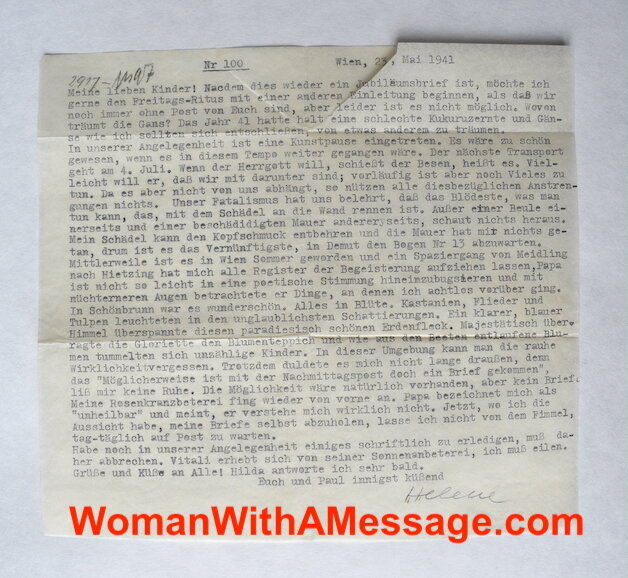
Vienna, 23 May 1941

#100

My dear children! Since this is another anniversary letter, I would like to start this Friday ritual with a different introduction than that we still haven’t received any letters from you, but unfortunately that’s not possible. What is the silly goose dreaming of? The year 1941 had a bad harvest of corn, and geese like me should decide to dream about something else. We’ve had a dramatic pause in our matters. It would have been too good if things could have just stayed on track at the same pace. The next transport is going on July 4 and as they say, if the Lord God wills, even a broomstick can grow [a variation on a German saying - God can make impossible things happen.] Maybe he wants us to be among those who go, but in the meantime there is still a lot to do. It’s not really dependent on us, so all of our efforts are not going to help at all. Our fatalism has taught us that the stupidest thing you can do is to bang your head against the wall. All that gets you is a bump on your head on one side and damage to the wall on the other side, so nothing comes from that. My head can do without the decoration and the wall hasn’t really done anything to me so the most reasonable thing to do is to wait for Form #13 in all humility. In the meantime, it’s become summer in Vienna and a walk from Meidling to Hietzing has brought all sort of enthusiasm up in me. Papa cannot be moved into such a poetic mood as easily, and he looks at things with his sober eyes that I cluelessly ignore. It was beautiful in Schönbrunn. Everything was blooming. Chestnuts, lilacs, and tulips were shining in the most incredible colors. Clear blue sky covered this little spot of the world that looked like a paradise. With great majesty, the Gloriette towered above the carpet of flowers and like flowers which had escaped from their beds, a large number of children were darting about. In this environment I can forget the raw reality that we have to deal with. However, I didn’t have much patience for being outside so long because the “maybe the afternoon mail has brought a letter” did not leave me any peace. The possibility would have of course been possible, but there was no letter. My prayer with the rosary beads began again from the beginning. Papa says I am incurable and he says he really doesn’t understand me. Now that I have the possibility of picking up my letters myself, I cannot seem to get away from the obsession of waiting for the mail every single day.

I have some more writing to do for our matters and so I need to go now. Vitali is getting up from his sun worship and I must hurry. Greetings and kisses to all. I will answer Hilda very soon.

Kissing you and Paul most sincerely
Helen

Helene mentions that this is an anniversary letter — I assume that she is referring to her marriage to Vitali on May 18, 1920. Or is it that this is the 100th letter she has written to her children since they were separated almost 2 years earlier? At this point, Helene and Vitale are at a standstill and unable to do anything to further their cause and they have had no news from their children for awhile. In order to not think about their current difficulties, Helene takes us on a lovely springtime walk in Vienna. The walk they took was about 4 miles from their home, so they must have taken a bus or tram to get to Meidling.

It was approximately a two mile walk from Meidling to Hietzing.

It was approximately a two mile walk from Meidling to Hietzing.

May 22

Link to Family Tree to understand family relationships.

First page of HSM (Vitali) Cohen’s “business card” - title is “Abandon Not Hope - Turn to Me!”

First page of HSM (Vitali) Cohen’s “business card” - title is “Abandon Not Hope - Turn to Me!”

In a few previous posts, I’ve written about Helene’s husband Vitali’s occupation in Vienna. Although my mother Eva never talked about her father’s metaphysical endeavors, she spoke of how many people sought his advice. I never had a clue what form that advice took until my cousin discovered the photo of Vitali at work when we were young adults. My mother merely told me that many people, including some famous and/or important, came to Vitali for assistance. A few prominent people gave testimonials, and in those cases the people were identified. All others were identified by their initials and sometimes their profession.

Both Harry and Eva had copies of the translation of testimonials in their possession. Many of them were included in the green printed “business card” seen above.

The translation of the testimonials, has the same title as the original brochure: “Abandon Not Hope - Turn to Me!” It must have been translated before Eva and Harry left for America in October 1939. Vitali planned to be able to pursue the same work after arriving in San Francisco and hoped these testimonials would help his cause, both in getting a visa to come to America and in convincing people of his talents.

Cover page of translation of testimonials by people who sought Vitali’s advice.

Cover page of translation of testimonials by people who sought Vitali’s advice.

The following are some of the testimonials from this document. As I was writing today’s post, I finally understood the numbers on the first page – between March 2, 1933 and August 24, 1939, Vitali had consulted with 3,132 different clients and given 5,584 individual consultations. The majority of testimonials simply state that what Vitali predicted came true or that he read their characters uncannily accurately. Others go into great detail. Having had a similar experience when I decided to get a hand analysis to better understand my grandfather’s vocation, I understand the surprise and fascination of having a complete stranger seemingly see into your soul in a way no one had ever done before. Vitali seems to have gone further in his readings and consultations, including diagnosing medical issues. There is a whole field of medical literature on the use of hand analysis in medicine.      

·       I admire your gift of prediction, and am hoping for a happy future for you, as well as for myself. I should like to thank you for the accurate data that you have given me.  Dr. K.R.

·       You have, on the strength of the lines in my hand, read my character and certain important moments of my life with an accuracy of 100%.  

·       You have described some details of my life - which could not possibly have been known to you beforehand - with great accuracy.   R.G., President of the Metaphysical Society of Vienna

·       This is a case where one must stop and call out in astonishment: “There are more things in heaven and earth, than are dreamt of in our philosophy.” You have, from my hands, read events of incisive importance, which could not possibly have been known to you in advance; and you have, by this, given me the impression that you dispose over the mysteries of intuition.  

·       “Well roared lion.!” You have an accurate grasp of that mainspring of our intellectual activity, direct to some purpose, which lies within our subconscious mind.

·       I am genuinely surprised. 

·       I have, today, seen you for the very first time in my life; and it was a mere accident, your offering to take an imprint of my palm. You have, on this occasion, said things to me about both the past and the present which are so strikingly true, that I greatly hope that the things which you told me about my future will also come true.

·       I was simply speechless by the truth of everything you told me.  

·       I understand nothing of those matters, and my attitude towards your gifts hence is a skeptical one; I was, nonetheless, amazed about your diagnosis.  

·       It is interesting to see, with which lucidity you read a person’s character, as well as that which he has lived through, from the lines in his hands.  O.H. Inspector

·       You cannot even know how true are the things which you have told me!   Professor M.H.

·       You have looked into my soul’s most secret corners in a manner which is perfectly amazing! I hope that your advice will be valuable to me for my future life, and I shall keep you informed for purposes of checking up on your predictions.  

·       You are an uncanny person, Mr. Cohen - with those unerring x-ray eyes of yours - I feel myself sitting naked before you. 

·       You are a man who should be taken perfectly seriously.  

·       You are a fabulous psychologist and clairvoyant. I enjoy my visits to you, for you can give me consolation and courage.  July 23, 1934. 

·       You have a grandiose intuition which is perfectly amazing; it is not the ordinary type of clairvoyance; it is more; it is seeing.  

·      Sub specie aeternitatis
The deeper I am looking into thee, blue sky,
The nearer dost thou still appear to me;
The stronger, God, I think Thee to the end,
The pitifuller do I fall before Thee….
From my volume of poems To Mr. Cohen, with grateful admiration.  Alfred Werner.

·       “Bend down to greatness! For the very greatest
who look down placidly on our storms
they do not soar, as angels and as blessed;
they bend themselves to far-off courses
of even deeper life,
to higher greatness, which they do but dream,
in that which is unmeasured, unexplored and high.”
From my poem: Gratitude to Greatness
To you, Mr. Cohen, in remembrance of a highly interesting hour of spirits
Fred Hernfeld [later known as Alfred Farau]

·       You have predicted a dental abscess for a patient of mine, who never had had anything serious the matter with his teeth, a few weeks beforehand. This abscess has now been discovered by way of an x-ray being taken; it is a highly important center of infection.  Dr. R.W.

·       You have, by intuition, told me characteristic traits as well as facts of my own and my parents’ past; this shows your extraordinary gifts of clairvoyance; and I find you, also in other respects, a very interesting man.  Dr. L.D.

·       You draw away a dark curtain, and one gets a glimpse of a strange world - one’s own.  Dr. M.B.

·       I have, repeatedly, taken the opportunity of convincing myself of your gift as a clairvoyant; but you really are filled with human kindness and philosophical peace too; and this makes your phenomenal capacity of giving advice to the questioning human fellow-being such a boon. July 20, 1934

·       I came to you, on August 5, 1933, to ask you for your advice about a certain matter; I asked you, besides, whether you could not help my boy, eleven years old, who had been coughing terribly all the time since 1931; a thing which keeps him back in his schoolwork and is a disturbance to his surroundings. You refused my request at first, saying that you were not a physician. You advised me, at the same time, to consult a specialist. It was but after I told you that I had done everything possible, but without success, that I came to you, with my son, on August 7, 1933.  After having taken an imprint of his hand you said, in your smiling way: “Now look here: you are not allowed to cough anymore; do you hear?” to the boy. It is a fact that ever since that day, and up to now - June 10, 1936 - that is to say through three years, the boy has no longer been coughing, much to the surprise of the physicians in charge of his case. I am very happy, and very grateful for the help you have given me. August 5, 1933/June 10, 1936

·       He who knows you need never despair.                   June 7, 1936  

·       My dear Mr. Cohen, I want to write and thank you for your well-meant advice, and I am, at the same time, taking the liberty of replying to it. I write to you with all my heart. Just imagine that I am much better, physically. I often feel that you must have prayed God for me, or have done something else for my sake - and that this is the reason for which my condition has changed so much during the last time. Do you know, my dear Mr. Cohen, that I think of you almost every hour of my life. Whatever I start doing, I think within myself, is that a thing that I am permitted to do? What would Mr. Cohen, the physician of my soul, have to say about it? I always see you before me in my mind’s eye; you are with me wherever I go. I shall be grateful through all my life to Mrs. V. for having taken me to you. I pray to God that He may protect you from all blows of destiny, and that there shall be nothing but sunshine in your life. That is the wish that your grateful Mary feels for you. When I shall come to Vienna again, my first errand will be to come to you. You have great power over me; I constantly have the feeling that you are near me. If you will permit, I shall have much to tell you about. I have, of late, had a good appetite and been capable of enjoying everything again. All that which is within wants to get reconciled to God and men again. I believe that I owe my wonderful recovery to you.    November 12, 1933

·       I have, ever since the mandrake is in my possession, slept deeply through the entire night; a thing which had not occurred for almost a year; for the reason of the worries waking me up again and again.             April 11, 1936/April 16, 1936

·       Two specialists wanted my wife to undergo an operation in her belly; I was terribly frightened of it, as doctors said the case was a very grave one. I went to see you, and, without having seen my wife, you told me that the operation would be unnecessary, after having asked me for a few dates. I have since sent my wife to yet another specialist, who has cured her without the operation. If it had not been for you, my wife would have been operated on the next day (i.e. July 10, 1935). After a fortnight’s treatment she has since recuperated without the operation; and she is feeling very well to this day.                    November 11, 1935/November 14   

·       On the point of leaving Europe, I should like to send you a word of grateful memory and thanks for the wise advice you have given me to take with me on my new path - to start out on a new life. Greetings! June 21, 1935, Trieste.       

·       Having no job and being, consequently, very depressed, I went to see you at 5 o’clock this afternoon. I had lost all hope of finding a chance to earn in the course of the summer. You consoled me and said, literally: “It’ll be all right as time goes on; why don’t you spit out all your ill luck?!” Involuntarily, I acted accordingly, and lo! half an hour later, walking on the street, I ran into a manager whom I had not met until then, and who happened to be walking with a friend of mine; he gave me a contract with an unexpectedly high salary!         July 18, 1935.

·       I felt so unhappy during the night from January 29 to January 30 that I wanted to blow out the gas; just so I had to live no longer. Then I remembered that I won a mandrake - I took it into my hands - my weariness of living was over at this very moment. Then again in the night from February 18 to February 19, I could not go to sleep with exhaustion; I again took hold of the mandrake - I hardly had felt it in my hand when I went off to sleep. Again my little mandrake has helped me! February 19, 1937.            

May 21

Link to Family Tree to understand family relationships.

LT.0192.1941.jpg

Vienna, 21 May 1941

My dear sweeties!

Since the 17th of February I have not had a letter from you. The American Consulate has not even let us know if they have received our affidavit. Not even to speak of the strange Form #13 which they should send, and we are living with the crazy idea that we will be seeing you soon.  We call that “Optimismus”, or maybe it should be Ob-die-Miss-Muß? [pun: missing the point]. Papa has already left : he is working on getting us our clearance certificate of good standing as far as taxes go. Joy is also relative. I am happy about every piece of clothing that I have decided I don’t need anymore, which has done its job and which can go away. I don’t think that in other days the acquisition of something like this would have made me so happy as now the realization that it is really not worth keeping this stocking, this shoe, or this fragment of a pajama to take with me or to get permission to take it with me. I would prefer to go on this trip like a very hopeful vagrant, but when we are over there with you, we will need some things. Customs audits were always the drop of vermouth in the glass of joy even when it was a matter of a vacation or a trip for fun, but I would be happy to take on these unpleasantries. The number of the ways and running around is legion, but sometimes one needs several days to get passage. It’s hard to believe with what calm and skill Papa has managed to get over the obstacles which are basically insurmountable and how he manages to pass the greatest difficulties with a laughing and quiet nature. Vitali is only unhappy with me because I cannot seem to get out of the habit of waiting for mail and he is jealous because he says I spend more time thinking about Jessica’s namesake [?] than I do about him. It’s ridiculous after 21 years of marriage, but when we get over there faster than we had originally hoped, then that has always helped to achieve that. But I think of you much more than about Rudolf. Last year I think at this time, Eva was getting ready for her graduation and this year it will be Harry. Or do they not have these ceremonies at his school? What wouldn’t we give to be able to be there, but unfortunately others will have to be represent us. You must describe the whole process to us in detail. Paul will certainly take pictures which will have to make up for our not being there. I have started my travel preparations in the following way: I have had a permanent, and the hairdresser and Papa were happy with the results. I wouldn’t have decided to do that so easily if Papa hadn’t threatened me that he didn’t think they’d let me into the USA with my old hairdo. Well that hit home. Without any further objections I let happen with my head what Papa and his hairdresser accomplice had in store for me. Afterwards I was even allowed to go to the movies, which I laughed very hard at, I was laughing even more that I had gotten this disastrous procedure over with than at the movie, although the movie was very funny. It was of course a rerun. Papa is very careful to keep tabs on the hairdo which is decorating my head so that I don’t destroy it and says I have to wear a scarf to bed. I am planning revenge, but I haven’t really thought of anything useful to do yet. Well, as I know you, you will certainly help me with that. At the moment I’m reading a quite obscene book: “Ladies in Hades”, by Frederic Arnold Kummer. I think I will have learned lot of slang from it by the time I leave. The way to hell is, in my opinion, less paved with good intentions as with curse words. I don’t actually appreciate of this kind of book and in German I would, not because I am a prude, not have reached for such a book, but with these too often chosen expressions of good books, you really don’t get any farther. One time, I even knew a whole book by heart: “The Christmas Carol” by Charles Dickens, but I don’t believe that the grocer would have known what I meant if I were to declaim: “Marley was dead, to begin with. There is no doubt Whatever about that” and so on. You get a lot more done with “shut up” and “let me alone.” You will be amazed at what a fine tone I can affect in English, as if I came directly from the underworld. I’m done. Cross your fingers [literally, press your thumbs] that I will get letters from you soon and that we will see you soon. Kiss, kiss, kiss.

Helen


This is the 99th numbered letter that Helene has sent since she began numbering her letters in late 1939. She did this to try to keep track of how many letters were making it to their destination. The earliest numbered letter I have is #6, written on December 14, 1939. Sometimes multiple letters were sent together, and some letters were not numbered. This means she was writing to her family in America more than once a week. Numbering letters was not a new thing, particularly during wartime. Helene’s nephew Paul Zerzawy numbered some of the letters he sent home during World War I.

Helene and Vitali are cautiously optimistic that they will be able to get the documents together to travel in the next few months to San Francisco and be reunited with their children. Helene is happy to get rid of everything she no longer needs and imagines arriving in America with virtually nothing. This clearing out, which feels so cleansing at this point, must have felt like yet another cruel blow when they found themselves stuck in Vienna, facing yet another cold winter, even more impoverished than before, and with few remaining clothes and belongings to keep them warm.

We learn about how Helene came to become more fluent in English – reading popular fiction rather than classics in order to be able to speak and understand language. Ladies in Hades appears to have been quite the novel. We see that Helene was an omnivorous reader!

May 20

Link to Family Tree to understand family relationships.

Today’s letter is written from Helene in Vienna to Hilda and and her husband Nathan Firestone in San Francisco. Hilda was Helene’s first cousin once removed.

LT.0135.1940.jpg

Dear Hilda and Nathan! Many thanks for your kind letter, which gave me so much joy, happiness, and courage, besides your nice lines gave me the certainty too, that Paul and the children have your sympathy in such a great measure and you don’t feel them burdensome. At this thought I am feeling happy. Maybe, you find me tactless sometimes, to be in sorrow about the children, although they are in your care, but it the emanation for anxiety only consequently comprehensible and to excuse in this exciting days.

Please to excuse also, when I write to you by machine, but my handwriting has changed in such a manner, that I cannot decipher themselves.

I am sorry that we don’t get all letters written to us and that we must wait some weeks for mail. But there is nothing to do against, as to take a lesson in patience and not to lose nerve.

To hear that you are all well makes me contented and I hope the same in future.

Perhaps in the next weeks we shall get some letters at once and so we are knowing what you are doing. I wish you luck and peace, health and good humor, all things not to have in Europe now. 

In sending my love to you both I remain 

Yours truly
Helen


Paul Zerzawy lived at least for a time with the Firestones during his first few years in America. When Harry arrived in San Francisco in October 1939, he went to live with them while his sister Eva stayed with a different cousin. He stayed with them until he finished high school in 1941.

We learn a great deal from this brief letter. Unlike the long letters she sends her children filled with humor and musical and literary references, this letter is short an to the point. As we’ve seen in previous letters in 1939 and 1940, Helene’s English is nowhere near as fluent as it will be by the time she arrives in Istanbul in 1945. She is grateful for the hospitality of the Firestones and is happy that her children and nephew are safe. Yet she is understandably heartbroken to be separated from her family. Helene’s handwriting has become illegible due to the tremendous stress she is under. The post office is unreliable and there is nothing they can do to improve matters other than try to maintain a positive attitude. Life in Europe at this time is awful. She makes no attempt to hide from Hilda how difficult things are for them in Vienna.

May 19

Today we continue our look through Eva’s Poesiealbum which we began in yesterday’s post. I assume that every inscription was a familiar quotation and have included the author when I was able to find it. These works of art put to shame the scrawls I made in friends’ autograph books and yearbooks when I was in school.

Poesie p12.png

[by Otto von Leixner]

Do not judge man’s worth
Quickly after a brief time.
Above there are moving waves,
But the pearl lies at the bottom.

In friendly memory of
Friedl Schätter

Vienna May ‘34


Poesie p13.png

Should someone do something nice for you,
Look upon him kindly!
And give him a kind good word –
Because that is easily done

In friendly memory of your classmate
Edith Wurth

Vienna, 16 May 1934


Poesie p14.png

In friendly memory
of
Lina Deutsch
20 June 1934


Poesie p15.JPG

6 May 1934

To have understanding of somebody’s sorrow,
To take pity, to be mild with every mistake,
This is how in these times
You recognize the chosen soul
      (M.E.E.)

In memory of
Susi Teraunten


Poesie p16.JPG

Clever was the man who
Created the first record book
And remembered his friends.
Because if they are in need,
as so often happens, if they disappear,
so at least you can find them again in your family book.

In friendly memory of your classmate
Stephanie Marchart

 Vienna, 30 April 1934

This post makes reference to the German friendship book, the precursor to the Poesiealbum.


Poesie p17.JPG

With many share your joys,
With all share your happiness and jokes.
With only a few noble people, share your sorrows,
Only with chosen people share your heart.
(Salis)

In friendly memory
Your classmate
Eva Ried

I found a slightly different version of this saying, which translates as:

Share your joys with many,
With all cheerfulness and joke,
With a few noble ones your sorrows
And elect only your heart.
by Johann Gaudenz von Salis-Seewis


Poesie p18.JPG

To be content is a great art
To appear content is just empty smoke
To become content is a great joy
To remain content is a masterwork

In friendly memory,
Christl Eichinger

14 June 1934

[German proverb]


Poesie p19.JPG

Dreams are not deeds
And without work
You cannot achieve anything!

Your classmate,
Gerthe Riegler

Vienna, 30 June 1934


Poesie p20.png

Be always happy and in a good mood,
No sorrow should cloud your heart
Joy should always accompany you
Never should worries and pain meet you.

In friendly memory,
Imgard Mohr

27 June 1934

May 18

Eva’s Poesiealbum

cover of Eva’s Poesiealbum

cover of Eva’s Poesiealbum

Today’s and tomorrow’s posts are devoted to an object from my mother’s childhood – her Poesiealbum – an autograph/friendship book. I didn’t know what it was called until Amei Papitto recently translated its contents. The book has a simple red suede cover and measures 6-1/2x9-1/2 inches.

The first time I saw an example of someone else’s album was a few years ago when I read Leslie Maitland’s Crossing the Borders of Time: A True Story of War, Exile, and Love Reclaimed.

The autograph books and yearbooks of my childhood pale in comparison to this album – it appears that each person borrowed it for a few days, chose a page at random, carefully wrote in beautiful calligraphy, and often drew or painted lovely pictures. I am in awe of their talent. The words usually are not original or personal, quoting a poem or literature. The entries were done between 1931 and 1934, when Eva and her friends would have been 10-13 years old. There are 18 entries, one from Harry, two from teachers, and the rest from classmates.

Several of the children chose bittersweet, nostalgic poems. All the more touching given what was about to happen in Europe just a few years later. Who knows what happened to these girls? 

Once I had a name for this object, I was able to find websites that discuss history of the Poesiealbum and include verses that were often used.

The following are a few album entries.


Poesie p8.png

This book is dedicated to friendly remembrances, and shows you the names of those who wish you luck and this includes your teacher

Gina Mayer
1931


Poesie p3.png

[from a poem by Marie Calm, pseudonym for Marie Ruhland ]

If you want to be happy
in life, make other people happy
Because the joy that we give comes back into our own heart!

With friendly memories!
Nelly Kangik

Vienna, on 9.11.32

This 19th century poem continued to be used (continues still?) long after it appeared in my mother’s book.


Poesie p4.png

[From a poem by German poet Cäsar Flaischlen from Heimat und Welt]

So: to live in beauty…
To be clear and quiet in oneself and all things around
To be clearly visible and open..
One with itself and with the world..
To be allowed to work and not to have to work..
I always think: 
This is how life should be that we humans create on this earth..

In remembrance of your first school years!

Auguste Müller

May 1931

These are not carefree verses – it’s hard to imagine my 10-year old self appreciating the sentiments of this poem.


Poesie p5 Latin.png

This entry appears to be from Eva’s Latin teacher.

Carry on and be strong! God will provide an end to these things as well.

Dr. Helene Miltner

A retired classics professor friend explained to me that the first part ("Perfer et obdura") is from Ovid, Amores III.xi and the second ("dabit deus his quoque finem") is from Vergil, the Aeneid, I.  She said: “I can understand blending the two; Ovid's follow-up line is about suffering making it all worth it in the end…  not exactly uplifting!” So Eva’s teacher chose to inject hope for the future.


Poesie p6.png

Blessed is the heavenly tie of friendship,
Sympathy, souls are sad with other souls;
The tear lets the friend know how the friend feels
And an eye that looks into the other’s eye,
Most precious it is to be jubilant when the friend is jubilant
To cry with him when he cries.
(Schiller)

In friendly remembrance of your classmate
Traute Yarwitsh

 Vienna, 10 March 1932


Poesie p10.png

 I could not find the original source for this, but assume it is a quote Eva and her friends knew.

Love truth, hate lies
Love the good
Hate anything bad
Truth and willpower
Will help you be victorious!

In remembrance of your classmate
Bella Nizkoletti


Poesie p11.png

In remembrance of your brother Harry

Even her brother was included in the book – I don’t know if he was responsible for the beautiful marbling of the paper - there are no other pages like this.


More tomorrow….

May 17

Today we have a letter and legal document from soldier Harry Lowell to sister Eva Goldsmith in San Francisco.

LT.0927.1945 (1.2) P1.JPG
DOC.0322.1945 (1.2) front.JPG
DOC.0322.1945 (2.2) back.JPG

Philippines
May 17, 1945

Dear Sis,

Enclosed you will find the instrument giving you the power of attorney. Any document you sign as my attorney must bear your signature as shown on the instrument. (Mrs. E.L.G.) Use it wisely and don’t forget to consult Paul any time you are in doubt.

As to your inquiries about my assets, I can lay my hands on twelve-hundred dollars as of this date. In case of emergency wire me for money.

For your information, my bank is the Merchants’ National Bank, Sacramento; in case of my death you may open my safe deposit box which contains documents such as: passports, diplomas, war bonds, etc. I don’t think that the necessity will arise to open the box at any time.

I covered everything, I think, in my letter from New Guinea. I know you’ll keep me posted. 

I’ll write you a long letter very shortly.

Give my best regards to all.

Love,
Harry

P.S. Most of the money is deposited with the Soldiers’ Deposit bank and I can draw it out at any time.


This letter and power of attorney show us how quickly Eva and Harry had to grow up. By May 1945, they knew that their mother had been released from Ravensbrück and been sent to Istanbul. I doubt if they had seen their mother’s letter that we saw in the May 10 and May 14 posts.

Eva and Harry must figure out how to bring their mother to the U.S. It appears that 21-year old Harry had saved almost every penny from the moment he arrived in America, hoping that one day he  and his sister would be able to help his parents join them – according to inflation calculators, $1,200 in 1945 would be worth about $17,500 today. I’m guessing that Eva had done the same, since all of my life my mother saved every penny, rarely spending anything on herself. Although I have a lot of Harry’s letters from New Guinea, I haven’t seen the letter where he “covered everything.”

May 16

Link to Family Tree to understand family relationships.

Today we have a letter from soldier Harry Lowell at Fort Francis E. Warren in Wyoming to his cousin Paul Zerzawy in San Francisco.

LT.0540.1943 (7.8) envelope front.JPG
LT.0540.1943 (1.8) P1 front.JPG

May 16, 1943

Dear Paul,

Well, I know you couldn’t believe your eyes when you saw my handwriting on the envelope – but here I am writing you a letter so soon. You have probably read the letters I wrote to Hilda & Tillie and you have therefore an idea of what I am doing, etc. But this letter will contain facts you might be interested in – opinions which would be misinterpreted by the folks. I know you’ll understand.

As I said before I like it here very much, indeed. I know that if you were in my place, you too, would enjoy the happy fellowship and good spirit that prevails amongst us. Unfortunately very many of the soldiers cannot get used to the fact that there is a war going on and that they are in the army to be fighters, not playboys. We really are fed the best food, and plenty of it, but still the majority groans and squawks because they had beans twice in a row and couldn’t get more than two pork chops. They scoff at scrambled eggs for breakfast, and so on. I get pretty disgusted at times to listen to their unreasonable complaints. If they’d only use their thinking apparatus and be thankful for what they had! (And to think that we all say grace before meals!)

I lost quite a bit of respect for my second lieutenants the other day on parade grounds. Our company was to review before the commanders of the day; the privates were standing in formation and all officers and noncommissioned officers were commanded to come before the inspecting commanders. It’s unbelievable, but – none of the ten second l’s knew what they were supposed to do. I was standing in the first line of the company and had, so to speak, a ringside seat to what was going on. The lieutenants took one step forward, looked to the left and right to see what the others were about to do, finally formed a line, and marched (entirely out of step) toward the big shots. We, in the front line, had a hard time keeping from laughing out loud. These lieutenants were the ones that get excited when someone gets out of step – our teachers! (I know that any high school R.O.T.C. boy could have put them to shame. I remember how we reviewed at Mission.) There is a shortage of officers and the army is glad to get hold of these men who are well-schooled and of good reasoning. The officers’ candidates school fails to teach efficiently in the short time they are given. Just wait until I get to become an officer!

To round out my criticism I must add to the aforementioned facts that there is too much wasting of valuable time and money going on. That’s all right now.

I haven’t mentioned yet that every soldier is furnished with a complete wardrobe – from sox to overshoes; there’s nothing we lack. For further details write for a catalog.

How are you getting along with your pupils? The Lowell Loan Co. [cute graphic] is still in existence.

If you have any questions, ask them and I’ll try to answer them.

I am enclosing a picture of myself. (Purty, ain’t it?)

Well, so long!
Harry

P.S. This letter is restricted. Order 7-12-T650 PvtHL
P.P.S. Will you kindly take my foil and mask to the … next time you come from Hilda’s. Thank you.
P.P.S.S. (Sorry, my pen isn’t housebroken yet.)

Harry’s graphic of the “Lowell Loan Co.”

Harry’s graphic of the “Lowell Loan Co.”

In this letter to his cousin Paul, Harry seems to want to speak soldier to soldier. He knew Paul had been in the army during WWI and would understand what he was experiencing.

Here is a photo of Harry with his parents and Paul in Vienna from around 1930 – despite the close family connection, they were of different generations.

From left: Harry, Helene (crouching), Paul, Vitali

From left: Harry, Helene (crouching), Paul, Vitali

Harry talks of the fellowship he enjoys in the army. Paul kept many photos of his time as a soldier. Here is one that shows them all with a list of names on the back. It does not appear that Paul was in the photo. Perhaps he had left that company by then. One other thing to point out is something that was common in the early 20th century – making photos into postcards so you could send to friends and family. Sort of the Snapchat or Instagram of the time.

IMG_4198D.JPG
IMG_4199D.JPG

As I mentioned in yesterday’s post, Paul Zerzawy never quite found his footing in San Francisco. It must have been both comforting and embarrassing to be offered loans from his young nephew.

May 15

Link to Family Tree to understand family relationships.

Growing up, I knew that Paul Zerzawy was some sort of relative of my mother’s. He was 25 years older than my mother, so I was surprised to discover that he was her first cousin and Helene’s nephew. I’d seen his photo album which had wonderful photos from the early 20th century, but I didn’t know any of the people and felt no real connection. 

As I organized all the family papers, I came to realize how important Paul was to my family’s story. Although only 9 years difference in age, Helene babysat Paul and his siblings when they were young (see post where she describes babysitting Paul). Paul’s mother/Helene’s sister Ida died when he was only 7 years old, so Helene must have felt even more protective and parental. Helene was a diligent correspondent when Paul was a soldier in WWI and hosted Paul when he was on leave (see March 19 post). Paul lived and worked in Vienna in the 1920s and 1930s and spent a lot of time with his aunt and her family. He was the first in the family to make it to the U.S. in 1939, helping to pave the way for his young cousins.

As I have mentioned in earlier posts, I have been touched by how much loss Paul experienced throughout his life. He helped the family throughout WWI, providing them with money and provisions to help them through the lean times. He worked hard to bring his cousins and aunt to the U.S., but was unsuccessful in helping to bring Helene and Vitali in time. He had a successful career in Europe, but was never able to find footing in America. He’d been trained as a lawyer, but was not able to practice here. His English skills may not have been good enough to allow him to qualify. In San Francisco, he eked out a living teaching piano and accompanying singers, trying not to rely too much on the generosity of his mother’s cousins in San Francisco. His health wasn’t robust and he died in 1948 in his early 50s. As far as I know, he never had a romantic partner.

In addition to understanding how integral Paul was to my grandmother’s and mother’s story, I feel like I’ve come to know him and wish that I had met him and could have thanked him for all he did. I wish he had had more joy and been able to be carefree in his life.

My mother had in her possession Paul’s family photo albums and some official paperwork – death certificate, school records, etc. Harry had a box with Paul’s name on it which was filled with letters and photos from his life. I assume Harry took it after Paul’s death in 1948. I don’t know whether he or anyone looked at it before I found it in 2017. The box included a few hundred photographs of unknown people and places, which meant nothing to me at first. Now that I know more about Paul, these photos paint a fuller picture of his life – not just one of loss and difficulty, but one that included friends, fun, and travel.

This photo below was taken on a trip on May 15, 1931 – I cannot make out the location. His brother Robert has his glass raised.

PH.1358.1931 (1.2) front.JPG
PH.1358.1931 (2.2) back.JPG

 The following photos were taken on a different trip in May-June 1929.

collage copy.png
collage2.png

May 14

Link to Family Tree to understand family relationships.


Moda. Istanbul, May 10-45

My Harry-boy! Did you ever think that your mother aimed at adventures? Never, or did you? For voyages, yes, I always had a foible but under other circumstances . Six weeks I was doing nothing else but eating, drinking, sleeping, and reading and admiring the various landscapes, all things I was missing during a year and a half as I had been in Ravensbrück, a concentration camp for women. Probably there were great gaps in my education which must be repaired found out the Nazis and I learned things which do not belong to a good all-round education. I can see by the astonishment of the reporters who came to see us and I had been interviewed and printed several times. Now I am surfeited by sea, glaciers, towns, people but not yet of tea, coffee and chocolate. I am sitting among magnolia, lemon-bushes, quite indifferent, from the balcony I see the Sofien-Marchee from one side, Prinkipo.

from the other, not having the wish to see more. All my thoughts are directed to you all and to Vitali from whom I don’t know where he is just now. He was arrested with me on the 15th of October 43 and separated immediately. After 6 months I knew that he was brought to Buchenwald, a concentration camp for men. His letters - I received one every 3 months - were gay and full of confidence. This camp, I had been told, was better than that of mine and he assured me in every letter that his condition is in apple-pie order. I hope he had withstood the last days of Buchenwald till the liberation. I can’t understand why Turkish men were released with the exception of those from B. One must have forgotten them. You can believe me I have not let untried everything. I know it will last very long till I shall get answers to my inquiries but notwithstanding I hope I shall bring him with me as soon as you have done those steps which are necessary to claim us.

Please, Harry write me very soon. I am sorry for you too.

I am happy about Eva! Marriage, although at the first day I was anyhow stricken nearly stupefied. By and by I became familiar with the thought that Ebi became pledged. I asked so many questions that Eva will not be able to answer them. You must help her, likewise Paul.

Now I am glad that I have finished my letter. There is a great fuss about a thing I don’t know what. Farewell, darling, remain healthy and write very soon.

I kiss you.
Helen


This letter was kept with the letter to Eva that we saw on May 10 (which cousin Lisette’s sent with own letter of May 11). So much is packed into this brief letter to her son – details of her separation from Vitali, and Helene’s relishing of her first days of freedom and plenty after a year and a half of cruelty and deprivation at the hands of the Nazis. Vitali in his letters to Helene from Buchenwald tried to make Helene believe that life was easier for him than for her in Ravensbrück, and it must have been much more comforting for her to believe that fantasy than imagine his reality. She has begun what will be at least a 10 year search for her husband. She is worried about her son the soldier. I don’t know if Harry saw this letter in 1945 – at this time he was stationed in New Guinea. I assume Eva would have at least written to him about the letter’s contents.

May 13

Link to Family Tree to understand family relationships.

Today we have another postcard from Helene’s nephew Erich Zerzawy, a POW in eastern Siberia, written on May 13, 1917. He is writing to his younger siblings – his father and older brother Paul are soldiers far from home.

LT.0088.1917 (1.2) front.JPG
LT.0088.1917 (2.2) back.JPG

13./V.17.

My dear ones!

This time I got a card from Kätherl, but other than that, nothing at all. I wonder what kind of old letters she got, I can’t really imagine. But she has become a big girl, Papa wrote that to me. I have often asked you for photographs. Do send them. You could just send them as a card or possibly in a see-through open envelope. My comrade Canni [?] Kohn from Prague has already received very many. Now I remember that Katherina did once write that Hedl was engaged, but who her fiancé/groom is, my fantasy cannot guess that after such a long time. 

Along the side: I congratulate her most sincerely. She will accept them from me now also.


You can see the section of the family tree that shows the dates of all the children that only Paul and Robert survived past 1918. Neither of their sisters lived to 18 years old and according to the International Committee of the Red Cross, Erich “fled from Beresowka on July 15, 1918 (a typo on the tree says he died in 1917).

Zerzawy children family tree.png

Käthe was the baby of the family, half-sister to the other Zerzawy children. Her mother Mathilde married Julius in 1903 after her sister and Julius’ first wife Ida died the previous year. I have two photos of all the Zerzawy children together. I have labeled them with who I think they are. The first photo must have been taken in 1910 or earlier because Mathilde died in 1910. The later photo must have been taken no later than early 1915, because later that year, Paul was in the army.

Zerzawy children.JPG
Zerzawy children2.jpeg


May 12

Link to Family Tree to understand family relationships.

LT.1724.1942 1.2 front.JPG

From: Haim Seneor Cohen, Vienna

To: Miss Eva Marie Lowell, 2200 Post Street Nursingschool, San Francisco, California, USA

Dear children!

Special greetings to our May child!  Not knowing when these lines will reach you, we are also thinking of our January kids.  We are healthy.  Greetings and hugs to all of you.

Date: 11 May 1942

Signature: Haim Seneor Cohen


This is one of only two letters I have from Vienna written after October 1941 and before Helene and Vitali (Haim) were arrested and deported to Ravensbrück and Buchenwald in October/November 1943. Both letters were sent through the International Red Cross via the German Red Cross. Although they were still living in the same apartment in May 1942 that Harry and Eva had lived throughout their childhood, the boilerplate indicates that Helene and Vitali were considered prisoners of war. The Luftpost stamp on the top left says that it was paid with 3 “American coupons”.

Rather than say anything about their situation within the 25 word limit – besides which it no doubt was censored and they wouldn’t have wanted to worry their children – the message shows that despite the circumstances, they are always thinking of and missing their children, especially on their birthdays. They have no idea when they’ll be allowed to write again, so in addition to sending May birthday greetings to Eva (which were received in late July), they acknowledged eventual Harry’s birthday in January.

At this time, Eva was 21 years old and in nursing school, while her 18-year old brother had enlisted in the army the previous month. I can’t imagine what it must have felt like to be separated from her entire family, to receive this letter and be unable to help her parents. As far as I know, this was the first news she’d had from them since the a brief letter sent in October 1941 before the U.S. entered the war.

Old Mount Zion Hospital where Eva lived and trained to be a nurse from 1941-1943

Old Mount Zion Hospital where Eva lived and trained to be a nurse from 1941-1943

May 10

Link to Family Tree to understand family relationships.

LT.0321.1945 (1.6) P1 front.JPG

Moda, May 10. 45

My dear Eva! Since about a week I knew that you were getting married but only that. Neither I knew your surname nor your address. Lizette, Lilli and Ticco contrived the most incredible, no, the most credible excuses making me believe that they have only forgotten your letter. These good children didn’t want to excite me by showing me your writing because they wanted to conceal from me that Harry became a soldier. This I learned by a conversation with Ticco. Of course I insisted to bring me your letter. Yesterday Beppo brought it and I found out that Harry is in the South Pacific still but by no means I could make out that he is a soldier, consequently they must know more about him than they will declare to me. Excuse my long introduction. I am no more up to date and in my time we had been taught to do a long-winded prelude before going on with the real theme. Of course in German my style would be less circumstantial.

Sorry, I haven’t learned how a mother has to congratulate her daughter on her marriage in the case she is separated from her by war and ocean. Again I had the old-fashioned feeling of a sitting-hen which has hatched duck-eggs, cackling tremendously seeing her naughty covey diving the first time at duck-manners: “Köpfchen in das Wasser, Ärchchen in die Höhe.” [should be “Köpfchen in das Wasser, Schwänzchen in die Höhe” – head in the water, tail up] Simply I can’t imagine that my ducky Ebi is swimming in the pond and left me waiting and cackling excitingly. That your wedding took place on the 13 of January must have been a great surprise for Harry, whom I beg not to imitate you immediately. I was - Lord is my witness - with you all the time. On the 11 of January I thought: today it is Tillie’s birthday, tomorrow that of Hilda and a day after tomorrow that of Harry and I learned by my friend Gemma Gluck-LaGuardia (yes, she is the sister of the Little flower) sitting with her hand in hand what a great day it is to come of age. That this day shall be a double-festival to our family I couldn’t dream. - But today I will not relate, I will ask you to do it. At first please, introduce me to your husband. How is his first name? Ebi, do you remember your composition about Hagen? Yours was one of the best, only too short, remarked your teacher. In five sentences the German hero was settled. Well, that was all right, but my son-in-law is not the sullen Hagen, is he? I am sure that you are more interested in this theme and your description will be more detailed. Please answer me the following questions:

1.     Are you happy, really very happy? And your husband also?
2.     Where and how did you make his acquaintance? Is he an American by birth? Is he small or tall, thick or thin, blond or dark, light eyes or dark eyes? How old is he?
3.     What is he doing except to be glad that his mother-in-law is over the big lake? Tell him that 2 parents-in-law in hand are better than one in the concentration camp.
4.     How many Creme-Schnitten had you to pay Harry before getting engaged? And Paul, Hilda, Tillie, did they agree with you?
5.     In which way you were you informed of my staying in Sweden? By dispatch, letter, or newspaper?

In conclusion, I will only tell you that I am in Istanbul just one month. Our relations learned the news by the newspaper. Fortune, Estrea, Beppo, Bondi, and his wife cousin Romano paid me a visit just when they read my name in the Gazette. I am too excited today to describe to you how nice they are to me, and I am glad and proud having conquered the affection of the youth. Lilli and Lizette I see every Sunday, Ticco comes during the week to see me, Fortune, Estrea and Beppo come as time permits it. Moda is situated on the Marmara Sea - and to be reached by a boat not too frequently.

For myself war is not yet over inasmuch I don’t know where Vitali is. His last letter was from January 7.45 - I received it on February 7.45 and after three weeks I left Ravensbrück. I hope I can stay here till I know about Vitali. Please council with Harry what to do to be able to come to you. Lizette will tell you about her information at the American Consulate.

Have you received letters from me from Götheburg, Liverpool, Lisbon? How is Harry, Paul, Tillie and Julius, Hilda and Nathan, how is Tillie’s brother [Al?]? Fulda-Anderson family and did you hear from Robert? How is Bertha Schiller, her husband, Arthur and his family?

Please go to the nearest stationers and buy a ream of paper to answer all my questions. Tell Paul, Hilda, Tillie, Harry to send me long letters, I am letter-starved. In my suitcase there are letters from the Drottingholm still which I could not post. Next time I shall send it to you.

With many kisses I remain your
Helen

 P.S. To fill this space I will give you an idea of our Odyssey.

March 1. Departure from Ravensbrück at Lübeck.
Staying there 5 days, via Flensburg at Kopenhagen Helsian, sojourn 5 days
March 11. Arrival Helsingborg (Sweden) Götheberg by railway and now we climbed [boarded?] the Drottingholm”
March 18. Our ship put to sea at the waters of Norway
March 22 Färro Islands - Thors Hava [Tórshavn] 17 March
March 24 Liverpool
April 1 Port Said
April 10 Istanbul
April 15 Moda


After my mother had a stroke in 2006, I sorted through her papers to make sure I had everything I needed to be able to handle her affairs. As I searched, I found letters written from my grandmother from Istanbul in 1945-1946, a Red Cross letter from Vienna just before their parents were deported, and one from Buchenwald from Vitali to Helene. In addition, my mother had her cousin Paul Zerzawy’s official papers – school records, bank documents, death certificate from 1948. I was so excited to find all these items that I photocopied them and gave them to Harry since I imagined he hadn’t seen these papers in decades. I had never seen them. Little did I know that Harry had hundreds of letters from Helene and Paul stashed away that he never bothered to mention. Who knows why my mother had some documents and her brother had others?

Today’s letter is one of the first things I read in 2006. Happily for me, the letter was in English and it told me more about my grandmother’s experience than I had known. Until then, I knew the barest of details – she’d sent her children to safety in San Francisco in 1939 and for some reason she and her husband did not follow and ended up in the camps. I knew she’d been traded as a Turkish prisoner and had come to the U.S. via Istanbul and that her husband Vitali was never seen again.  

When I first read this letter, I did not have the context of the hundreds of pages of letters that had been come before. After rereading it in preparation for this post, it feels like a synopsis of the entire archive: even if I had never seen the other letters, I at least had the facts of Helene’s years in Europe after being separated from her children and the sound of her voice.

Although Helene writes of other letters she’d sent on her journey to Istanbul, as far as I know those letters never made it to San Francisco. At this point she is feeling well cared for, before the Joint began moving her around Istanbul and Vitali’s relatives could not always find her. See post of February 2.

This letter reminds me that there’s more research to do. I had recalled that Helene mentioned talking to reporters, but had not remembered that she said that they had published things about her. When I first read her May 1 Joint testimony, it felt like another puzzle piece fitting into place.

Finally, Helene even explains her writing style. In the stories I posted on March 13 and April 22, I commented on how she sets the stage for her story and then takes us in amazing directions. In this letter she apologizes for the long introduction before going on to the “real theme.”

May 9

Mother’s Day

Link to Family Tree to understand family relationships.

As I tell my family story, I realize how much of it is about mothers and daughters – strong women protecting their children from adversity as much as possible, trying to give them a better life, as mothers everywhere have been doing since time immemorial. Several of these women married men who, although charming and intelligent, did not have a practical bone in their bodies, leaving day-to-day affairs to their wives.

Rosa and Helene (and perhaps Helene’s father Adolph?) planned to move from Bohemia to Vienna in the early 1900s. Unfortunately, Rosa’s eldest daughter Ida died in 1902, leaving 4 children under the age of 7. I believe Adolph died at this time as well. Helene moved to Vienna on her own. In 1903, Rosa’s daughter Mathilde married her sister’s widower Julius Zerzawy. She died in 1910 and Rosa again took care of her motherless grandchildren until the end of World War I. It must have been heartbreaking for Rosa to be called upon to bury her daughters and care for her grandchildren, and then to lose three of those five grandchildren to war and illness before 1920. Yet, she soldiered on trying to hold the family together.

We learned a bit about Helene’s grandmother Babette and mother Rosa in the post from February 16.

I think often of my own mother’s strength. At a time when most American teenagers were going to high school dances, Eva and her brother had left their parents behind in Vienna, imagining that they would see each other again in a few months. She finished high school and began earning money to send to her parents, hoping that what little she could provide would ease their lives and perhaps help them make the journey to America. After the U.S. entered World War II in 1941, Eva and Harry stopped receiving letters from their parents and had no idea what was happening to them. Eva completed nursing school and began working. Her brother joined the army as soon as he was able. By 1943, Eva was in San Francisco with neither her parents nor her brother. She must have been terrified that she might never hear from her parents again and that Harry would be killed in the war, particularly given how often he talked in his letters about longing to see combat. In 1945, Eva must have been thrilled to know that her mother was safe, but she also had to find the resources to help her mother come to the U.S. and help support her when she arrived. My mother was always an ultra-responsible person, but I can’t imagine how difficult it was to shoulder the responsibility of supporting her parents (and probably trying to act maternally to her younger brother who wouldn’t have been interested), all before she was 25 years old.

I am touched that one of the few cards my grandmother kept was a Mother’s Day card I gave her at some point in the 1960s.

LT.0030.ND (1.2) front.JPG
LT.0030.ND (2.2) back.JPG

I am so grateful to all of my foremothers. Happy Mother’s Day!

May 8

Today we have a letter to Harry in San Francisco from Lucienne Simier who was a fellow prisoner with Helene at Ravensbrück. We saw a letter that Helene wrote a to Lucienne on January 22. More information on Lucienne and others Helene met from Angers, France can be found at the post of April 18.

LT.0557.1946 (1.2) P1 front.JPG
LT.0557.1946 (2.2) P1 back.JPG

May the 10th 1946                                          

1 Avenue Marie Talet
Angers

Dear Harry,

I just got your parcel and my friend’s letter telling me your dear mother has come to you. It is so sweet of you thinking to send me such good things. You certainly are the dear boy your mother spoke to me of and I thank you very, very much indeed.

Since your mother’s letter, I am thinking of you and trying to imagine your meeting. I feel so happy about it. At last, my dear Helen is free. I cannot tell you how much she has been for me. I love her like a sister and all those she loves I love too. You must think I am very “Frenchy” in telling my feelings!! I have been so near feeling no more that I feel now much stronger and enjoy what is good. And your mother may explain – she knows me so well.

I hope she will write to me very soon – she has such a lot to tell me. Mrs…. writes that you are getting an apartment all together. I hope your mother is not too tired after such a long journey. How is she? She was so thin when I left her.  

I must leave you now. Tell your mother I am with her with all my heart. I wish her such a lot of happiness, poor dear. She must be missing terribly your dear father. I kiss her most affectionately. 

For you and Eva mille remerciments et mes sentiments très affectieux.

            L Simier


There is nothing to add to this beautiful letter except how heartening it is to know that in the depths of hell, these women found and comforted each other. No wonder Istanbul was such an isolating and wrenching experience for Helene – imprisoned again but with no moral support from fellow prisoners and no way of contacting her husband.

May 7

As the letters jump from time to time, my husband suggested that a timeline would be helpful. I hope this simple chart is useful:

Screen Shot 2021-05-02 at 11.21.04 AM.png

Today’s letter is from Helene in Vienna to her son Harry. He and Eva have been in San Francisco for a little over 6 months.

LT.0134.1940 (1.2) front.jpg
LT.0134.1940 (2.2) back.jpg

 Vienna, 7 May 1940

My most beloved pickled herring!

There is a song for the Heurigen [young wine in the fall]: “Vienna becomes beautiful only at night.” The person who wrote this song surely had no idea how right that was. While all of Europe is in danger of war, there is only one oasis: the land of my dreams where everything has remained just as it was. The doctors who have not figured out the secrets of dreams yet would probably laugh at my interpretation. Wouldn’t it be possible that nature has helped out by creating a balance? A fraction of a second creates a dream and takes us to almost heavenly realms, and leads us to believe in the fulfillment of our most nostalgic wishes and this little fraction of a second gives us the power and inspiration to further plans.  Sometimes I can hardly imagine myself how I could always wish: “I just wish the children were outside.” In my motherly way like the raven I even went so far as to be happy about having this wish fulfilled which often seems to me like a confusion of feelings and I ask myself :“Are you really normal?” The expression of joy has been pushed off a bit. Inside, one is happy to know you are outside of this witches’ cauldron and go around with the bitter expression of a corpse. But sometimes it’s the opposite. “Keep smiling” should hide how it feels from the inside. There’s nothing new here. “I’m sitting in the rain waiting” for mail and the possibility of seeing you near me not just in my dreams. Papa calls me nothing but “Mrs. Lowell” and believes he has a formula for his dreams. I don’t wonder about anything else. I wouldn’t even be surprised if I lay down here at night and woke up in Frisco. It would seem so natural for me that I could express my joy not just in antics because it just seems so natural to wake up where one wants to and actually belongs. Four weeks is a long time to wait for mail but they would pass quickly if we were sitting across from each other.

On back, handwritten:
Just received your letter of April 6. Thank you, great joy, [?]
Kisses
Helen


I love the wonderful pet names Helene has for her children – a way to show her affection for her children as well as her joy in clever wordplay. In this case she calls Harry “Herring” as a play on his name.

Helene and Vitali are hoping to soon join their children in San Francisco. Vitali has taken to calling his wife “Mrs. Lowell” since their children now go by that last name. I don’t know if it was their intent to change their names upon arrival. My grandmother never did, but by the time she was reunited with her children, they were adults and on their own.

When Roslyn first translated this letter a few years ago, I did not yet realize that Helene made so many references to music and literature. When preparing today’s post, I googled a few of the words she had in quotations marks and found two songs. The first about Vienna at night was popular during World War I.

The song about sitting in the rain appeared in a 1937 film “Zu neuen Ufern” (To New Shores)

 Here are the Lyrics:

Ich steh' im Regen und warte auf Dich, auf Dich
Auf allen Wegen erwart' ich nur Dich, immer nur Dich
Der Zeiger der Kirchturmuhr rückt von Strich zu Strich, ach, wo bleibst Du denn nur? Denkst du nicht mehr an mich?
Und ich steh' im Regen und warte auf Dich, auf Dich
Immer warten nur die Menschen, die wirklich lieben

Kommst Du noch nicht? Wie die fallenden Tropfen am Ärmel zerstieben
Ich steh' im Regen und warte auf Dich, auf Dich
Auf allen Wegen erwart' ich nur Dich, immer nur Dich
Der Zeiger der Kirchturmuhr rückt von Strich zu Strich, ach, wo bleibst Du denn nur?
Denkst du nicht mehr an mich?
Und ich steh' im Regen und warte auf Dich, auf Dich

And a translation from Google Translate:

I stand in the rain and wait for you, for you
On all roads I only expect you, always only you
The pointer of the church clock moves from line to line, oh,
where are you? Don't you think of me anymore
And I stand in the rain and wait for you, for you
Only the people who really love are always waiting

Aren't you coming yet? Like the falling drops on your sleeve
I stand in the rain and wait for you, for you
On all roads I only expect you, always only you
The pointer of the church clock moves from line to line, oh,
where are you?
Don't you think of me anymore
And I stand in the rain and wait for you, for you

May 6

Link to Family Tree to understand family relationships.

Today we have a copy of a letter written by Eva (on her 18th birthday) to her parents in Vienna. On April 27 and 28, we saw letters from Eva and Harry to their parents, describing their first few days in Vienna.  I don’t know how we have a copy of this letter – perhaps Eva and Harry kept a copy and brought it in their luggage when they came to the U.S. a few months later.

LT.0386.1939.JPG

Yesterday we got the letter about which we had been notified. I did not want to give the enclosed letter to Onkel Isak. Because, as I already mentioned, he is very formal and prim, and that might have been viewed as presumptuous.  

So please, mom, when you write to Onkel Isak, it is better not to mention the letter. An example of Isak’s formality:
#1. You must announce your visit, let him know you are coming. I think that’s all right. A visit may not last more than 1/4 hour.
#2. Yesterday afternoon, I took a walk with Harry and we met our uncle. He invited us for tea. It was all very stiff. Afterwards he asked us if we were going home. We said yes and we said goodbye, but we went a long way in the same direction but on the other side.

Fortune told us that when we visit Onkel Isak, we must kiss his hand since he is very old (58). We did that but he took his hand away almost in a fearful way as if it were unpleasant to him. (Please write about this.) When we visited his brother who is much older than Isak, we were the only ones who did that. I think it is just some sort of preventative feature having to do with money. 

Harry had to go pick up your letter from the uncle yesterday when he went with Albert to do that. Harry said that he had been very arrogant and hadn’t spoken with Albert at all, as if he were a subordinate. Harry said that our furniture was nicer than the ones the uncle had. I actually didn’t see them myself. If it’s possible, please when you, bring bed linens for Harry and me and also we both need a bathrobe, the other things we wished for, and the radio. The radio will bring you a sort of glory.

I don’t feel all that great here, although Fortune and Beppo are trying to make it as nice for us as they can for us. They show us off to all the family members and we don’t understand very much of the whole conversation, not more than maybe “tout à fait la mère ou le père.” As soon as they speak French I do amazingly well. But except for Fortune, most of the people in the family speak Spanish.

For what we’re used to, we don’t really live that well, although Fortune thinks they lives like a prince. The only prince-like thing I can see is that 99% of the vegetables are thrown away as garbage. For example, they have big thick meaty green beans, but all they do is eat what’s inside of the pods. They are being economical in sense. But what bothers me a lot more is that whether you’re respected or not here really only has to do with money.

Mom, you don’t need to think that you had the “fame” of being the worst dressed woman (of course I don’t mean right now, I mean 5 or 6 years ago). Fortune has a lot less than you had back then and it’s much the same for her children. Lisette doesn’t wear a hat so because of that I have to act the same and act like a country cousin.

When I go out and take a walk with Harry though, I really have to dress tip top. I have realized what the culture consists of. Women walk around like Parisian models and they are all fixed up (at the moment, lips the color of cyclamen are very modern).

I eat just as much as I used to eat in Vienna, but Beppo is angry that I eat so little. Here they eat 3 times as much as we do at home but nobody believes me that that’s not good for you. I’m about to explode.


 As in the letters from a few days ago, for Eva life in Istanbul compares unfavorably with Vienna in almost every respect. As I mentioned earlier, I wonder how much of that is her true feelings and how much is her trying to make her parents understand how much better she felt life in Vienna had been. Although they never had much money, we have seen that their lives were rich in love, laughter, music, and literature.