October 12

Link to Family Tree to understand family relationships.

Today’s letter was written by G.I. Harry Lowell to his sister Eva while he was recovering from a tropical illness at an army hospital in San Diego. This is one of a few letters he wrote in German. When my friend Roslyn translated the letters a few years ago, she had trouble deciphering his handwriting. It was only in preparing my posts for October that I realized that he had written in the old German script and I asked translator Amei Papitto to look at them. Phrases written in English are in italics.

LT.0922.1945 (1.4) P1 front.JPG

6 October 1945

My dearest little sister!

The pitiful condition of my fountain pen forces me to write this letter with a pencil. I am writing this letter from the one of many USO writing rooms in San Diego.  

I just received the pictures back which I had taken during my leave. I will enclose in this envelope some of the pictures that will interest you. Despite the dim light in your apartment, the photos came out pretty good.

Since my last letter, nothing has changed here. The weather is still the same and I cannot complain about the treatment by Uncle Sam. It seems that I have to stay for about another two months in this hospital. All of my hopes lie in the possibility that I will be dismissed from the army before the end of next year. So there we have to cross our fingers [I am amazed at my memory (in German, the expression is “press your thumbs”)]. I need several hours of memory refreshment (holy mackerel, what a long word!) in order to master my mother tongue again.

Sometimes it is difficult for me to remember this or that word. Then it takes me a few minutes until I find the missing word in the dictionary of my brain. Please send me your German-English dictionary.

How is my brother-in-law doing? (it took me a hell of a long time to remember the translation for b-in-law). Even his criticism of my German language ability is more than welcome.

“Won’t you feed the little lamb,
The little lamb so gentle and good.”

This is all for today. Every time I’m in a grumpy mood, it’s better to end my letter. I’m professing my brotherly love and I remain your charming brother

Harry

P.S. I dare you to answer me in German. Good luck.


According to one website, “USO clubs served coffee, cookies, donuts and sandwiches, but no alcohol. They offered stationery to write letters, bunks to take naps, services to mend uniforms and the latest phonograph records.”

Like his mother so often did in her letters, Harry makes a literary reference, recalling Der Alpenjäger, a poem by Schiller that was set to music by Schubert.

The only photo I have of Harry in an apartment is of him ironing his uniform – perhaps this is what he is referring to?

PH.0667.1942.JPG

October 11

Link to Family Tree to understand family relationships.

Today we have two letters from 1940 from Helene in Vienna: the first to her children and the second to her nephew Paul. Eva is in her first year of nursing school and Harry is a senior at Washington High School. Paul is trying to eke out a living as a piano teacher and accompanist.

LT.0147.1940 (1.2) P1.jpg
LT.0147.1940 (2.2) P2.jpg

Clipper # 54                Vienna, 11, October 1940

Children, my beloved children! If the sun were not shining in a summery way and the trees did not have such fresh green foliage, I would believe that it was Christmas because the day before yesterday was so full of pleasant surprises. Within 24 hours we got 3 letters from you, each one delighting us more than the last. The first thing I got was a letter from Hilda written on September 19. In quite a funny way she told about you and Paul and her letter really improved my mood. While I was still studying her letter (deciphering it is really quite a difficult course of study), the next mail arrived and your letter #4 from September 26th and I was absolutely swimming in bliss. I left everything else sitting where it was and I ran as fast as I could through torn up Marx Street to Papa at the shop. The next morning, letter #3 from September 19th appeared. I cannot imagine a happier person than I am right now. We laughed until we cried about Eva’s anecdote #1 and I had to think of the cannibalistic text of the cross-polka. It’s a dance which my older sisters learned which was en vogue then, among the dances that were typical in those days, might be described as the jitterbug that Harry loved so much. The text which the residents of Bilin put to this melody, and I believe there was only one, went something like this [in Bilin dialect]: 

“Oh look there he comes,
He’s taking very big steps.
Here he comes again,
The drunken son-in-law
He finds a woman,
He cuts open her body
He takes her lung and liver out
And makes a great big beefsteak out of it.”

It’s a good thing that your lecturer on operations is not from Bilin, because he might possibly follow the instructions in that song. Maybe Paul still remembers the polka. By the way, talking about polka! Is Eva taking up her piano lessons again? Is she going to do the funeral marches for the hospital? Your hospital surely has its own cemetery, doesn’t it? The geographic anatomy knowledge of your fellow student we found very amusing, as did the washwomen anecdote. We found the geometric knowledge of Harry’s classmate equally amusing. Of course, I give my vote to Harry L. Lowell for board of education! With his usefulness in so many ways, he could be a porter, office-boy, newspaper boy, all that might be possible in the land of unlimited possibilities. A career worth of a Hearst, if not a president. 

We have nothing interesting to tell you. We used to go to the anniversary observation point, the Hapsburg observation site, and all the observation points as they used to be. Today the points are coming to us [makes a pun in German - observation points/guards]. Now the guards come to us - the house guard, the block guard, and all the other kinds of guards and so we have all sorts of visits.

Our renters are quiet, well-brought up and educated people, with whom it’s pretty easy to live under one roof. We finally sort of agreed that I will do the cooking, my renter will wash the dishes, but drying them and keeping the kitchen in order will be my job.

Everything is okay here at the apartment, but everybody who comes here seems to bring all sorts of dirt into my apartment and there’s plenty of opportunity for that because the stairway has been painted recently. On one of the freshly painted walls, there was a giant modern eagle painted. It’s a good thing Harry wasn’t home anymore because they probably would have thought he did it. At his request, I looked up the old cashier from the movie house nearby. She has now become a nice young man [presumably a new cashier, now male]. But I now must tell you a funny story because we’re talking about the movie theater. Last time we were there, the following happened: the newsreel had just ended and instead of the movie we heard “come out, come out”. They turned the light on and the usher repeated “come on out, come on out, come on out, get out of here.” The one who was meant by this seemed not to move. First, we thought a Jewish boy had smuggled himself in there where he wasn’t allowed, but this didn’t seem to have been the case. The usher bellowed “come out, I said!” The culprit seemed not to pay any attention to this order. The usher lost patience with him and he decided to use brute force against him and yanked a young man out of one of the front rows by his arm. Now a few excitable 14-year old boys took up his cause and using their Vienna soccer jargon said “let him out, let him out I say!” And right in the middle of all of this kerfuffle a guard showed up. When the unruly boy saw the eye of the law, he quietly followed the keeper of order out. A few seconds later with a triumphant expression, he went into the audience. Admittance to this film was strictly forbidden to young people under the age of 16. The young hero of my story was however exactly 16 years and 2 days old. So, there was a lot of satisfaction among the 14-15 year old boys who had made some ruckus before. After this exciting scene (which was, by the way, the most amusing thing that happened that evening) the film did run but it got a late start.

Eva wanted to know why I sent a return envelope. Well Paul surely has to write to a lot of people and he probably doesn’t have much money. He shouldn’t be mad at me that I write a few lines to him to put in your letter. I’ve told him so often that I am happy when he adds a few lines to your letters when he doesn’t have time for more than that. I am leaving you now to deal with Paul and I leave you with many kisses. By the way, the number of kisses that you send seems to be affected by inflation. I don’t want to fall behind so I’m sending you 1,000,000,000,000,000 kisses.

Helen

Dear Paul! I was brought up too well to remind anyone of the old promise, but if anybody should should happen to know how much someone would like to be heard from maybe such a person might send a little bit more.

Hilda sent a vivid description of your family life and I was really happy to get that, especially the kindness that you experience in the Firestone house. Unfortunately I can’t answer this delightful letter today because I need quite a bit more time than I have to write back in English. Today I just don’t have time. I want to do that on Sunday and that’s my plan. Hilda must be a real treasure. Tillie and Bertha told me that they were sure I would like her if I knew her. I do, even though I don’t know her personally, and from what I can tell from letters, she seems to be a person with a lot of charm and it would be wonderful for me if you would tell me more about her and her husband. But please don’t forget to report back on everything you like to do. Also, if you’ve heard anything from Robert.

From Harry’s last letter, I understand that you had something to do with sending me money. Paul, I thank you but that’s really not okay with me because I know you work so hard to earn it and you don’t have much yourself. I hereby promise you, on my honor, that I will ask you for help if I need it, but at the moment I don’t.

I am so happy that the children are so well cared for and of course it is my wish and intention to be able to do this myself and I would like to show gratitude [in person] to the relatives. I hope that it’s still possible in this lifetime.

A snippet of your life and work would make me so happy and would be very interesting to me. Also, if you perhaps have heard something from old friends and also about your new friends. I want to know everything, I want to know details. That’s only a modest proposal, right? Otherwise, I don’t need anything except that I would hope that you would greet the Zentners, Schillers, Firestones, and Sol from me.

With warm greetings and kisses
Your
Helene


After getting a windfall of mail from her beloved family, Helene is positively ebullient in this letter. Yet, there are indications that life in Vienna is stressful and dangerous, particularly for Jews. I could not find a reference for the song Helene recalled from her childhood, but did find a reenactment of the cross-polka. Helene writes of America being the “land of unlimited possibilities” — it certainly was for her children, but she was less enthusiastic about it once she arrived six years later.

October 10

Link to Family Tree to understand family relationships.

Today’s letter is from 1941 from Helene in Vienna to her children in San Francisco.

LT.0204.1941.JPEG

Vienna, 10 October 1941

My dear children! Hopefully, even before this letter reached, you were already able to send us a message that our matter has been definitively and positively taken care of. If that was not possible, we hope that you can send us a letter to that effect after the receipt of my letter today. Which is really necessary in case your news should reach us here. We have to plan for all eventualities. There is a housing shortage and it is leading to some unusual arrangements. The neighbors just said their good-byes, probably forever. I wonder whether the disabled woman will be able to handle the different climate? We are in excellent health. We would just be glad to make room for others. I enjoyed living here, but when they don’t want us, I don’t want to stay, and I will leave, preferably of my own free will, or go where we want to, not where someone wants to send us.

I haven’t received any letters, although I have written not only to you but also to Paul, Tillie, and Hilda. Do you have Olga’s address? It is Alter Kornmarkt 16. I am really hungry for a few lines from you and I hope I will get mail from you soon. The old Zentners were over here yesterday. They get news regularly. 

See you later my dears and I hope all goes well with you, okay? Paul should oil his brain machine and invent some sort of way by which we can take you into our arms soon.

I love and kiss you.

P.S. I have tried in the last letters to arrange, if nothing else should be possible, for us to emigrate to Cuba, and notify us by telegraph immediately should you have gotten one of our letters from us. Papa feels strong enough to be able to pay back all costs as soon as we have gotten ourselves on our feet in Cuba.

Helen


In her previous letter, Helene makes it clear that getting out of Vienna is becoming virtually impossible. She and Vitali decide that Cuba might be a more viable destination than California.

This is the last regular correspondence that Eva and Harry received from Helene from Vienna. I have no idea when their parents lost hope of being able to leave Vienna – the former city of Helene’s dreams, which has become the source of her nightmares. Once the U.S. entered the war,  the children received a few Red Cross letters (see May 12 and September 18 posts).

October 9

Voyage to America – young and carefree


Link to Family Tree to understand family relationships.

I spent most of my life thinking that my 18-year old mother and her 15-year old brother were wrenched by the separation from their parents as took the train in Vienna to Genoa to board the ship headed for New York. After reading Helene’s letters, I realize that although being apart must have been a challenge, the entire family was confident in October 1939 that they would be reunited within a few months. They had no idea they would never see their father again and would not see their mother until 1946 after she had been through hell.

Thus, Eva and Harry could look forward to their voyage and future with enthusiasm and optimism. My mother always spoke fondly of the ocean voyage. For a brief period in her life, she was carefree – no responsibilities, no expectations, and the promise of America before her. Rather than being a foreigner in a new land and school, she was surrounded by others making the same voyage with the same hopes, who were not judging her accent, clothes, or manner. She loved every moment and as soon as she could afford it, she took cruises all over the world. I imagine none of them lived up to her first experience of traveling 3rd class on the “Rex”.

Growing up, my mother had a small album of photos from Europe, which included these 2 photos of her on board the ship:

Image 10-6-21 at 10.31 AM.jpg

 On back of the photo with Eva in a bathing suit, with the date 10/10/1939:

Screen Shot 2021-10-06 at 6.25.36 AM.png

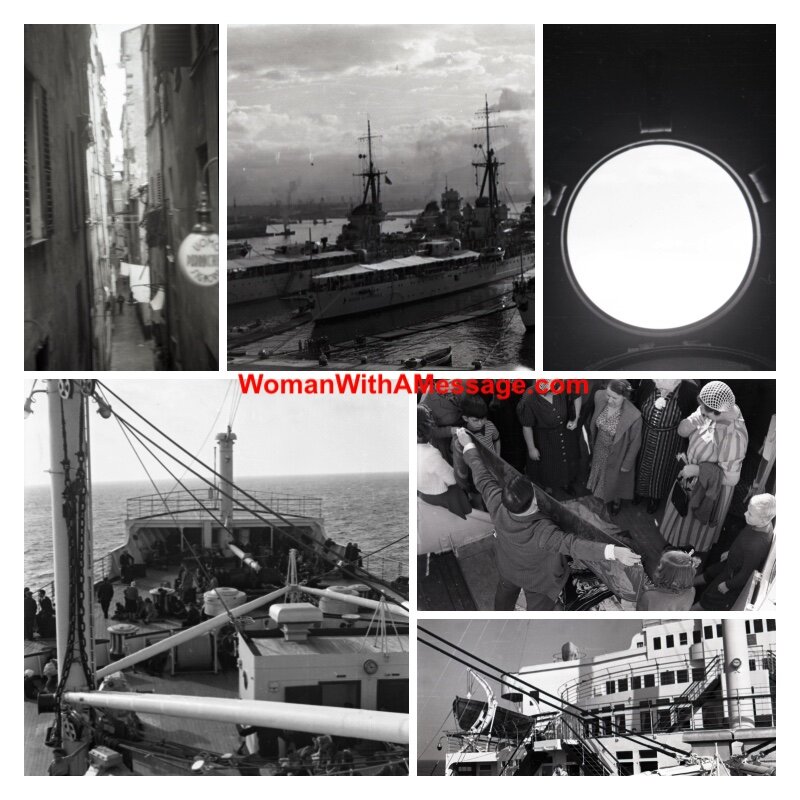
When I was going through Harry’s boxes of documents and letters after he died in 2017, I found a roll of negatives labeled 1939. I held them up to the light and only one photo seemed familiar – the one with Eva on deck with a scarf. Since the photo of her in the bathing suit is not on the roll, I assume that Luis Antonio Martinez sent her that photo.

I realized that the roll of film included images from their voyage and first moments in San Francisco and got the negatives digitized. Imagine my delight at seeing their voyage and new world through Eva and Harry’s eyes.

Harry documented much of the trip, presumably in order to send photos back to their parents in Vienna, which I imagine is why we had no hard copies of the photos. Below, we see a grainy photo of an Italian town, presumably Genoa. From the ship, we see a vendor selling rugs to a crowd of people below, other ships in the harbor, the deck of the Rex, and even the “view” from their porthole.

Image 10-6-21 at 10.05 AM.jpg

Here is a photo of Harry on board the ship:

NPAI3026.JPG

Harry saved a menu from the ship – I don’t know whether they had menus for each meal, or just for October 12 in honor of Columbus Day – which must have been quite the celebration since the ship departed from Genoa, the birthplace of Christopher Columbus. Apparently even the 3rd class passengers were invited to participate in the dancing or watching the featured film La Mia Canzone al Vento of the evening which featured Giuseppe Lugo, a famous Italian tenor. Harry used the menu as a sort of autograph book – someone wrote a nice note and a few people included their addresses.

DOC.0398.1939 (1.2) front.JPG
DOC.0398.1939 (2.2) interior.JPG

Harry kept in touch with at least one of the people, Elsy Howard, who sent him a card the following year from the New York World’s Fair, on which she wrote around the edges: "Many thanks for letter, which I will answer later. Hope you like Amerika now. Best regards, also to Maria, Elsy Howald."

LT.0531.1940 (2.2) back.JPG

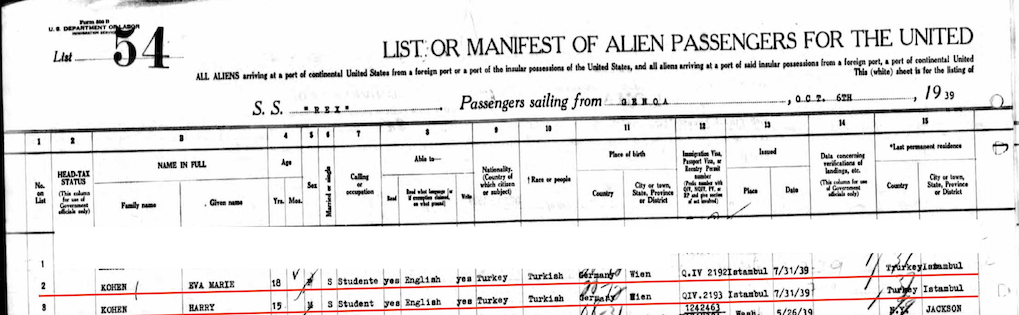
After nine fun-filled days at sea, Eva and Harry arrived in New York. In one of my first forays into searching through Ancestry at the public library in 2017, I found the ship’s manifest page of arriving passengers on the Rex that showed Eva Marie Kohen and Harry Kohen’s departure from Genoa on October 6 and arrival in New York on October 15, 1939. They are listed as students, Turkish citizens who could speak English , born in Vienna, Germany (Austria had been annexed), planning to live permanently in the US. They had visas issues July 31, 1939 from their last permanent residence of Istambul, Turkey. Amazing what you can learn from a line from a ship’s manifest!

ManifestP1.png

In August, I attended a Jewish genealogy conference, and at one session the speaker mentioned that manifests covered two-pages. I went back to Ancestry and found page 2:

ManifestP2.png

We learn that their father was named Simeon (presumably a mishearing of Haim Seneor) who lived in Vienna, Germany; that their final destination was San Francisco; that they paid their own way; that they had $8 in their possession provided by HIAS; that they were planning to reside at 200 Washington St. in San Francisco (I’m not sure whose address that was); that they did not plan to return to their home country and intended to become U.S. citizens; that they were never in prison, were not polygamists, anarchists, did not believe in overthrowing the government; they did not have a promise of employment; had never been arrested and deported; that they were in good mental and physical health and had no deformities; their height, complexion, hair and eye color, and had no other identification marks.

A new piece of information was that they had received $8 from HIAS – worth over $150 in today’s dollars, – although probably not enough money for the journey from New York to San Francisco.

I spent most of my life having a vague idea of Eva’s and Harry’s voyage. I had only seen the first two photos above. After discovering Harry’s trove of saved objects and photos and doing some research, I now feel like I have a sense of what it was like. A wonderful window onto the beginning of their new life.

October 8

Link to Family Tree to understand family relationships.

Today we see a postcard from prisoner of war Erich Zerzawy in eastern Siberia to his family in Brüx, Bohemia.

LT.0087.1917 (1.2) front.JPG
LT.0087.1917 (2.2) back.JPG

8./X.17.

My dear ones!

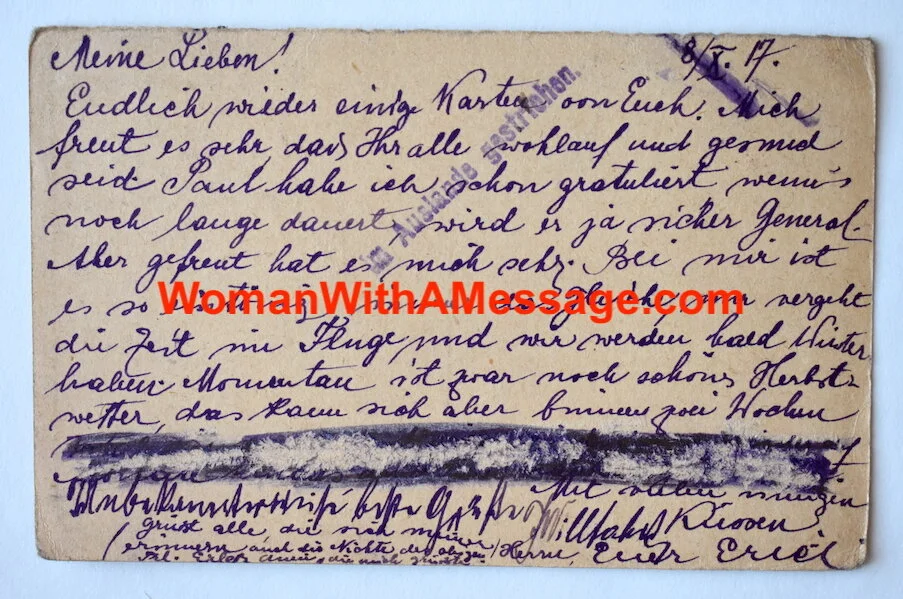
Finally, some cards from you again. I’m so happy that all of you are happy and well. I’ve already congratulated Paul. If this lasts longer, surely he will become a general. But it did make me very happy. It’s so much the same all the time for me. But time flies, and soon we will have winter. At the moment, we still have beautiful fall weather, but in two weeks that can….[censored…]

With many sincere kisses.

Your Erich 

Greetings extended… Greetings to all who remember me, and also to the niece of the above-mentioned Fraulein Erlers who sent me greetings.


This letter has both Russian and Viennese censorship stamps on the front and is the only one in my archive that was clearly censored. The stamp on the message side says “Deleted Abroad”.  The postscript may have been written by another person.

Erich mentions that he congratulated Paul  - on his October 2 birthday perhaps but also on a promotion?

It is hard to imagine enduring a Siberian winter. Particularly as a prisoner of war in the early 20th century. According to Wikipedia, the average annual temperature in Siberia is 23 °F, an average for January of −13 °F. During the search, I discovered something important about my family’s experience during wartime. It was an extremely cold winter all over Europe during December 1916-February 1917. And it happened again during the winter of 1939-1940. We saw letters earlier this year where Helene writes of burning furniture to keep warm in Vienna. See February 22 post. So in addition to the “normal” hardship and deprivation of war for prisoners, soldiers, and civilians, they also had to brave the bitter cold.

October 7

Link to Family Tree to understand family relationships.

Today we see another letter from Helene to her children in San Francisco.

LT.0203.1941.jpg

Vienna, 7 October 1941

My dear children!

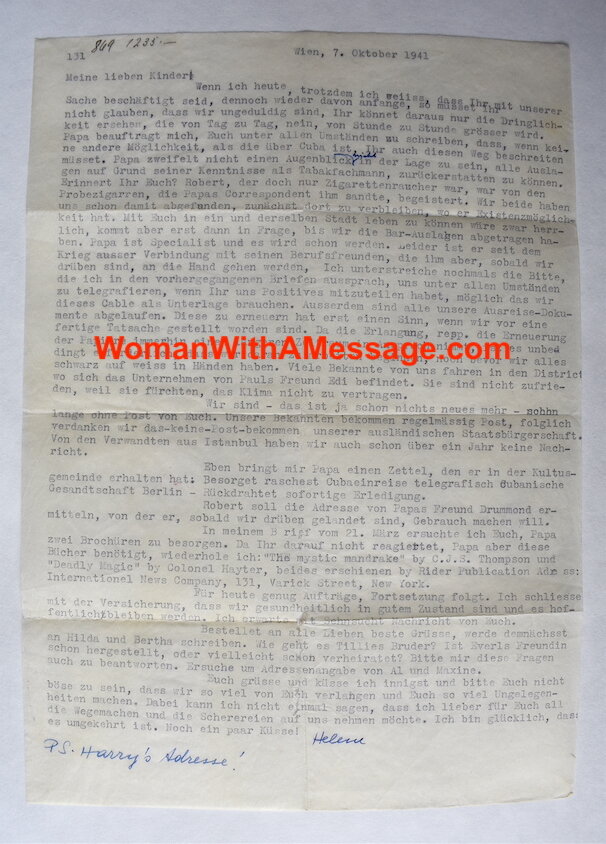
Well today although I know that you are working on our issues, despite that I am going to start talking about it again. So please don’t believe we are impatient. You can just assume that this matter is really urgent and that it’s getting more so from day to day and even hour to hour. Papa has given me the assignment to write to you that if there is no other way besides the path via Cuba, then you should go down this path as well. Papa has absolutely no doubts that he will be able to use his knowledge as a tobacco expert and then be able to reimburse any expenditures. Do you remember? Robert, who was really just a cigarette smoker, was enthusiastic about the sample cigars which Papa’s correspondent sent to him. We have come to terms with the fact that we may need to stay wherever we end up for a while at least where he has the possibility of making his livelihood. To live with you in the same city certainly would be wonderful, but it’s something we can only do when we have paid off the expenses that people have paid on our behalf. Papa is a specialist and this will happen. Unfortunately, he has been out of touch with his friends in his profession since the war broke out, but we know that they will give him a hand as soon as we’re over there. I must emphasize the request that I have also made in letters in the past to send us a telegraph if you have any positive news to tell us. It’s possible that the cable might be of use to us or we might need it as a document. Besides that, all of our exit documents for travel have expired. It doesn’t make much sense to renew them unless we know that it’s a done deal. The renewal of the papers will take quite a while, so it’s very important that we start working on it even before we have everything in black and white in our hands. Many of our friends and acquaintances are going to the district where Paul’s friend Edi has his business, but they are not happy because they are afraid that the climate will not agree with them.

We are - well, that’s nothing new - here without any mail from you for a long time. Our acquaintances do get mail regularly and so we’re thinking maybe the fact that we don’t get any is because we have foreign citizenship. But we haven’t heard anything from the relatives in Istanbul for at least a year either.

Papa just brought me a piece of paper which he got in the religious community: “get Cuba papers for entry as soon as possible.” This is from the Cuban Embassy in Berlin – send a telegram for immediate processing.

Robert is supposed to send the address of Papa’s friend Drummond, which he will be able to make use of as soon as we land over there.

In my letter of March 21st, I asked you to get 2 brochures for Papa. Since you didn’t react, Papa really needs these - I am repeating: “The Mystic Mandrake” by C.J.S. Thompson and “Deadly Magic” by Colonel Hayter - both appeared in Rider Publications and the address of that is: International News Company, 131 Varick St., New York.

OK, that’s enough duties for you to fulfill today and I will send more information later on. I close by assuring you that we are in good health and we hope that it will stay that way. I long for news from you.

Please give everybody my best greetings, and I will write to Hilda and Bertha soon. How is Tillie’s brother? Is Everl’s friend already spoken for or perhaps married already? Please answer these questions too. I’d like to get the address of Al and Maxine.

I kiss and greet you most sincerely and I ask you not to be mad that we ask so much of you and we’re causing you so much of an inconvenience. At the same time, I can’t even say that I’d rather be doing all this for you, and dealing with the trouble. I don’t know if I’d want to take that on. I am happy that it’s the other way around. A few more kisses! 

Helen

P.S. Harry’s address!


Helene and Vitali’s plans for traveling on July 15 to the U.S. did not materialize and theyare trying their best to find a way out of Europe. As has been true since German occupation, nothing is easy or straightforward. The rules and goalposts keep changing just as Helene says – day by day and hour by hour. They had pinned all their hopes on being reunited with their children in San Francisco. By this point, they are ready to go anywhere and have set their sight on Cuba. I found a movie trailer about what happened to some of the Jews who successfully made it to Cuba.

Vitali continues to emerge as an unusual man – in addition to his interest in metaphysical matters, according to Helene he was also an expert on tobacco products, or at least cigars. We learn that Robert’s smoking habit from 1918 (see October 3 post) continued at least another 20+ years.

Apparently Harry and Eva never received the March 21 letter requesting books on mandrake root – it is not in my archive. Both books from the 1930s are extremely rare. There is little information readily available about F.J. Hayter, who was an anthropologist and wrote primarily about Australia.

October 6

Other voices from the past

Link to Family Tree to understand family relationships.

As I was getting ready to prepare today’s post, I realized that the letter I had planned to write about wasn’t completely translated. It was one of several that my original translator had trouble reading. I had ascribed the problem to difficult handwriting, but now understand that it was written in the old German script. We will see the letter at a later date.

When I began trying to make sense of my many documents, I contacted the US Holocaust Memorial Museum when I was trying to find contact information for historian Corry Guttstadt because she had done a fellowship there. From that contact, I learned a great deal about my grandmother and my family and I made a new friend. I requested information about my father’s parents and they sent me documents from the International Tracing Service. They had been deported from Frankfurt on September 1, 1942 to Theresienstadt. According to one of the documents, my grandmother Rosa Adler Goldschmidt says she was transported to Maly Trostinec. Although there was no proof of death, the letter said that fewer than 10% of prisoners returned after the war.

My father was born in 1907 in Gelnhausen, a town in Germany not far from Frankfurt am Main. He came to the U.S. in 1934. At that time, his parents were living in Frankfurt. He had a brother who also came to the U.S. and lived in San Francisco for a few years, but I never met him and do not know where or when he died. He never spoke about his family.

In 2007, I began going through the papers my mother had saved. These included: her mother’s letters sent from Istanbul in 1945-1946; the letters Harry sent her when he was a G.I. in 1943-1945; Paul Zerzawy’s photo albums, school records, bank records from 1939, and his death certificate. She also had about 2 dozen letters from my father’s family.

When I first began looking through those papers, I asked for help from a few German speakers. Although they were able to read Helene’s letters, none of them could decipher the letters written by my father’s parents. When Amei Papitto started translating Paul Zerzawy’s letters written in the old German handwriting, I asked her to look at them and she couldn’t read them either. I had resigned myself to never knowing what the letters said.

When I contacted Michael Simonson at the Leo Baeck Institute a few months ago to ask for some advice, I mentioned my father’s letters. He asked me to send a few examples and he would see whether one of the LBI volunteers might be able to read them. Incredibly, he could!

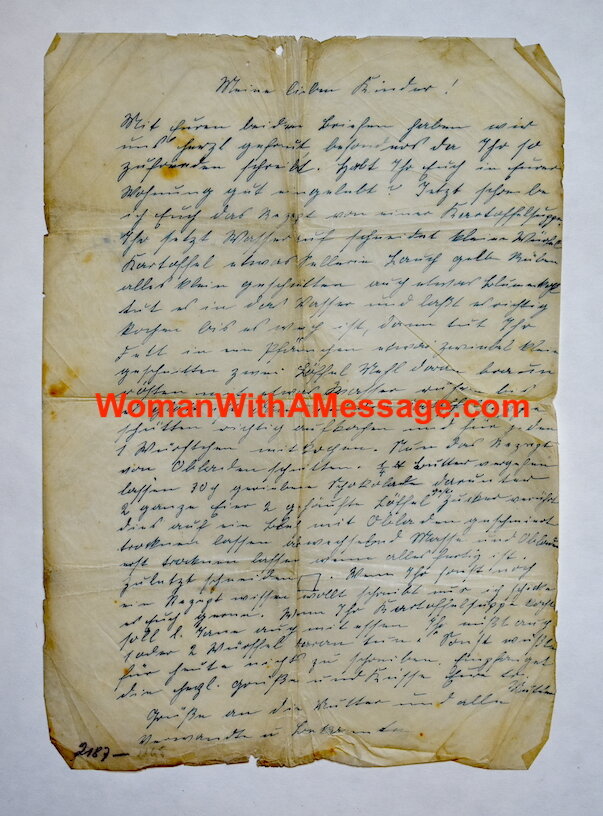
In early August, Michael sent me the translation of the undated letter below. Imagine my delight at hearing my paternal grandmother’s “voice” for the first time. Given my grandparents’ tragic end, I’m glad that they were not silenced forever.

LT.0336.nd.JPG

My dear children!

We were very happy with your dear letter, particularly since you sound so satisfied. Have you gotten properly settled in your apartment? Now let me give you the recipe for a potato soup. You start some water boiling, cut small cubes of potatoes, some celery, leeks, carrots, everything cut small, and also some cauliflower, place it in the water and let it cook until it is soft, then put some fat in a little pan, some onions, cut small, brown two spoons of flour in it, stir in a little water until it’s smooth, then pour into the potato soup, bring to a boil and add 1 small sausage per person. Now the recipe for wafer cuts. Mix ¼ pound butter, 30g grated chocolate, 2 whole eggs, 2 heaping spoons of crushed sugar cubes, allow this to dry on a sheet smeared with wafers, allow the mass and the wafers to dry alternately when everything is ready. Finally, cut.

If you would like another recipe, write to me I will gladly send it to you. If you make the potato soup, dear Tane <?> should also eat with you. You must also put 1 or 2 small sausages in it. Aside from that I know of nothing to write for today. Sending warmest greetings and kisses. Your faithful

                                                                     Mother

I was charmed that the first thing I “received” from my grandmother was recipes for my father’s favorite foods! It took me a while to figure out what a “wafer cut” cookie is. I tried reverse translation and came up with “Waffelschnitte”. They are the layered wafer cookies known to us as Neapolitin wafers.

Below is the only family photo I have that I believe shows my father’s family - I assume the baby is my father and the people in the photo are his parents and three of his grandparents.

PH.1678.nd.JPG

October 5

Link to Family Tree to understand family relationships.

Today’s letter was written by Paul (on his 22nd birthday) to his brother Robert in Brüx, Bohemia.

LT.0100.1917 (1.4) front.JPG
LT.0100.1917 (2.4) back.JPG

Morgonda 2 October 1917

Dear Robert!

I have already begun to answer your letter that I received today, but since I will not be able to finish it today, I will only write about what could be relevant for our possible meeting. Of course, it is clear that I would be really glad to see you, even twice as glad. First of all, because I think that you will not regret it if you are able to get a position in Bucharest. Second, because the prospect of seeing each other will then be pretty likely. If we are lucky, and if you don’t mind taking the time.

If everything goes normally, we will stay here for another 4 weeks, possibly longer, i.e., pretty much all of October.

I will notify you of any change immediately.

As far as the railroads are concerned:

[Drawing of train lines]

In terms of the railway, as far as I know, after Bucharest there are three main lines:

1. Budapest-Temesvar -Eisernes Tor [Iron Gates Gorge] Craisva – Bucharest
2. Budapest-Arad -Alvinor-Hermannstadt [Sibiu]-Roten-turm-pass
3. From Hermannstadt to Kronstadt [Brasov] to Predeal  

I hope that the rules for non-military travelers in war zone will allow you to go through Hermannstadt (you have to get the necessary documents as soon as possible). From Hermannstadt there is a train which runs on narrow train tracks. In four hours (once a day) to Agnetheln (Agnita). From there you reach Mergelen in two hours by foot. But there are many farm wagons. The other way: Szombatfalva  - Klein Schenk – Gross Schenk is 6 hours.

[Map: Hermannstadt to Szombatfalva] 

From Hermannstadt or Agnetheln you can try to get a telephone connection: The central command stationed in Morgonda station command headquarters is, I think, Nagy Sink (Gross Schenk). Ask there for the Sattler Rüdl (his work hours are 9-12 and 1:30-6) who is here in the station and can help you with all information.

Telegrams take at least 2 days from Vienna. Registered letters take a little less time than Fieldpost. My service and my position here allow me to come to meet you if necessary, e.g., in Agnetheln., or I could go as far as Hermannstadt so that we do not have to meet exactly in Morgonda. Our travel at the front does not go through Bucharest (see map), but rather Szombatfalva   – Kronstadt -Ploesti - Focsani — or so we hope!  

Everything else is in the other letter.

Your Paul


The map below shows most of the locations/train stations mentioned in the letter — you can see that Paul did a pretty good job of drawing a map. I couldn’t find all of the places, because Paul often used the German terms for Romanian place names. The “pin” shows Merghindeal, where Paul was stationed (called Morgona in the letter). Since it was not on a rail line, Robert would have to walk or hitch a ride with a passing farmer.

Screen Shot 2021-10-02 at 2.26.55 PM.png

This is the only letter in which Paul drew a map, so I was very curious about its contents. Unlike his aunt Helene, Paul was not one for humor and small talk – his letters were only long enough to include all the information he found necessary – he is all business. Although Paul is looking forward to the prospect of seeing his brother, he is anything but effusive!

I do not know whether Robert ever made this trip. It was almost 800 miles from his home in Brüx.

October 4

Link to Family Tree to understand family relationships.

Helene writes from Vienna to her children in San Francisco. They have been separated from each other for a year.

LT.0151.1940.jpg

Vienna, 2 October 1940

My dear sweeties! I will have to use all of my powers of persuasion to get Papa to mail the letter because he thinks it’s “immoral” to write letters when you’re not going to get an answer. Since I have a very different view of “morality” in this context, I will insist that the letter gets mailed today.

The rather deep bend on our floor has done so much damage that the work is still not finished. The new floorboards stand out from the old ones quite a bit, and the masonry provided such protection out of this that I had to have the carpenter strip off the floor because it wouldn’t have served to have things rubbing against everything. The carpenter made me a dance floor which I’m sure my daughter would have been delighted at and my son probably would have wanted to dance. Unfortunately, I don’t know what to do with it and I just have the satisfaction that people can see that I’ve really been cleaning thoroughly.

When I pick Papa up in the evening for our usual walk which usually takes us across the quay to the Rotenturm Street, your father always asks me if I have bought my daughter’s built-in soap dish for the bathroom, which is still highly recommended by the Schwadron Brothers. Especially since we now have a sketch of Everl’s room, this acquisition seems particularly important to him. I will see soon what I can do about that.  

Please don’t forget to give all of our loved ones our most warm greetings and best wishes and to assure them of my love and gratitude.

Embracing you with all my heart, I am your
Helen


When she translated this letter, Roslyn pointed out that there is now a restaurant chain in Vienna called Zuckergoscherl - for sweet tooth – the pet name Helene uses to address her children. Helene gives a brief account of their lives, emphasizing how just about everything she and Vitali do reminds them of their children. The children also try to include their parents as much as they can – in a recent letter, Eva sent a sketch of her bedroom so they could imagine her living quarters.

October 3

Link to Family Tree to understand family relationships.

Today we have a letter from soldier Paul Zerzawy to his brother Robert in Brüx, Bohemia written in 1918. Pages of this letter got mixed up with pages from the letter we saw on September 16 and 29.  

LT.0103.1918 (1.5) P1 front.JPG

3 October 1918

Dear Robert! Your letter from the 26th has left me very depressed, even more because I am not in the position to help you from here with your unpleasant circumstances, and even my advice will not be very helpful to you. As far as the food situation is concerned, I cannot help you other than by sending home as much flour as I can whenever possible. Maybe also the much more important fat. In very small quantities. When you have received enough for your needs, try to trade some of the flour for other food items. So far, I have sent you 19 boxes of flour and 3 boxes of wheat. Significantly more than 150 kg, and again I have about 70 kg wheat in my house now and another 50kg ordered, which hopefully I will have somebody grind. On the 30th, boxes d and e containing beautiful flour were sent to Käthe’s address.

As far as the money question is concerned, you have to speak with Papa. I need my money to purchase wheat. I have already used up my October salary up to 170 Lei [Romanian currency], and those I need for occasional purchases throughout the month, yes, it is not even enough for that.

Here, among the officers there are some who engage in the opportunistic business of sending flour. They send out flour to merchants for private people and they charge 15-25kr for each kg of flour. In this manner, you can earn thousands. I have never considered such action, except to help out family members. I have too many scruples for that and I think it unworthy of an officer. Yes, even of any decent human being. When I think about the sad money worries in our family, I often vacillate if I should not make this sacrifice to my self-respect. It would be a small matter to earn a few thousand kronen. The conditions: some capital of about 800-2000 kr, some connections, and some skill. Would I have those? The biggest risk would not be the possible loss of a number of boxes, but that the situation here is not stable enough, and I might suddenly have to leave, etc.

For now, it is not possible for me to think about such things. We just have to make do without it. If you spend money carefully and if you use my flour in the right way.

In your next letter (which by the way you have to respond to my worries from my last letter), please give me information about the officers association. (Br. Kohlen Bgb Ges)

Do not give up in the midst of all these difficulties; always there is a solution to every problem. Everything or much depends now on your courage and willpower.

I have already welcomed your decision to look for a position, even when you first mentioned it. I would be very pleased. I advise you urgently to look for a position in Vienna (through Helene) with her help.

As long as I’m here in Romania and as long as I can send things home, you shall not be lacking bread, peas, beans – I can supply you with these things. Also, I can supply you with cigarettes, but in moderation because of your health.

Now regarding your enrollment, this is my advice: As long as you have not completely abandoned your law studies, you should definitely enroll, even if you are deployed, and also at home study hard. If you go to Prague after the beginning of the semester, or if you go just before they start, you can with skillful motivation if there’s extreme need, telling the truth you can try to enroll with Rektor Magnificus and you can try personally to enroll. Possibly you can get an attestation by the doctor that you have returned belatedly from your summer break due to health reasons.

By the way, I estimate the costs even for a round trip are not so very high. If under the condition that Aunt Luisa will put you up for a few days.* I will repay the favor with flour. If it is really necessary in the worst case, I will contribute up to 100kr, maybe even more. But I want to make a condition that you will limit yourself to whatever is necessary when you spend money and stay there. On the other hand, for now you have to borrow the money, just as I would have to ask my comrades right now because at the moment, I have nothing liquid.

This is my advice. The decision is not mine to make.

Also, the thought of giving up the household and the apartment – if our situation is really that bad, I can only say that it would be right. Even though my heart is heavy thinking we will lose our home – on this issue, Papa has the last word.

What will happen with Grandmother, you have to ask Helena and Uncle Max. Should it be necessary to do this, then it would be best if Papa tries to get some leave for family reasons. If necessary, me too.

What do you hear from Papa? Again, he has not written to me in the last 10 days. How is his hand?

Please also write to Erich, always telling him my greetings and whatever is worth knowing.

I thank you for my birthday wishes, also dear Grandmother and Käthl and I will write to them separately.

I also thank Grandmother for the letter dated the 20th which arrived only today. I have sent out two unnumbered boxes, one with bread flour and one with corn flour. I already wrote about this to you in a card. Also, the first box has arrived with the bags, nails, and Papa’s bathing suit. Many thanks. Do not send any more of these kinds of boxes. They are not sturdy enough. Better to send mine back empty.

Please send me my winter clothing, but only: sweater **, snow hood, mittens (2 pairs), and especially, socks (can be summer socks, mine are totally torn up) in the manner which I have last described to you, possibly with iron around the box.

Greetings and kisses,
Your Paul

*In 2-3 days you should be able to get all the signatures you need to verify course completion
**the green one


We learn a tremendous amount in this letter – that Robert is doubting his law studies, that money is so tight that the family will likely lose their home and another family member will need to take in their grandmother, that flour is an invaluable resource to pay for favors from others when money is unavailable. Paul has just turned 23 years old and feels the weight of responsibility for his entire family while their father too is a soldier and unable to help. Paul is the wise elder to his 19-year old brother, who after recovering from an illness (perhaps influenza?) is deciding between going back to school in Prague; finding a job, perhaps in Vienna; while at home in Brüx he is trying to keep the impoverished household afloat as they figure out where they might live, what food they can find, and what will happen to their grandmother. Huge decisions and responsibilities for such young men. In the midst of this, Paul realizes that winter is coming and that he is ill-prepared.

October 2

Link to Family Tree to understand family relationships.

Today we see a half page letter from Helene to her children in San Francisco — she had already written a longer to her nephew Paul in honor of his 46th birthday. Unfortunately, that letter is missing from the archive.

LT.0266.1941.jpg

Vienna, 2 October 1941

My dear children!

Since today I wrote to the birthday “child” first, this letter will probably be a little shorter than usual, because Papa is going to combine his walk to the post office with some other errands which have to be done at certain times, such as shopping. But that doesn’t matter—I’ll start by telling you what we consider important right now. If you need any documents, then we can only get them to you by telegraph since it’s questionable whether we can receive other news; for other important communications, please send them by post, and write to Olga every now and then. Our neighbors say hello to you. They are supposed to be moving tomorrow, but they’re not sure where. But otherwise, everyone is doing very well. Papa is impressing upon me that I should tell you that if you need photos of us, you should get them reproduced from the ones you took with you. I believe that you have thought of this yourselves, but I am obedient and I do what I am told.

Otherwise, I am dying to receive a letter from Everl again. I’m hoping one of those will slip through soon. But I have had to give up hope of ever getting a letter from Harry. I am fearful for you, but I have to call it a day. Papa is calling from the next room that he has finished shaving and he has to mail the letter. I will smooch more next time. Kisses and hugs.

Helen


Although only in her mid-50s herself at the time she wrote this letter, Helene often thought of Paul as another of her children – a few months earlier in 1941, she wrote to him recalling a time she was his babysitter. After Paul’s and Robert’s mother and step-mother died, she was the only connection hey had to their mother’s generation.

As we’ve seen, acknowledging birthdays was paramount for the family, regardless of circumstances. Whether in the army in World War I, as prisoners of war in World War II, or continents apart in the 1960s, Helene and her nephews made sure their loved ones knew they were thinking of and missing them.

Even in this brief note, we see how constrained life has become: Vitali must plan his errands to coincide with limited business hours; vital documents and photos are impossible to send, even if required to satisfy paperwork requirements to leave the country; friends continue to flee Vienna (or are being deported?). We see the need for economy in the letter itself – there are no margins and every bit of the half-page is filled with type.

October 1

Link to Family Tree to understand family relationships.

Today we see two letters from Helene and Vitali’s friend Paula in Vienna, one from 1952 and one from 1955. We saw letters from Paula in the July 11 and August 22 posts.  

LT.0599.1952.JPG

Vienna, Oct. 1, 1952 

Dearest Helene,

Today I am taking time to write to you, my dearest.  Thank you for your last letter, but don’t take it the way Franz said it.  We know you love us very much.  A friendship doesn’t just end like that.  We have done enough together, and you are not like the others.  As you know, we have helped many people and now they don’t want to hear about it, because we might need help, they all have excuses.  I think you know what I as a friend have done to help.  She wouldn’t be able to live abroad and I wrote to her that maybe she would like to lend us some money, she could have also demanded that interest be paid.  We are not looking for a handout.  Her excuse then was that she can’t get it for free, but previously I could do anything.  Yes, my dear Helene, you can imagine that we are very sad.  Franz could have rented a business and everything would have been paid back by now, but the poor fellow has to go as a representative where he only earns something when he brings in orders, no health insurance, no child support, nothing, I would like to work but unfortunately I can’t find anything, you know, if we didn’t have any debt it would be easier, everything was stolen from the old man at Salamander, and what he brought there he will not get back, believe me, dear Helene, I don’t write to the friend anymore because I don’t deserve this, she complains to me because she did transfer a few hundred Schilling and she thinks that is enough, you see, dear Helene, we can’t help this person any more, you can imagine that they will have to leave everything behind, but we aren’t helping anyone anymore.  When Vitali comes, you are different, even though you have so many problems, you still think of us, but believe that better times will come for you, Vitali will come back as soon as he can and then things will be better for you dear Helene the package you mentioned has not arrived, please don’t send any more, it’s too bad about the money you spend and which is so hard to earn, and the others have it.  Dear Helene, years ago you sent me a coat, I had it altered for Annemichen, and it turned out so nice that everyone thinks it is a new coat, you know, I sew every day to make something useful out of old things for the child, it won’t be long until I will have to go out in an Eva suit because my daughter takes everything away from me, I’m just glad I can sew everything. You would be amazed at all the things I can do, but it’s just that I can’t get work to help support my good husband which makes me very sad but as soon as Vitali comes he will tell us what to do.  I often see him in my dreams and he encourages us, telling us he will come soon and stay in Vienna as far as we know, and you will come back to us and everything will be calm again and better times will come dear Helene forgive my mistakes but I am in a hurry because I still need to go shopping although I don’t know what I’m going to cook but I will find something my dear I’ll write soon and you must believe firmly that Vitali will come we really believe it and think he is doing better and he will soon have everything he needs.

That’s all for today my dear, a thousand kisses from me and the little one and greetings from my husband

Your Paula


LT.0604.1955.JPG

Vienna, October 13, 1955

Our dear good Helene,

Please don’t be mad that we haven’t written until today, but unfortunately there is always a lot going on, here too, and it’s something different every day.  Also, I am not as healthy as I should be, and my husband suffers a lot from headaches, and unfortunately he can’t afford a vacation.  If I could contribute by earning something, it would be easier, but the ladies always want me to stay all day, and I can’t do that.  After all, I have my own household to take care of.  And, as you know, the occupying forces have left, but unfortunately Salamander can’t work here because the local shoe factories are opposed to that, and so it’s hard for my husband too, but with God’s help we will stay on here until Annemarie has finished school, and hopefully she will have a good job by next year and be able to support herself.  So, my dear Helene, now about your question re Vitali.  He is in Turkey, but why he doesn’t get in touch we cannot say, but please write to his sister and tell her to put a notice in all newspapers asking him to report in.  And we will go to the Turkish Delegation here; maybe they can do something.  I think by now he must have found the means to come here.

This Jewish man, Rosenberg, has not been here for a long time.  I also don’t know if he may know something, I repeat how everyone left Buchenwald and he came along too, but then he stayed behind but did not die, my husband also says why does he keep quiet for so long, but it’s strange:  I often dream of seeing him packing his suitcase, but we are very far from giving up hope about him coming.  Whether your children believe it or not, that doesn’t change things.  But you, Helene, must believe that you will see each other again.  You know how many people were declared dead in this war, and now, gradually, they are returning and many women are married.  If you were here, you would be amazed by everything that is happening.  Dear Helene, as soon as we can, we will go to the Consulate here, my husband will go too, so that he can give an exact report, and his sister will certainly offer the money to put notices in the newspapers.  Vitali must read some newspaper or other; it seems unlikely he would be somewhere else.

My dear, we wish you good health and don’t be sad, everything will be all right, it would be better if you were here with us, then you could handle it all better.  America is no country for you.

Many sincere greetings from us all and many greetings and kisses from me

Paula


Paula’s earlier letters are stream of consciousness and manic – perhaps not surprising considering how difficult life was in in post-war, occupied Vienna. Letters continued to be censored, finding employment was near impossible, old friends seemed to have deserted them.

Paula felt that Helene was one of the few people who stuck by her, sending hand-me-down clothes and other gifts, not all of which arrived. Paula talks of going out in an “Eva suit”, which presumably was one of my mother’s old outfits that Helene sent for Paula’s daughter Annemarie/Annemichen. Now that her daughter outgrew it, Paula will wear it herself. Like with Paul Zerzawy’s recycling of an old dress shirt (see September 29 post), we are reminded how precious material and clothing was - not like how virtually disposable fashion has become.

Although my grandmother was a prolific letter writer – even after the war when she was reunited with her children – she saved a relatively small number of letters she received in the 1950s and virtually nothing from the 1960s and beyond. Did she stop writing letters after her grandchildren were born? As earlier in her life, did she write far more letters than she received? Or did she only save the letters that had the most meaning? Why were Paula’s some of the only letters she kept? Paula kept Helene’s hope alive that she would see Vitali again. By 1955, Helene’s children were trying to convince her that it was unlikely he had survived. It must have been so much more comforting to pin her hopes to the ravings of an old friend, one who knew Vitali well and who wanted to believe almost as much as Helene did in his eventual return.

Salamander was a German shoe company founded in the late 1800s by a Jewish man, Max Levi (no relation to my family), and a Christian man, Jakob Sigle. Max’s family was forced to sell their shares when the Nazis came to power and the company used forced labor during the war. According to Wikipedia, in March 2020, a memorial plaque was posted in Berlin acknowledging the company’s role in the war.

September 30

Link to Family Tree to understand family relationships.

Today we see Paul Zerzawy’s student body card from the College of Global Trade in Vienna. It was valid until September 30, 1921.

DOC.1504.1921 (1.2) front.JPG

Before enrolling here, Paul attended college in Prague before and after the war, and received his law degree in Vienna in 1920.

Given his level of education and skills, we can appreciate how difficult and frustrating it must have been to come to the U.S. and be unemployable, able only to fall back on his skills as a pianist.

This is one of the few photos I have of Paul at this age – we saw another from 1919 in the January 5 post. He has grown a mustache since leaving the army, which he will keep for the rest of his life.   

September 29

Link to Family Tree to understand family relationships.

Today we see the second part of the letter we saw on September 16 from soldier Paul Zerzawy to his family. As with so many things on my journey, mysteries and missing links have a way of being solved. Pretty amazing after over 100 years.

Upon transcribing the translation for a letter we will see in October, I discovered that it solved the puzzle of the earlier letter. That letter is dated October 3, 1918 and is written to his brother Robert, but included part of a different letter to his family – the missing pages of the September 16 letter!

Since the letters were written in old German script, it was impossible for my archivist and me to determine the order and content of letters. Our only clues were dates and signatures. Letters were organized in a way that would have made sense to their reader, but not to those of us unused to writing letters or worrying about saving on postage. Letters often were written on rectangular paper (7”x10” or so) that had been folded in half. When unfolded, a four-page letter would have the first page on the right side of the front and the last page on the left side of the front, and pages 2 and 3 on the other side. It seems that the writer started a letter with the intent of it being a single page and if they discovered that they wanted to say more, they’d start a new page with the same order. However, they rarely numbered the pages. It was only after finding one long letter where Paul had numbered the pages that we got the hang of it. Today’s letter was doubly confusing, because the last two pages were written on a the same size paper but in the way we would normally write a letter!

The first part of this letter began with a check in about himself and family members, followed by detailed information about the boxes of flour that would be coming their way. It continues here:

LT.0103.1918 (3.5) P2 front.JPG
LT.0103.1918 (4.5) P2 back.JPG

…On top of this, there is postage for which 1 kg is about 3kr. On the black market, it probably costs 8-10 times as much. Do you have the opportunity to get the wheat ground or to exchange it for something else? Please write to me about this right away (see my last letter from September 5).

Please write me everything concerning the beginnings of your university studies. -- What is the situation with my war bond insurance? – Has my good shirt already sent out to be turned inside out and when? – I ask Robert to take charge of the work for Couleur news as soon as possible.

Lido writes to me that he probably will go off on his leave in the middle of the month, so you can get advice and help from him.

I do not know if I have already written about it, that here there are 2 color brothers [Farben Brüder] with whom I am in regular contact. They are A.H. Pfiff (medical officer, 62nd Feldpost) and Griff (c/o medical lieutenant Julius Gutfreund, Feldpost 645).

Please send them your questionnaire immediately.

Finally, dear Robert, I still have to write to the following soldiers who are on leave in Brüx; please greet them for me. Please give me the following addresses:  [list of names]

Metzel’s address: Oscar Metzel Feldpost 405
Pepp’s Address: Chief doctor Dr Josef Weiss, FP 638, Field hospital 303
I will send other addresses for CB.

When you reply, please answer the questions so that I do not have to ask everything twice. Especially since the exchange of news by Feldpost is already slow enough.

Kisses to all of you,
Your Paul


We learn about another money-saving measure – rather than buying a new shirt, he asks whether his good shirt has been sent out to be altered, presumably to be refashioned/recycled by turning it inside out to hide any stains or blemishes to the material. Like food, I would imagine new clothes were difficult to come by, so even if he had plenty of money, he might not have been able to purchase anything.

It appears that Paul refers to his college fraternity brothers and the clothes they wore: per Wikipedia, “Visually, the most discerning characteristic of many Studentenverbindungen is the so-called Couleur, which can consist of anything from a small part of ribbon worn over the belt, to elaborate uniforms with riding boots, sabers, and colorful cavalry jackets, depending on circumstances and tradition.”  

In the letter, he asks for information about and provides addresses for a number of his friends. Paul’s photo album included many photos of groups of men in various uniforms. Paul had numbered the people in some photos which led me to the realization that he had written something on the back of many pictures. This led me to the discovery of the card we saw in yesterday’s post.

I assume that the photo below from April 8, 1915 is of his fraternity brothers. I don’t think he was in the army yet, so the uniforms they are wearing are consistent with the Wikipedia description above. On the back of the photo, Paul lists the names with at least two of the people mentioned in this letter: Griff and Pepp. In his absence, Paul relies on his friends to help his family and give his younger brother advice.

Screen Shot 2021-09-28 at 5.54.51 AM.png
Screen Shot 2021-09-28 at 5.55.11 AM.png

September 28

Link to Family Tree to understand family relationships.

This photo was pasted in one of Paul Zerzawy’s photo albums:

PH.1790.1934front.jpeg
1549 page.png

Earlier this year, I realized that on the back of some of his photos, Paul had listed the names of people in the photo. When I removed this photo, I received a wonderful surprise. It turned out to be a photo postcard addressed to his young cousins, Eva and Harry Cohen in Vienna, probably in 1934. It is the only piece of mail I have that is addressed to my mother when she was a child in Vienna.

The postcard shows Paul and his brother Robert walking on a street in Marienbad in Czechoslovakia with their father and his third wife Elise (see February 10 post). The postmark shows that it was sent on the 28th of an unknown month in 1934. Both Paul and Robert signed it and Robert included a “self-portrait” to let his cousins know that he had a lot less hair than it may have appeared in the photo (reminiscent of some of Harry’s drawings in his letters!).

PH.1790.1934 back.jpeg

In pen: Father, Mother, and two children. Greetings.
Paul

In pencil: On the picture I am flattered, in reality I look different, kind of like this: drawing.
Robert

In pen: Everything is okay.

September 27

Link to Family Tree to understand family relationships.

In the September 25 post, we read about the situation of the refugees in Istanbul. At the same time, today we see that one of Vitali’s relatives was working to facilitate Helene’s reunion with her children in San Francisco. As a prisoner, I don’t know how she could have managed it on her own.

LT.0018.1945.JPG

Istanbul, 26 September 1945

Very dear Mrs. Helena,

I have the pleasure of telling you that the local Consulate of the USA just advised me that the documents for your visa have arrived here.  Since those at the Consulate are very busy for the next few days, I was asked to wait 8 days to visit the Consulate about this matter.

I am very happy to give you this good news.  In three or four days I will contact the American Consulate to find out on which day you will be able to present yourself.

In case you need to tell me something, please write to me, because I am very busy these days and do not have time to go to Moda.

I am sending you 50 pounds via the person delivering this letter; I assume this will be welcome for you.

Hoping to see you again within a week, I greet you warmly

Yomtov Cohen


Earlier in the year, we saw several letters from Yomtov Kohen – I believe he was one of Vitali’s nephews. He was a successful businessman, working for the Turkish division of Gislaved, a Swedish company that produced rubber goods. I found a Turkish site which is selling a copy of Yomtov’s business card.

We saw other letters from Yomtov in the June 22, July 20, January 14, January 26, and April 17 posts (listed in the order they were sent during 1945 and 1946). What a comfort it must have been for Helene to have his emotional and financial support, as well as a connection to her beloved Vitali. Fortunately, Helene was still in Moda when Yomtov wrote this letter, since we learned in the September 25 post that the Joint was planning to move the refugees to less expensive lodging. After they moved the refugees, it became difficult for Vitali’s relatives to find and visit Helene. I do not know what 50 Turkish pounds were worth, but it must have felt like a windfall!

September 26

Link to Family Tree to understand family relationships.

Helene writes from Vienna to her children via Eva in San Francisco.

LT.0267.1941.jpg

Vienna, 26 September 1941

My dear children! I am in the pleasant situation today to be able to tell you that I have received a letter from the 2nd of this month. However, we can cross out the ones that are from the 23rd of July to the 2nd of September. But Everl’s letter contained quite a few things worth knowing. For example, we know that our letters have arrived and I am not forced to foolishly repeat everything as I have been; I know that you are working on our very pressing matter, that Harry is still in Sacramento but unfortunately I don’t have his address and so I have not been able to write to him even once. I was quite shocked to hear that cousin Al is still not out of the woods health-wise. Everl, I am grateful that you wrote to me that I should write to Tillie directly. I am not mad at you, I am, rather, thankful. You just have to bear in mind from the many letters that I have written that those that you wrote to me probably contained details were never received. If I write about things that I was informed about but of which I still have no idea, it is because I didn’t get the letters – you might assume that I am not interested or that I am just quite superficial. I therefore ask you, in your interest, to clarify this. I have received quite a few letters in the last few years, not only from Tillie but also from Bertha Schiller. I’ve written to Stella without receiving any answer. Everl, you yourself wrote that Tillie is so busy with Julius’s correspondence that she doesn’t have time to answer. And it is not a matter of affront to my vanity that I have given up on writing to them directly lately, because I assume that Tillie who is being kept up to date by you doesn’t really value this direct, brief contact with me. Hilda also owes me quite a few letters and why even bother to talk about Paul anymore. I can hardly count the number of letters that I have written to him. He has germs that keep him from doing anything that absolutely has to be done. You can tell him that I am very disappointed in him. He can follow my example. I have gotten over my pathological dislike of writing letters and now I write letters even when I’m completely exhausted. My letters probably seem like that, but what did it matter when I got a “pinch” from your professors. The main thing is that you understand me and that the letters arrive. At first, I was bothered by the knowledge that other people were reading our letters, but I’ve even gotten used to that and the Mr. Censors should turn a blind eye to that if they find my spelling or my grammatical errors a problem.

I had quite a bit to tell you today, but I don’t have time. I will follow up next time. Heartfelt greetings and kisses.

Helen


As I read many of my grandmother’s letters this year, I felt the guilt her children and relatives must have felt every time Helene was disappointed when she didn’t hear from her loved ones. In today’s letter, I recognize something that often happens– when one is unhappy with someone’s behavior, more often than not the person one vents to is an innocent party – one communicates one’s displeasure to the person who shows up, rather than the one(s) who didn’t. So, ever-reliable Eva hears all about the letters not received from Paul, Harry, Tillie, and Hilda.

This is one of the few letters where Helene acknowledges the fact of the censors – I always thought she avoided mentioning them for fear that her letters wouldn’t go through. At this point she realizes how often her letters don’t reach their destination, so she has given up being discreet.

September 25

Link to Family Tree to understand family relationships.

As we learned earlier in the year (see July 10 post), Helene was part of a prisoner trade which led to her release from Ravensbrück, put on board the Swedish ship Drottningholm to Istanbul, and interned there in April 1945. In the absence of any governmental bodies taking responsibility for these penniless and traumatized souls, the American Joint Distribution Committee (the Joint) took responsibility: interviewing the prisoners, helping connect them to loved ones around the world, and facilitating transport to their ultimate destination – whether it be their country of origin, another country that would take them in, or Palestine. At this time, the Joint was trying to help Jews all over Europe, and this small group of refugees was costing them a lot of time and effort with very little results.

Today we see excerpts from two letters letter from the JDC archives. The first letter is from Arthur Fishzohn who worked on behalf of the Joint to Earl L. Packer, the interim chargé d’affaires at the American Embassy in Ankara; the second is from Packer to Celal Osman Abacıoğlu from the Turkish Ministry of Foreign Affairs:


September 20th, 1945

Earl L. Packer Esq/.
Chargé d’Affaires ad interim,
American Embassy, Ankara

Subject: Re “Drottningholm refugees”

Dear Mr. Packer,

…there are now a total of 49 refugees still interned. We are making strenuous efforts to obtain visas for these people to…countries where they resided previous to the war. 

As you know, the financial burden for carrying these refugees at the hotel in Moda… is very high and we are trying to reduce these excessive costs. A Jewish Istanbul resident, who owns a summer house in Burgas Island has offered us this house, without charge, for the accommodation of the interned refugees.

At my request, one of the local leaders of the Jewish community applied to the Police Headquarters in Istanbul asking for the transfer of these people to Burgas Island. The police seem disposed to grant this request but advised that permission … should be obtained through the authorities in Ankara.

I would deem it a great favor if you would take this matter up at your first opportunity with the Foreign Office – or perhaps it is the Office of the Interior – and would welcome hearing from you as soon as conveniently possible.

With many thanks,

Sincerely yours,
Arthur Fishzohn


 Ankara, September 25, 1945

M. Celal Osman Abacıoğlu
Director General of the Department of Consular Affairs
Ministry of Foreign Affairs, Ankara

Dear Mr. Abacıoğlu,

Referring to our conversation today regarding the Drottningholm refugees now living at the hotel in Moda, Istanbul, … Mr. Arthur Fishzohn has requested the Embassy to inquire whether permission may be granted to enable the refugees to move from the hotel in Moda to a summer house on the Island of Burgas, owned by an influential Istanbul Jewish resident, who has offered the house without charge for the use of the refugees referred to.

In view of the fact that as the Joint Distribution Committee is paying for the living expenses of the refugees at the hotel in Moda … I should be grateful if you might find it possible to ascertain whether the proposed change of residence of the refugees could be authorized.

Sincerely yours,
E.L. Packer


Helene listed and described the different locations she had stayed in Istanbul in the letter posted on February 2. Here is a photo taken during her time in Istanbul:

Helene+in+Istanbul.JPG

Although the war was officially over, Helene was still a prisoner. I don’t know how much my grandmother knew about the other refugees interned in Istanbul – over the months she undoubtedly saw fellow internees leave one by one, but she was not so lucky. Part of the problem is that she didn’t know her children’s addresses so letters yet again took a long time to reach their destination – when last she’d heard, Eva was in nursing school and Harry had just finished high school. In the intervening years, Eva had graduated and gotten married and Harry had joined the army.

September 24

Link to Family Tree to understand family relationships.

Today’s letter from Helene in Vienna to her children in San Francisco continues the story from September 6, 20, and 21 which describes their straitened circumstances and their surprise and happiness at the windfall from San Francisco.

LT.0150.1940 (1.2) P1.jpg
LT.0150.1940 (2.2) P2.jpg

Vienna, 24 September 1940

My most beloved children! Yesterday I got the money sent from Berlin which I thank you for once again. You can hardly imagine how quickly the letter came, which was proof that the largest part of our subsistence comes from you and relatives, which, with the receipt and proceeds of the remaining stock in our business and the sale of dispensable items in our apartment, all helped us to pay for our living costs – all the easier for us now because we have sublet half of our apartment. We have also figured out a way to cook together and that will cost less as far as heating goes and this will have more of an impact as the weather gets colder in the winter months. That’s about all there is to say about what we are doing here.

In general, quite a bit has changed and, in 10 days, it will be a year since we caressed that train that took you away to a new life. It is odd how it seems to me - it seems as if it was yesterday and 14 days ago, when we had not even had a sign of life from Harry, I believed I hadn’t seen you for an eternity. I can certainly understand that Harry is homesick for Vienna but he would feel as we do like a survivor of the sunken continent of Atlantis. There are hardly any friends left in Vienna. The city of songs has become the city of wandering children’s prams and caryatid columns: all that’s old falls and new life blossoms out of the ruins. Speaking of ruins, in our living room it still looks like there was a battle here. The slats of the floor are stacked up all over the place and we’re waiting for the contractor to have time to finish the work. We are getting used to our acrobatic lifestyle, but at night when it’s dark, my sleepy eyes can hardly understand what this monster is doing because that’s how the furniture that is piled up in the corners of our living room seems to me. Since my bed is against the other wall in the other room, I pretty soon realized that I had bumped my head and then my thoughts straightened themselves out again. Papa is working on the interior design as it were, to make modern furniture from fruit boxes. I wanted to get some fresh air into my lungs yesterday and I picked up your dad and went out shopping with him and I just kept in the background passively. First, we went to Knoll’s store. You would not believe what you would see there, how well Papa does with the shopping when he uses his meat coupons in the best possible way. For example, you get the full weight of liver if you buy that because they don’t charge extra. You get more if you eat innards and if you eat head and feet, you even get four times as much. When he had made his choice and he was looking over the bill, he asked “which is the foot and what is Blunzen [blood sausage]?” The butcher was trying to keep a straight face and he explained: “well typhus is a disease and blunzen is too.” The other people were laughing. Papa got back at him by asking Mr. Knoll “and where do you have the dogs? I want one.” Everyone looked quite confused, like “what did you say?” He pointed to the poster on the wall, where normally you’d have calves and lambs hanging, which said “bringing dogs into the store is forbidden by the police.” Apart from Papa, no one objected to this particular German formulation. We kept going with our shopping. Mrs. Heindl’s store was the next place we stopped and he asked “Do you already have Gock-gock-gock-gack?” and she said [in Viennese dialect] “they just got here so you’re always the first one to get the fresh eggs.” Pech. Let’s go to Crete. “Give me an Omega.”
Pech: “Do you want a big Omega?”*
Papa: “Omegas are always big. I want a Delta** and a Parallelaped.***”

[footnotes at bottom of page: *peasant bread, **Emmantaler cheese with no rind, ***1/8kg of butter]

Our bargain and the Greek lesson for the grocer were over and we are going home with our geometrical food for supper.

I have been in such a hurry to finish this and now Papa has just gone off without taking the letter with him. Before I get dressed, it’s already too late, the letter will have to wait until Friday. That’s okay. Maybe I will have more to tell you by then and I don’t have to just build castles in the air. I am really looking forward to getting your next letter which will tell us about what you’re doing at school.

I am addressing the letters to Harry even though Everl gave us her new address, since I assume that Harry can put the letters in order more easily than Everl. If I’m wrong in this assumption, I will then just go back to the old way of doing things.

Friday, 27 Sept. 1940

My dear ones! Papa was right about waiting to post the letter until today, because I can tell you with great joy that I received your letter #2 from the 8th of this month. I am excited about the Nursing-School. It really seems to be an educational institution comme il faut. Just the right kind of place. Maybe when you get a chance you can tell me which of your clothes were so distasteful to Aunt Tillie and meant that you had to go shopping for some new ones. Harry’s schedule, except for Chemistry and Literature, is the same, only the Australian girlfriend is new. Bravo Harry! There is nothing like starting young. It was like a feast for me to see Paul’s handwriting again. The different meanings of “auditorium” and “audience” are now clear to me from Eva’s Graduation Number – i.e., the dictionary gave me some insight into this ambiguity. I read with schadenfreude that Paul had no success in getting an audience - serves him right since he hasn’t written to me in so long. And I don’t even get anything for his promises at the Dorotheum [auction house in Vienna]. I am also be interested in knowing how many virtuosos have already come out of his school.

Nothing much has changed here. From the balcony and windows to about halfway into the room, we are waiting for the floor contractor to show up; however, he cannot be reached. I explained to the architect today that I would use the basin to put goldfish in (not silverfish). He did not seem very happy with my intention to put an aquarium in there because the ceiling supporting beams seem to have a problem because of the unfortunate positioning of the balcony. When it rains hard, the water flows down.

I’m already looking forward to #3 and the day after tomorrow I will continue. Papa will have no excuse about not waiting for the end of the letter. I feel unusually well because I am getting regular letters again and I am not worried about Everl’s health anymore because she is seeing a doctor regularly. Harry should not be careless when he’s playing football. He shouldn’t overdo it and get all overheated and then have to drink tons of cold water. Paul could have done his cure more easily here. He really didn’t have to go across the big pond for that.

I am kissing all of you one after the other and I remain your
Helene


Helene’s mood is light because letters are arriving regularly from her children. Nothing can bring her down – not their poverty, their involuntary downsizing and sharing their apartment with strangers, the unreliable contractors (apparently a problem that has been going on all over the world forever), or the meager rations of food and distasteful cuts of meat. She makes light of all of it, making us laugh instead of cry at their situation. They don’t just laugh at the situation in the letters – they make light of the circumstances as they search for the meager provisions that are available at the markets.

I can identify with Helene’s joy at seeing her nephew Paul’s handwriting for the first time in ages – I had the same feeling when I saw my (then 18-year old) mother’s letters for the first time.

In 1940, Paul began giving piano lessons to earn money. He was unable to continue his profession as a lawyer in the United States, probably primarily because his lack of language proficiency — unlike his young cousins, he was in his 40s and not able to become fluent in English. In the February 25, 1940 issue of the San Francisco Examiner, I found a amall announcement in the arts section:

New Piano Studio
Formerly of Vienna and Prague, Paul Zerzawy has opened at the Heine Piano Company, 279 O’Farrell Street, a piano studio for instruction, for coaching in ensemble and for accompaniment.”

September 23

Link to Family Tree to understand family relationships.

Today we have a letter from soldier Paul Zerzawy addressed to his brother Robert Zerzawy in Brüx, Bohemia. Paul continues to send a few boxes of flour at a time to his family as described in the posts on September 3, 14, and 16.

LT.0105.1918 (1.2) front.JPG
LT.0105.1918 (2.2) back.JPG

23.9.1918

My dear ones!

Thank you for Grandmother’s letter. I am not just a little bit surprised and frightened by Papa’s illness. I knew nothing from him. A letter came saying nothing – what is he writing to you?

Yesterday I sent the boxes numbered 16 and 17 in Robert’s name and #18 and 19 in Grandmother’s name. 8 kilos flour, just as I sent you previously. If you want to have really fine flour, you only need to use a sieve one more time. As for getting cooking fat, it is very difficult. I will see. Write soon.

Your,
Paul


In the address line, Paul uses the abbreviation “jur” in front of his brother’s name. Robert had graduated from high school and was trying to follow in his brother’s footsteps by studying law. In those days, legal study was seen as a more universal educational foundation than it is today – the idea was that knowledge of and training in the law and legal thinking would be useful in any field.

Like Paul, their father Julius Zerzawy was serving in the military. Although we have seen that letters and packages went back and forth often, it was still difficult to know how loved ones really were doing. Particularly since family members didn’t want to worry each other. So they wrote of “nothing” or like Helene in 1940, tried to make light of impossible circumstances.