December 11

Link to Family Tree to understand family relationships.

Today we see two letters from 1958 between Helene and her attorney Paul A Eisler. The letters were found together and they were translated on the same day. I imagined Helene’s December letter would be a reply to Eisler’s September one. As is so often the case, my lack of German led me to jump to the wrong conclusion.

The letterhead reminds us how addresses and phone numbers changed over the years. Rather than a zip code, the area of San Francisco is indicated by the number 4. The letterhead uses the old phone number convention – “YUkon” to indicate the first two digits of the telephone number, instead of numbers 98. When I was a child, we still used the names. It was easier to remember a word/2-letter prefix plus 5 numbers than 7 numbers. I suppose the convention fell out of favor when we began to use area codes more often.

September 2, 1958

Subject: HILFSFONDS

My dear lady,

We are very happy to be able to tell you that quite soon the amount of 20,000. Schillings as a payment will reach you. You will probably receive the money in September and we ask you right after that to send to us the equivalent of 2,066.10 Schillings, which is the honorarium for our Viennese lawyer. As you already know, we here do not take any honorarium for allowances from the aid fund.

At the same time, we would ask that you make an appointment by telephone with our office since we will need your signature for any possible future allocations. This needs to happen as soon as possible, because the period designated for this to happen is going to end on the 10th of this month. 

Greetings,
Paul A. Eisler

“Hilfsfonds” is the generic term for relief fund – during COVID Austria provided “Corona Hilfsfonds”. Here, it refers to the Fund for the Settlement of Certain Property Losses of Political Persecutees (see page 23 and forward of the document in the link). The purpose of the fund was to make “lumpsum awards to natural persons who were the owners of properties, legal rights or interests in Austria which … were the subject of forced transfer or measures of confiscation on account of the racial origin or religion of the owner or in the course of other National Socialist persecution of the owner…”  The awards were for confiscated bank accounts, securities, money, mortgages, and “payment of discriminatory taxes”.

According to an inflation calculator, $700 in 1958 is worth about $6,400 in 2021.
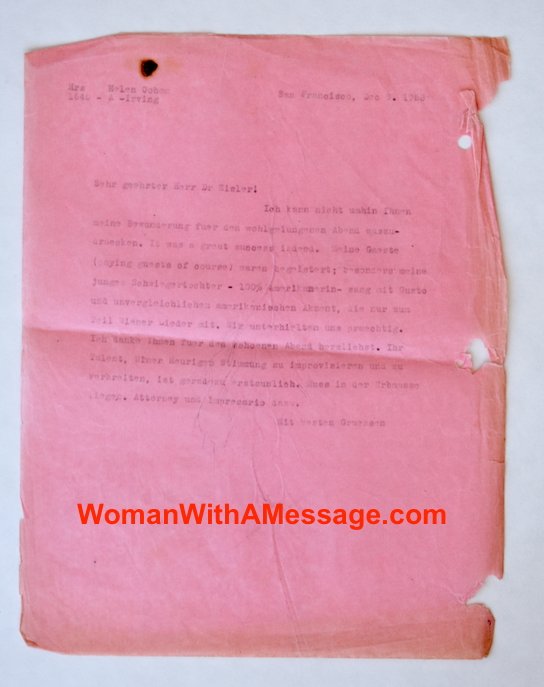

San Francisco, Dec 9. 1958

Dear Dr. Eisler!

I just can’t help express to you how impressed I am that you put on such a successful evening. It was a great success indeed. My guests (paying guests of course) were enthusiastic, especially my young daughter-in-law -- 100% American – she sang with gusto and with an incomparable American accent, only part of Viennese songs. We had a splendid time. I most sincerely thank you for the lovely evening. Your talent, improvising and propagating the feeling of a Viennese Heuriger is really quite astounding. It must be something you inherited. Attorney and impresario also. 

With my best greetings


As I mentioned above, the content of this letter was unexpected — rather than a business letter regarding the legal matter he was helping her with, Helene writes of a music-filled evening, much like the ones she enjoyed in Vienna. Helene’s son Harry got married in 1958. Throughout their marriage, Harry and Marie made beautiful music together. At age 95, she still loves to sing.

I wonder whether the musical evening in 1958 was a fundraiser like the one Paul Zerzawy was involved in that we saw in the October 14th post.

December 10

Link to Family Tree to understand family relationships.

Today we see two letters written six years apart from Helene’s friend Paula. During the war, Paula was one of the few friends who visited Helene while she and Vitali were separated from their children. Paula continued to write until at least 1955. As we saw in the July 11th post, mail from Vienna was still being censored, this time by the Allies. As in earlier posts, we see Paula’s letters become less coherent as the years go by. Her sentences often go on for over 150 words, long even by German standards. My translator tried to find natural breaks to make the letters more comprehensible. 

Vienna, 10 December 1946

My dear dear Helene!

Finally I got the dear letter from you and am very sad that you hurt yourself. I hope everything is okay now. My dear Helene, you write if I have already received the package. I have actually gotten two — one small one from France and nothing else yet except those. It will come in time. It always takes awhile. There was a ship strike and that had an effect. In any case, I thank you so much, but I worry that you scrimp and save and maybe that your children have a hard time. Maybe don’t send any more because I couldn’t stand if you were to suffer because of me, because I know how much you love us and you want to give us everything and I thank your dear children for all the things. Dear Helene, I was at the Kultusgemeinde [Jewish religious community in Vienna] again, and through the newspaper I reported to Herr Krell that maybe we could still find out something. I see Vitali so often in my dreams and I see that I believe that he must come soon. I can’t believe that this splendid person wouldn’t exist anymore. Annemie also talks about him so much and it’s so strange that the child was born in the same month as your husband, and he was always so proud of that — do you remember? Everything that she did was good. Dear Helene, I must tell you one sad thing. I was at the doctor and he told me that if my child doesn’t get better food with more fat in it, she will probably only survive for two years. She is growing so quickly that her heart and her lungs cannot keep up. Can you imagine how I feel at the thought of losing my child? I was in Salzburg again and got various things for the child. God should make it so that she does not get sick on me because it is so cold and we have no coal for the winter. Only 200 kilos for the entire winter and my mother has promised that she would give me some of hers.

Yesterday Frau Else was here to visit us and of course we speak about you and she loves the child, gives the little one a pretty red cap - you know how the little one is always dressed beautifully, so if we can keep it together we’ll make it through this ugly time. Dear Helene, you ask what I am doing and what I am living on. I have two rooms and a closet - the closet I have rented to a Jewish boy. He is 27 years old and was in a concentration camp. He is going to America as soon as it is his turn. So sometimes I cook when he brings things. And then I earn something too. He has plenty of money and he pays well. I have fixed up my room so that’s it’s cozy here. I certainly have lost a lot, but in the living room I have managed to keep it together although some things are still broken. However, you know a woman’s hand can sometimes make things look better, but actually everything that was in the basement was stolen, especially my underwear and my clothes. I am so poor with my things and I don’t really have much to wear anymore, but another time will come. The main thing is that when the little one has it, you know I just live for the child. Dear Helene, Else will also write to you and she will go to her sister’s in America and then I will be alone. Yes, I would love to see you again. It was so nice when we were together, such splendid people as you and Vitali, sometimes I think maybe we all will get together in life again. I cannot believe that I will never see you again and your wonderful children. My dear Helene, you write it is a matter of course that you send me packages. No, my dear, first your children have to work to do that and then I have done everything out of love for you and I am just so sorry that you have gotten so few of the packages of all the good things. Helene, dear Helene, I would love to have a picture of you and from your children. The one I have with her tennis racket, you can’t really see very well and if you had one, we could look at you and your children every day. Annemie is sending you a picture of herself of her soon and a letter. I am curious to see when she finishes it. She has clairvoyance like Vitali did. She often says something that is really exactly right. Now, when your letter has arrived, then she says “Oh I see that is from Tante Helen and Irna” and together and the next day it was really so - both letters were there. So she loves her grandmother very much and everything is about the child for her. She wants to spend a few days in Salzburg at Christmas, she gets to go there because she doesn’t have school because they don’t have coal and the school rooms are too cold for the children to be in so she gets to go visit her much beloved grandmother and then she has better food there, because then she can get milk which is not possible in Vienna. Oh, how good it is that you are not in Vienna anymore dear Helene and that you don’t have to go through this bad time here. As much as I would love to have you here, I wouldn’t want you to starve, that would be terrible, and the extreme cold. Yes, Helene, this year you will spend the first Christmas night with your beloved children. I wish with all my heart that it goes very well, that you have a good day, and won’t be so sad. I know and I understand that you really miss Vitali, but look, maybe there will be a miracle that happens and I cannot believe that this dear and good man will not come soon. Herr Krell is doing everything he can to find out something. Dear Helene, I am going to write you an address now which you can probably do more easily in America than I can from here. Write to the organization Hic [probably HIAS] and then you must give them all the exact information you have - that your husband was alive in March 1945 and he got away from Buchenwald in the long marches. At this time he was entirely healthy and that I got another letter for the child’s birthday and he asked for a certain kind of package which I also sent. Dear Helene, your nephew is not doing so badly with money and maybe he as I have done can write everywhere. And I will try to see if my lawyer can help in some way perhaps. He had someone from Buchenwald staying with him back in the day, a fellow understood that he knew someone named Cohen and that he was there when they marched. Helene, I still have hope and I don’t give up, my dearest.


Paula’s post-war address in Vienna was on Invalidenstrasse, less than a half-mile from Helene and Vitali’s old home on Seidlgasse. The package Paula received from France may have been sent by Lucienne Simier, with whom Helene became close at Ravensbrück — see May 8th post. Paula makes it clear that post-war Vienna is not a desirable place to be.

[Received December 8, 1952]

My dearest Helen!

I thank you for your dear letter. You must have already gotten mine. I see that you are also having problems with your apartment and yes my dearest, it’s about time that you get some peace but all difficulties go away and we just have to go through everything, my dear Helene. Just keep the faith and all the difficult stuff will pass by, as soon as Vitali is with you things will be very different. You will have read what has happened in Prague [Probably referring to November 24, 1952 trial] and of course that will have consequences for us too and it is better that Vitali hasn’t come yet because otherwise he might have to go through difficulties here again like in the year 1940, and he realizes that.

Dear good Helen, you must not give up hope because otherwise you just won’t be able to stick it out and believe and it will all turn out okay. Look how bad we are doing and still we say there has to come an end to this time too.

My dear good one, we all wish you a good Christmas celebration and especially a happy new year and stay healthy and believe it that it cannot last all that much longer and then Vitali will come because he also has a hard time in Turkey and he shouldn’t really be there and he is living under an assumed name and he must always have some fear hoping that nobody finds it out. Thank God now he is doing better and as soon as he can he will go away. Believe it. More I cannot write about this because he does not want anyone to really notice him.

Dear Helene this will pass and then dear God does not let his children fall. For today I will end my writing and I will write to you soon again and I would hope that you will get the letter before Christmas. We all send you greetings and kisses and we wish you good health and that you will get some peace.

Your dear friends kiss and greet you. We think of you often.

Have hope that everything will be okay 

Kisses, Paula


As we have seen in previous letters, Paula kept Helene’s hopes alive about seeing Vitali again, often asserting that she had been in contact with him. Unfortunately, her optimism was unfounded. In fact, she had seen Vitali in her dreams, but nowhere else.

December 9

Link to Family Tree to understand family relationships.

Today’s letter to Helene’s son Harry is the companion to Clipper letter #62 that Helene wrote to his sister the day before.

Vienna, 9 December 1940

My dear Harry-boy!

So, you’re playing a “prankster in America”. I wouldn’t even think of saying anything reproachful to you about that, because I behaved like a rascal on the street myself this week. In order not to forget how to walk, I decided to go shopping last Friday.

When I left the apartment, the weather looked really great, although doors and windows were rattling quite a bit. Papa gave me the food ration card and some good advice - not to wear a hat. My first path led to Knoll. A woman was pushing the other ladies who were shopping there around from one spot to another because she had lost her meat card and she kept assuring everyone that it just had to be here because she had it in her hand the whole way there. The butcher said “well, maybe the wind took the card out of your hand” and she said “what would the wind want with my meat card?” Although the other various housewives certainly showed a lot of understanding for this problem of having lost her card, nobody could really keep from laughing after she said that. After I finished shopping, I went in the direction of “Nordsee” to the Löwengasse. And around the corner was the Kegelgasse and there was quite a wind and next thing I knew I was in the Bechardgasse. Branches and dried out leaves and scraps of paper and hats and caps were filling the air. And as if it were pecking at me, a not very appetizing piece of paper covered my face and I had trouble getting it off of my face with my hand, because the other hand had to hang on for dear life to my shopping bag which was trying to act like a hot air balloon, taking me with it. I worked my way up to Kolonitzplatz and it was if the advertising posters and the store signs were giving an atonal concert. A musician would have been able to hear it and imagine a modern rhapsody, but I think if he had passed this off as his own composition, he would have been booed. Because my God, the Pastoralecertainly sounded a lot sweeter. On Kolonitzplatz when I finally got there, I thought I was at a Mardi Gras ballroom - a nice Vienna wind enjoys playing a joke on you. Rather stout and serious looking gentlemen grabbed as if on command with both hands to keep their hats on and turned around in 3/4 time and took quite a few steps without making any progress. An invisible hairdresser made a Medusa head out of my hair and the storm was quite gallant to us ladies. It would pick us up from the ground and carry us along a few meters and then put us down on the other side of the street. After I had bought some pickles, I let myself be moved. Who was that drumming along there? A head of cabbage was rumbling towards me. Maybe that’s why I was on the Kolingasse [pun on street name and rumbling cabbage]. And then it sort of brought me a black wax shopping bag which was following as if it were its duty the head of cabbage that I had found. I had far too much to do to deal with keeping my pickles under control, but then a colossal stomach almost ran me over. The stomach belonged to a bag and the cabbage and what the dear maid yelled at me could have been a set of legs. The pickles may go up in the hot air balloon again as I am thrown up in the air. But anyway, what the dear maiden said to me is the kind of thing that no decent person would write down in their family album (hence the name Stammgasse) [Stammbuch = family album/tree]. In the Kegelgasse where I ended up again, the cabbage had seemed to have hit and knocked over all nine trees (hence the name Kegelgasse) [Kegel = bowling ball]. I took advantage of a moment when the wind died down and I set off at a trot. I almost knocked over a guy who was there with a beer mug (hence the name Seidlgasse) [Seidl = beer mug].

I got home shortly before Papa did, who told me about his experiences on the Stubenring. The wind had taken delight in pushing over several benches which were reserved for Aryans to sit on. On the corner of Viaduktgasse, there was a wind bride who wished to dance with Papa, but he managed to get away from her impertinence. On the corner of Gärtnergasse, he would have been able to get some wind pants [Pun with whirlwind] without even having to pay points for them. Just like me, he was very glad to be home and we took pleasure in drinking tea about a quarter hour later. The wind, wind, wind of Vienna did all of that today.

That’s enough for today. Maybe I’ll write more tomorrow.

Helen


One of the wonderful things about Helene’s letters is how chatty she can be – she invites her children along with her on errands through the streets they’d walked on together many times before. They (and we) can feel the wind whipping as Helene treks through the neighborhood. Despite the daily privations and frustrations, she keeps the tone light. She throws in wordplay and puns, and likens her (and Harry’s) misadventures to a character in a book they would both have known. At first I didn’t understand her reference to Beethoven’s Symphony No. 6 — the Pastoral — because I thought of the calm, lyrical movements. But she is referring to the 4th movement, which evokes a violent storm, including high winds.

Below is a map showing the route Helene took. Since I did not have street addresses for the shops she went to, the arrows probably show her going further afield than she actually went. The starting and ending point of their home on Seidlgasse is circled in purple.

December 8

Link to Family Tree to understand family relationships.

Today’s letter from Helene was written a year later than the ones we’ve seen in the most recent posts – as Helene and Vitali experience their second year apart from their children. Today she writes to Eva, tomorrow she will write to Harry.

Vienna, 8 December 1940

My golden Eva-child!

At this time of the year, it’s a hard decision for Papa to crawl out from under the feathers, especially on a Sunday. My attempt to make this happen: “breakfast is on the table!” But that doesn’t always work either. Only the call of the Valkyries “Hojotoho, the mail is here” - has the desired effect with him. Since I recently in a most vile manner, took advantage of his gullibility as far as it goes, yesterday even though he heard the mail delivery woman’s doorbell ring, he wouldn’t get up out of bed. But he believed that a less interesting piece of mail had arrived, because I replied to his: “bring the mail in” with “no” but only because of the rhyme [herein/in; nein/no], in order to compete with Harry. When I started laughing at letter #10, he realized there must be mail from you and he jumped right out of bed. A second jump was to breakfast, which we then had together with Homeric laughter. I don’t know, Everl, if you have done the right thing in having Harry not read your letters anymore. If I still remember my little son well, he will only with great difficulty be able to give up on the little tidbits that are in there. I thank you especially for the wishes for my birthday and one has to be glad that not all wishes are fulfilled: “you shall get fat, you shall get fat, three times as fat” [a takeoff on the traditional birthday song]. It’s horrible what you wished me there. I certainly agree with the third line of the song: “you should come here, you should come here, very very soon” [another takeoff]. This I wished myself for my birthday this year, and since this wish appears to be more necessary than to increase my girth three times – which the Lord himself would certainly see – I hope that this wish would especially be fulfilled by Him. It is noble the way I am now. I wanted to give some of the birthday kisses to Papa, but he didn’t take them. He wants to pick them up himself, and he says he wants to do that as soon as possible. I have nothing against that.

In order to shorten my wait for the mail, I had decided this week to scrub the floor and wash it. Papa saw a storm cloud on my forehead and he left the house early. I prepared the floor as if it were the only reason for the mail being late, and moaning and groaning it put up with my abuse. In this way, I let it out my displeasure and it was easier to do the work rhythmically. I remembered a refrain from the Lipinskaya repertoire: “I didn’t know I was so strong” When I was about at the last third of the work, my anger and my strength were about done, I made do with the battle cry: “strong muscles, fabulous”. Upon finishing at about 5 in the afternoon (I started at 8 in the morning), in my childish disposition, I hoped to be rewarded for it with the afternoon mail which of course didn’t show up. What should I do? Should I scrub the floor again? That would be stupid. Papa said he wouldn’t be surprised if I acted like a witch: if in the morning, noon and night, he arrived and found me riding my broomstick, which I could not really deny; my uniform was quite sporty, like something you’d wear in Blocksberg. [currently known as Brocken]

Yesterday we visited the girls, although we had actually intended to stay home. But they were so insistent about it that we didn’t stick with our original plan. They met two married couples this week. One couple, whom they know by sight, live in Laimgrubengasse. They could have probably handled that. But with the other one, maybe not. The dear Hansi Niese, who must be clairvoyant, sang:

Yes on the Lahmgruab'n and on the Wieden,
Dulidulijöhö, dulidulijöhö
yes, the taste is very different,
Dulidulijöhö, dulidulijöhö

I did my best to give them a lesson in a sense of community, but some people just don’t get the point of that.

Now I come back to your letter. You wrote that Harry had made the point several times that you were looking very nice these days. Why don’t you see at the post office if you might be able to send a picture? Paul could probably take one of you.

Many kisses,
Helen 


Having finally received mail from her beloved children, Helene is in a lighthearted mood. She makes puns and (mis)quotes songs. When relating a story about visiting friends, she includes a verse from a bawdy song.

I don’t think I have a photo of Eva taken at this time. Below is Eva’s yearbook photo which probably would have been taken in the spring of 1940. She looks far more serious and her hair and dress are far more conservative than most of her classmates — perhaps she has begun looking more “American” by the time of this letter.

December 7

Link to Family Tree to understand family relationships.

Today’s letter is from G.I. Harry Lowell at the California Desert Training Center to his sister Eva in San Francisco.

December 7, 1943

Beloved Sister,

It is with great pleasure that I received both your letters.

Well, first of all I want you to know how glad I am that you have found a good and well-paid job. Now that you are the capitalist of the Lowell family, you’ll be able to do a little saving on the side – I guess I don’t have to tell you that. As to my promotion in the army right now, chances are very slim, indeed. The only way that I can get a rank or rating is by somebody’s elimination [?] or transfer. I am doing some brushing up in Spanish, math, physics, and I may start some other language. Then I’ll take over my I.Q. test and try to get 140; if I can make that high an I.Q., I’ll be general before my next birthday.

So you finally moved, eh? Is the new place nicer than the old one? As to your bedroom suite I could get you some mahogany-ultra-modern-hazelnut-finished army cots if you need them very bad.

We had some rain lately, and the mountains that surround the camp have a thin – very thin – cover of snow; they look pretty.

How is Hilda getting along? Let me know how her state of mind is, so that I can write my letters to her accordingly. The last two letters to her have been on the cheerful side.

What are you and Ursula doing in your spare time? Have you been boating or horseback riding yet?

How is your beau Walter? Hahaha!

Have you seen any good pictures lately? I haven’t.

I suppose S.F. looks like a big ant hill, with all the people hustling to get their Christmas shopping done. San Bernardino is a sucker’s paradise, therefore I won’t buy you anything this year – unless I can get to L.A. As for a present to me, use your head and judgement, I don’t need any clothes or books. (Use algebra to find x=present; you know, the system of cancellation of factors.)

Well, that’s all for today. My best regards to everyone.

Your baby-brother,
Harry

P.S. That Turkish actor’s name is Turhan Bey.
P.P.S. Note my new address:
3352nd QM Truck Company
APO 181, Postmaster,
Los Angeles
P.P.S.S. The joke was pretty good.
P.P.P.S.S. What’s the name of that fancy restaurant you talked about in your letter?
P.P.P.S.S.S. Even if I didn’t remember the poems, at least my grammar was correct. (Did I have a hard time, too!)


Despite his light tone, Harry touches on a more serious issue when he suggests that his sister save part of her paycheck – an unspoken reminder of their parents’ plight and their hope to bring them to the U.S. after the war.

According to Wikipedia, Turhan Bey “was an Austrian-born actor of Turkish and Czech-Jewish origins.” Just like Harry and Eva! He “was dubbed ‘The Turkish Delight’ by his fans and acted in dozens of Hollywood movies.

The last P.S. refers to the letter he wrote in German a few weeks earlier, which we saw in the November 8th post.

I don’t know whether Eva and Ursula — a friend from nursing school — ever went horseback riding together. The photo below was taken a few years later (cigarette in hand) – my mother’s recollection was that it was taken in 1947.

December 6

Link to Family Tree to understand family relationships.

Today we have a letter from Helene in Vienna to her children in San Francisco. They are about to experience the first holiday season separated from one another. 

Vienna, 8, Dec. 1939

My favorite children!

This is the 4th Clipper letter that I am writing to you, still hoping to get a direct answer from you. The eventful week continued. I wrote you in letter #3 that Olga fulfilled my request and sent it as soon as she received my card. The next day I received a second letter from her as an attachment that said it was undeliverable even though the address was exactly right. As a corpus delicti I would have liked to send it to you, but I’m afraid that letters with enclosures are harder to get through the censors. You can probably tell how I feel about this. I don't feel good about asking Olga to take on such expenses a second time, especially because I don't have the ability to pay her back right now and will hardly be able to do that from the allowed 10 reichsmark. So there is nothing left to do but put a smile on your face and wait until the post office decides to deliver the letters that have arrived.

In the meantime, it has become winter in Vienna, with snow, frostbite and other accessories. We don't have much to spend on food. We are lucky that we do have a card that allows us to buy clothing – our neighbors and acquaintances were not issued one – and I have already gotten the sewing materials I need. A hank of embroidery thread, blue cotton wool and a universal-colored darning wool. We can also buy vegetables nearby. I’m not used to going out, as you can maybe tell from the following incident. I go downstairs, intending to go shopping, taking the garbage can to empty at same time so that I only have to go out once and discover I forgot my grocery card. Annoyed at my forgetfulness, I put a hat on – the weather that day was too tempting – to make a little detour. When I wanted to buy something without coupons, I realized that instead of my shopping bag, I had the empty garbage bin hanging over my arm. Papa latest eloquence when we go out is: “Helene, did you remember the garbage pail?” The fact that I am just writing about garbage reflects my mental state and should not surprise you, given my current, exclusive occupation and the milieu in which we live. Papa, who used to bring home something of a spiritual atmosphere from his professional life, no longer throws clients out on his own initiative and for his own private enjoyment, but because he has to and that is less fun for him. Spiritually, we have gone to self-sufficiency, and my letters are a small example! How many minus points would I my jokes get now? Fortunately, I don't feel like it anymore.

Its Christmas in 14 days and I will to the extent possible think about you and hope you have a happy holiday. If you think about how nice it used to be, don’t be sad. You will spend these holidays under completely different circumstances - certainly very nice - and think that we will always be united in thoughts.

Papa is about to leave and I will get him to take this letter to the post office. Warm greetings to all of you. Many, many kisses

Mutti

[written upside down at top of letter:] All the best, Jo!


As I mentioned in yesterday’s post, my translation efforts began with the typewritten letters, because they were easy to decipher. Roslyn translated the letter we see today in March 2018 and the letter written on December 2, 1939 in November 2019.

Life is becoming increasingly challenging in Vienna. The balmy days of a few days before have given way to the chill of winter. Food and essentials are rationed and there appears no rhyme or reason as to who gets the valuable coupons and ration books. Their focus is on survival and not on the rich intellectual and cultural life they had before the war. Helene is distracted due to the absence of her children, as well as by the unfamiliar and unkind world her beloved Vienna has become. It sounds like Vitali is no longer allowed to see clients in their shop. It was something he enjoyed doing and he brought comfort to many people’s lives – but apparently he also enjoyed not helping people he didn’t like!

Below is a photo of Helene’s daughter Eva — we can imagine Helene sitting in Eva’s place working with the valuable materials they bought with their ration book.

December 5

Link to Family Tree to understand family relationships.

Today we have another early letter from Helene in Vienna, at a time when she and Vitali were confident that they would soon be following their children to San Francisco.

Vienna 5 December 1939

My dear children! An eventful week has just passed for me. We got mail 2 days in a row, but unfortunately not from you. Olga N acknowledged my card which I wrote on November 23, yesterday. It of course reached her late as seems obligatory. She told me that she sent a message to you immediately upon receiving it on the 30th of November. The second letter was from Mila and Nervi [?] and we found out that Robert is Ayrshire. He is feeling well and glad to hear the same about you and Paul. I am happy at least to receive good news from all of you in indirectly. And as an unkillable optimist, I believe that one or the other of the letters written will reach you.

Otherwise, it is fairly quiet in Seidlgasse. Yesterday it was a very lovely springlike day. Papa called to invite me to take an evening walk. We walked first through the dark streets and then we came to the Red Tower movie house. There was a shoot ‘em up film being shown and since it was about the construction of the Pacific-Railway, we went in. Harry would be very surprised because we don’t like things about shooting anymore. But at the end, when the train in its current form rushed across the movie screen, my heart stopped for just a few seconds at the thought that my children were just recently sitting in such a monster of steel and iron. Really, a lot of what has happened to you is so problematic for me and my imagination is certainly quite different from what it was.

The truth is that I feel old as the hills and I feel like a hen would feel if she were hatching duck eggs and I am clucking. When the young ones go to the water and happily swim away from her for the first time, she probably can’t believe her eyes in that situation. But I’m an intelligent hen, and even if I do cluck sometimes, I am happy to know that you are with people who are good and noble.

Please kids, be detailed in your reports, write me about each and every thing, and you may imagine that your letters will reach me someday and that I will be informed by letter about everything. I know it’s a lot to ask in such a completely different environment from where you’ve been before, but I think it’s justified.

After 9 in the morning, the whole day is pretty uninteresting to me. There are just so many minutes until the next time I get mail and a lot of what has happened is really not that essential to me.

What I also want to tell you is please don’t get mad if I mention something that is kind of obvious -- don’t forget to write to Olga. First, it is possible for me to get news and besides it is as somebody once said that you only recognize the value of a person except on the worst days. Olga invited me to spend some time with her before we say good-bye to Seidlgasse forever.  I wasn’t wrong about Hedy either. She arrived at my birthday with a piece of butter which her parents had given her so she’d have something to eat on her trip. Touching, isn’t it? In these days, we are doubly thankful for proof that humanity still exists.

For statistical reasons, I am mentioning that this is the 3rd Clipper letter which I have sent. The others don’t count.

To all the dear ones, many, many greetings and to each one of you, thank you very much.

Many, many kisses
Mutti


After just a few weeks’ separation, Helene realizes that mail is unreliable and asks Eva and Harry to write to friends and relatives in the hope that news about her children will reach her through their letters. Helene mentioned her friend Olga in several Vienna letters, including one in which we learned that her last name was Nussbaum. I did a quick search on Ancestry and found a physician named Olga Nussbaum who was born in Vienna and was a year younger than Helene. She was living in England by 1941, moved to Los Angeles in 1948, and returned to Vienna a few years later. She may be the correct Olga, but who knows?  

Cecil B. DeMille directed a movie that came out in 1939 entitled Union Pacific — perhaps that is the film that Helene and Vitali saw. The trailer would strike terror in anyone considering a cross-country train trip, such as the one Helene’s children had taken just six weeks earlier.

Piecing together my family’s story has not been altogether straightforward. My mother had some letters and papers, her brother had others, and some were originally in their cousin Paul Zerzawy’s possession and ultimately were kept and organized separately. In 2006, I discovered the 1945-1946 letters written by Helene from Istanbul. I could read the few that were in English, and from those I learned more detail about my grandmother’s wartime experience. I made copies for Harry, thinking he’d like to see old letters from his mother, having no idea about the hundreds of letters he had stashed away. After Harry’s death in 2017, I didn’t know which of the letters were worth translating, so my translator friend Roslyn and I began with the typed letters, which were easier to decipher. Thus, Roslyn didn’t translate the first letters Helene wrote by hand to her children until after she had translated most of the later Vienna letters.  

December 4

Link to Family Tree to understand family relationships.

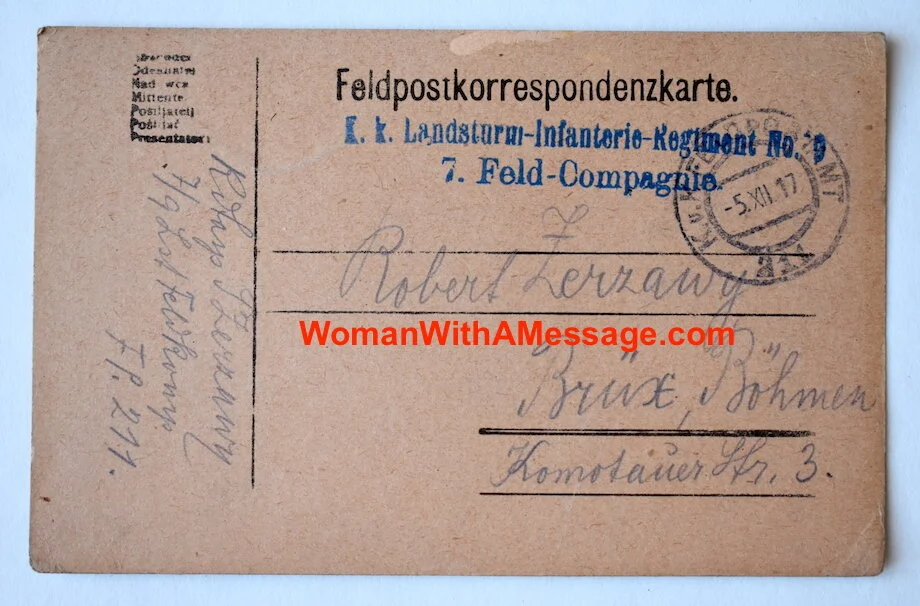
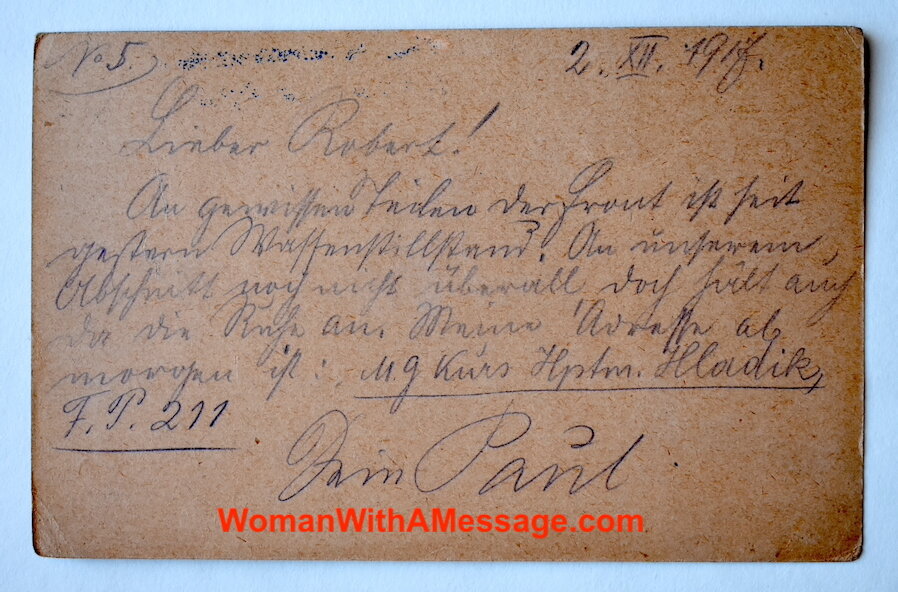
Today we have two numbered cards from soldier Paul Zerzawy at a field post in Romania to his family in Brüx, Bohemia. We saw #4 in the November 29th post and #3 in the November 24th post.
#5                               

2. December 1917

Dear Robert!

On certain parts of the front, there has been a ceasefire since yesterday. It is not yet everywhere in our section, but it has stopped here too. Starting tomorrow, my address is:

Machine Gun Course, Captain Hladik,
Fieldpost 211

Your Paul 


#6                               

In the field, 4. December 17

Dear Robert and dear Grandmother!

Above is my new address. After finishing my service (6-8 weeks), I will probably be moved to a machine gun company. For now, I do not know anything except that there is work to be done from 6am until 8pm. The prior idyllic living is over. You don’t go fishing in the Severs without being punished! Well, it will hopefully work out!

Your Paul


I assume the sentence about fishing is a variation on an old saying. Paul assures his family that all is comfortable and calm in the letters dated December 2nd and earlier, but he is far less sanguine in today’s correspondence. Like his brother Erich writing from a POW camp in Siberia, Paul tries to sound as upbeat as possible so as not to worry his siblings and grandmother. But it’s not hard to read between the few lines to appreciate that he is nervous about what the future holds.

December 3

Link to Family Tree to understand family relationships.

Today’s letter is from G.I. Harry Lowell at the California Desert Training Center to Helene’s cousin Bertha and her husband George Schiller in San Francisco.

December 1, 1943

Dear Bertha and George,

Despite my resolution to start writing more letters more often, I haven’t written to you since I saw you last. Yesterday was pay-day in joy of which I decided to catch up with my correspondence.

As I write this letter I trust that you, George, are in tip-top shape now and that you, Bertha, are working overtime in your victory garden.

I am still doing the same routine work, driving from one edge of the desert to the other.

Right now I am parked between Palm Springs and Cabazon, alongside a cool mountain, taking a little rest from a trip. We, another fellow and myself, were sent out in two trucks to deliver camouflage nets to a little place we’d never been to nor had we ever heard of it. Not even the M.P.s could give us any information; we were given just a superficial description of its possible location – somewhere around such and such mountain, maybe. Well, it was night and time to stop driving, but we decided to get to the place that night come what may. As this is maneuver area we encountered troops who were trying to work their night problems; we’d stop and ask them about the place we were looking for. They couldn’t tell us, but they asked us where they were because they got lost. I got a kick out of the majors’, captains’, and lieutenants’ helplessness and confusion. Those men were supposed to be competent leaders of a large number of soldiers! What a joke! After hours of driving we finally found our destination, though.

We had a few severe sandstorms during the last three weeks. I tell you, sandstorms aren’t pleasant at all. We had quite a time chasing after our clothes which were blown out of our tents. Otherwise the desert is in its beauty at present; it’s quite different during the winter months than during the summer.

We are all getting more anxious every day to get across to do something instead of wasting our time around here. Well, I guess we’ll have to be patient and wait until our turn comes.

I must move on so I close now, hoping that you both are well.

Yours sincerely,
Harry


As you can see from the map below, Cabazon is about 20 miles from Palm Springs. Although Highway 10 was paved, the surroundings were desert wilderness and their assignment would have been more challenging and time-consuming than mere distance would indicate.

Between this letter and the one Harry wrote to Hilda and Nathan Firestone on November 30th, we get a good feel for Harry’s life in the army – both the beauty and discomfort of the desert, the various personalities of army personnel (particularly officers), the sometimes seemingly pointless or incomprehensible assignments, and the unknown of what the future holds.

December 2

Link to Family Tree to understand family relationships.

In yesterday’s post, we saw a letter from Helene written in 1939. She has begun typing and numbering her letters. Over the course of a year, she has sent her children at least 61 letters from Vienna to San Francisco.

Clipper #61

Vienna, 2 December 1940

My dear children! Harry expressed joy in his last letter that we had not completely lost our sense of humor. I really lost it in the last few weeks, but I found it again yesterday when the letters that were on their way which had been taking their own sweet time, almost as if to say they were apologizing for having taken so long, did finally arrive. First #11 came from November 13th and that didn’t come as a surprise to me, because I heard from everywhere that letters from America were arriving in series. Since I considered letters #8, 9, and 10 to be lost, my joy about getting #11 was a bit clouded because the rest had gotten lost. I was even happier that I got letter #8 with the next post (it didn’t have a number on it, but it appeared to be a continuation of a letter I already had). My sense of humor that I had found again was in somersaults because I was expecting letters 9 & 10 and I was happy about that. Harry’s quarter report card was bursting with A’s and B’s and that really fills me with colossal maternal pride which I multiply by 2 because I am sure Everl’s report will soon be coming out. Don’t let your little brother tell you any different – go ahead and write when you want, because then nothing more will bother me. There’s not much new to report here. Across from Harry’s old kindergarten, in the house where my hairdresser was, there are large offices and several men who work there have already been into our store but they didn’t find what they were looking for. Just one of them had any luck. In the window display, there was a postcard which he was interested in and he ended up buying the entire stock (10 cards). Recently at breakfast, I noticed that the little pebble I thought I had found in my bread was actually one of my teeth and I had to have a Richmond crown made. I assure you that Dr. Uxi really wasn’t at fault. Have you ever heard of or read about crazy moths? Neither have I, but apparently there is such a thing and I’ve seen it with my own eyes. Papa left his summer suit, which he had still been wearing every day until quite recently, hanging in the front room for a few days. I got his permission to put it away for hibernation. Who can describe my horror when I found out that a hungry moth had eaten holes in it in the middle of November. The hussy had – there is no doubt about it – lost her mind. When it’s more than 27 degrees, the moths lose their minds. There is a certain threshold – the “moth horizon” – another one of those false things you learn in school – that moths cannot do any damage after August and there’s no point in killing the little male moths because those don’t really do any real damage, it’s just the female moths that prefer to lay their eggs on the most beautiful and newest wool items they find, which then serve as food for the moth eggs. Maybe I thought one of these damned female moths was a man and I didn’t kill it and the damned disguised woman, thinking it was the month of May, decided that Father’s suit was a good place to lay eggs and sought it out for that purpose. That she had gone crazy is not just evident from the fact that she was laying eggs in November, but fortunately also from the fact that she had found the oldest piece of clothing, even though it was hanging right next to my new jumper. I just noticed that the typewriter, despite the fact that there was a new ribbon, is not behaving and I am going to stop until Papa can come home and fix the problem.

So, until we write again [word play on the traditional – “auf Wiedersehen”/goodbye].

Helen

The original was not legible so I am sending a copy.


The postscript on this letter explains why so many of Helene’s letters look like they were carbon copies – indeed they were. Although the original page may have been difficult to read, the strike of the keyboard keys made the words on the copies legible.

We saw a copy of Harry’s Fall 1940 report card from Mission High School in the October 28th post.

The Richmond crown was introduced in 1878 and is still used today.

Although Helene was probably writing many more letters to her children than they were writing to her, they were more prolific than their numbering system made it look. We have seen many letters over the year when Helene begs them to number their letters so she would have an idea of how many were not making it to their destination.

December 1

Link to Family Tree to understand family relationships.

Today we see one of the first letters Helene wrote from Vienna after her children had left for America. At this point, Eva and Harry had been in San Francisco for about six weeks. 18-year old Eva was living with Helene’s cousin Bertha and her husband George Schiller; 15-year old Harry was with Helene’s cousin’s daughter Hilda and her husband Nathan Firestone. On the front page, she writes in German to her children, and on the back in English to the Firestones. Because the Schillers and Firestones did not live in the same neighborhood, Eva and Harry attended different high schools.

Vienna, Dec 1, 1939

My dear children, I am going to ignore the fact that I haven’t gotten any letters and I am going to write anyway, hoping that one letter or the other will reach its intended goal. The most important thing this week: Beppo wrote that we should not think that he is just sitting there with his hands in his lap. He’s doing everything he can and is asking just that we have a little bit of patience. Fortune’s brother is not allowed to work at all. As soon as I know more details, I will let you know. You know Vitali only by name, right? There’s nothing new here. Except for Jo and Paula, I don’t really see anybody because of the ... blackouts. We spend the evening writing or playing Tric-Trac. In our thoughts we are always with you, every minute. What time is it in America, and we are imagining: “I wonder what the kids are doing now.” We would love to know how you’re doing and if you have gotten used to it and how you spend your time. Eventually the post will come and we will no longer have this insecurity. Unfortunately, I cannot write anything more right now. Otherwise, the letter will be too heavy.

Greetings and kisses to all the dear ones from us.

Many many kisses
Mutti


Vienna, Dec 1, 1939

Dear Hilda and dear Nathan,

Nearly 5 weeks Harry is in your home and I hope you will not have much trouble with him. In my thoughts I am in your circle, I listen to your talks, doing my works mechanical and counting the days which we are obliged to be here. With all my heart I wish to know how you are and I hope the children will bring life in your house, but perhaps it is that which you don’t want, perhaps you are wanting silence. Please in this case excuse them. Youth is aloud and vivid, but they are intelligent enough to respect your customs and will surely being endeavored not to disturb you so much. Excuse my bad English. It is very difficult for me to concentrate and to express my thoughts in a language which I can use no practice.

Please give my best greetings and wishes to all our relatives.

In love and gratitude I am

yours truly
Helen


This is one of the few letters from 1939-1941 that Helene wrote by hand. Soon she would begin typing her letters, in the hope that they would be more legible for the censors and therefore might make it to their destination. She signs her letter “Mutti” (“Mom”). In most future letters to her children, she signs her name. I think Helene’s question about knowing Vitali by name is to let Eva and Harry know how hard he is working to get them to America – how “vitally” he is working on their behalf.

In the letter to Hilda on the back, Helene acknowledges that her English isn’t great, attributing it to the stressful situation and lack of practice. By the time she wrote from Istanbul in 1946, she was far more fluent. As I wrote in an early post, I believe that she worked on improving her English while at Ravensbrück.

November 30

Link to Family Tree to understand family relationships.

Today we have a letter from G.I. Harry Lowell to Hilda Firestone on Desert Training Center stationery in southern California.

November 30, 1943

Dear Hilda,

Today is pay day – the most joyful day of the month; it’s so joyful, indeed that I decided to write a whole batch of letters.

In contrast to what I thought of the desert during the hot summer months, I say now that the desert during winter is most enjoyable. The days are cool and sunny and the nights are very cold which makes one sleep very well. (of course, I have to be most careful not to knock my toes against any hard object early in the morning, lest they break off.) But it is rather nice now; and just when I get to like it here we are told that we may leave soon. Incidentally, my new mailing address is:
Pvt. H.L.
3352nd QM Truck Company
APO 181, c/o Postmaster
Los Angeles
I went to Yuma last week. On our way back we camped by Salton Sea, a nice salty lake near Mecca. The next morning I took a swim – alone, as my four [?] companies didn’t like cold water in the morning. When I got out of the water I was met by some major who had been watching me from a nearby cabin. Well, the old boy was furious and threatened to call the M.P.s to run me in for indecent exposure; he finally settled down and let me go with just a warning. How was I to know that anybody around there, especially pot-bellied majors, are in the habit of getting up before eight-thirty in the morning?

How are you getting along with your work? I guess you’re quite busy writing Christmas cards, too.

What is the civilian outlook on the situation of the war and the possibilities of its termination in the near future? The opinion among the soldiers is very mixed, partly due to the fact that some read only the funnies or the sports page; some of them are seriously interested in the events, but quite a few don’t give a darn and pick up news items from the “well-informed,” misinterpret them, and start showing off their knowledge during occasional evening talks in the tents. It’s great fun and I have learned to keep still and just listen to the “latrine politicians.” Paul would just love it, I bet.

Well, that’s all I have to say for the moment.
Give my regards to your father and Paul and everybody else.

Yours sincerely,
Harry

P.S. Many thanks for sending me the copy of Albert Elkins’ speech.


A quick search came up with no information on Albert Elkins.

Harry lived with Hilda and Nathan Firestone when he came to San Francisco in 1939. They served as his guardians until he graduated from high school in 1941. Nathan died in September 1943, which is why the letter is written to only Hilda. We read about Hilda’s grief in a letter she wrote to Helene in 1946.

I am in awe of young Harry’s wisdom in this letter. Already, he was a keen observer of human nature – he wrote this letter before his 20th birthday. His words remind us that there is nothing new under the sun.

November 29

Link to Family Tree to understand family relationships.

Today we have the 4th in a series of letters from soldier Paul Zerzawy in his current location to his brother Robert in Brüx, Bohemia. We saw #3 in November 24th post, and #2 (and presumably #1) in the November 9th post.
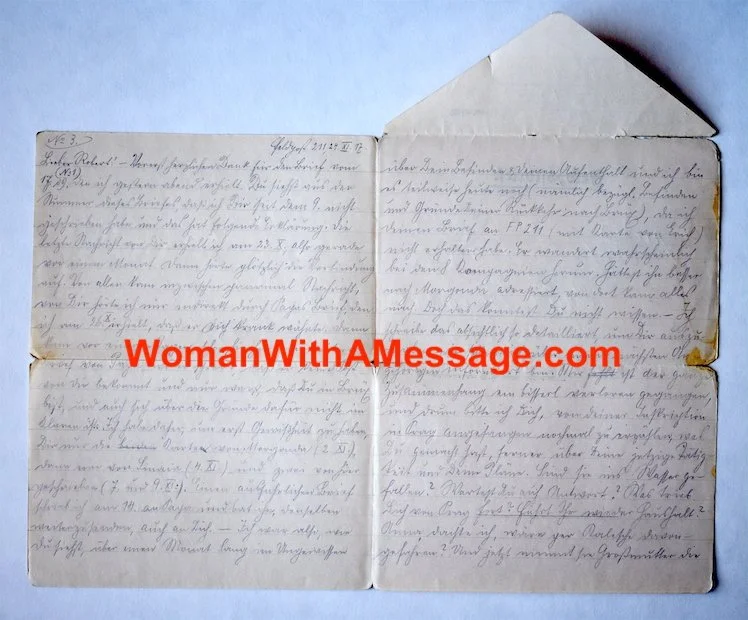
Fieldpost 211, 29 November 1917

#4

Dear Robert!

I have received both of your postcards (#1 and 2) of the 23rd and 24th, thank you very much. I have been assigned to the machine gun course, most likely under the same Fieldpost number, and I will depart for there on the 3rd of December. It is about two hours from here and you can reach it by horse cart. I will send the exact address later. Meanwhile, send important news twice [to both the old and new addresses].

I will be happy if I do as well in the machine gun course as I am here at the moment. For days there has been an idyllic calm. Once again, rumors of peace. Greetings and kisses to you and Grandmother, your dear

Paul


As we saw in the July 27th post, in 1916, Paul was assigned to the statistics office. As the war progressed, it appears the army needed more soldiers at the front lines. His mention of traveling to his new post in a horse-drawn cart reminds us that in 1917 the world was much closer to the 19th Century than it was to the 20th. As he often does in his letters, although Paul assures his family that all is fine — even “idyllic” — I imagine it was anything but. Like with Vitali’s experience at Gallipoli, I wonder how the war changed him and affected the course of his life.

November 28

Link to Family Tree to understand family relationships.

Today we see one of the first letters I asked Roslyn to translate. As I’ve mentioned in previous posts, when I first found the stack of World War I letters, they seemed like an interesting artifact, but unrelated to my immediate family’s story. I changed my opinion when I saw this letter from 19-year old POW Erich Zerzawy in eastern Siberia to his aunt Helene in Vienna.

28 November 1917

Dear Helen, the usual birthday greetings.  I wish for the only thing I can wish for in my situation – to see you again soon after a long, sad time.  And the prospects for this really aren’t so bad! But nobody knows anything for sure, that is the only sure thing.

If it makes you happy on your birthday, I want to reassure you, as I have done many times, that I am fine.  I think it must be the same for you; I know you!

Greetings and kisses from your old […?] Erich


This was the first evidence I found of Helene living in Vienna before my mother was born. Now I had the address where she lived while she was single. Salzgries was in the Jewish quarter, about a mile away from her eventual home on Seidlgasse, where Eva and Harry lived as children.

Like the Red Cross letters Helene sent during World War II, prisoners were not allowed to write long letters. The warning on the top reads: “Do not write between the lines!” Space was limited, at least partly because censors wanted to be able to easily decipher what was written.

Like Erich, I wish that he had been able to see his aunt and loved ones again, and to live a long and happy life. What a sweet boy, remembering his aunt’s birthday and thinking of her comfort and happiness. He unknowingly foreshadows Helene’s husband’s words to her from Buchenwald that we saw in the September 10th post. Both prisoners tried to reassure Helene that they were fine and were confident (or pretended to be) that they’d see each other again. Tragically, that was not to be.

November 27

Link to Family Tree to understand family relationships.

One thing I’ve missed in my family archive is the sound of my mother’s voice – I have the letters she received, but very few of the ones she sent. We’ve gotten to know the rest of the family, but have heard little directly from her. I was thrilled to find the few letters she wrote to her cousin Paul Zerzawy – 18-year old Eva in Istanbul (June 12th post) and upon arrival in San Francisco (October 23rd post).

Recently, I recalled that I have dozens of letters written by my mother, most of which she wrote to me during my junior year in college in 1978-1979 in southern France. I too kept every letter! One of the gifts of letters from long ago is that we get a sense of the times as they were happening, rather than some foggy feeling for the distant past. We see how the everyday world continues, even as sometimes the world seems to be spinning out of control.

November 27, 1978

Dear Helen,

If this letter is somewhat incoherent, you have to blame the state of shock due to the happenings in SF or related to SF for the past 10 days. I don’t know how much news you get in France about the US except that the events have been unbelievable. Before I start with personal news I better bring you up to date to the events I mentioned above. For the last week or so TV & radio had only reports on the tragedy in Guyana and most people in the mass suicide were Bay Area residents. It was a colony of a SF-based “religious group” which was located in the old synagogue on Fillmore & Geary & set up the colony in Guyana which was being investigated because the followers were not allowed to return to SF. The mass suicide involved over 900 people. You can imagine what the topic of conversation was wherever you went with all the newspapers & other media filled with it. Today as we finished up the clinic, the news came in that Mayor Moscone & Supervisor Milk (the spokesman for the gay community) had been killed by an ex-supervisor who resigned early this month, but changed his mind and wanted to be reinstated and must have gone berserk when his chances dwindled. Now you will understand my state of mind at this time.

When I received your card I started a letter to you and intended to finish it in my lunch hour, since my German dictionary was on my desk and I wanted to write a correctly spelled note regarding my birth certificate. Needless to say, I never got to the letter and to top it all I forgot your card and the letter I had written on the weekend in the office. Now I don’t have your new address and have to wait for tomorrow’s lunch hour and hope nothing will prevent me from sending it.

Now that I got all this out of my system, I can finish on a more personal note.

I am sure happy to hear that your move materialized and that you will have the experience you anticipated. I guess you will be able to use the recipes after all. How are you doing with the caterpillars? Did you ever get your winter clothes? Be sure to take the warmest clothes to Vienna. You might have to buy some snow boots (high waterproof boots). I don’t understand the telephone number. If I call do I have to ask for the “Poste”? I’ll wait to see my telephone bill before I do this however; and let me know the best time to reach you. Is this telephone actually in the people’s house?

Talking about Beethoven, Friday was the last opera this season and it was Fidelio by you know who. After the opera, we went to Elayne Jones’ house until 2am. She is leaving for Europe 12/12 and had thought of getting in touch with you, but instead is going to Spain. She is meeting her daughter in Rotterdam. Her daughter’s name is Hariette Kaufman; she graduated from Lowell with the class that had their exercise at the Cow Palace. She played cello in the school orchestra. Maybe you know her. She is 19 and teaches Englash in a town in Spain 2x a week. She makes 18,000 pesetas a month & spends 10,000 on room and board. The rest of the money she spends on traveling. I haven’t the vaguest idea how much this amounts to in American currency, but sounds to me that if you need to work only 2x a week, living must be cheap there.

I hope she will give me her address just in case you plan to go to Spain and might want to know somebody there. The town is not one I know, so it might be somewhere in the sticks.

Elayne was shocked to hear that you did not play a musical instrument, since she thought Lowell was geared to music. Do you still want some more of the guitar songs?

It will take me longer than I thought to write a German letter and my lunch hour won’t be long enough today; therefore, I will take my dictionary home and give you all the dope regarding the birth certificate. I am not sure how you will go about it without speaking German. That is the reason I will write a letter in German you can show to the authorities.

Things are quite hectic at work and our staff is getting smaller and smaller and at the same time we have more clinics, classes, etc. in the evening which cuts out all the day work. I don’t know if I told you, but I have to give parent classes and also Health Hazard Appraisals. Me and my big mouth. But the tendency is to give group presentations in preference to individual counseling. Maybe I can salvage my job by getting involved in all these activities. They are still talking about substantial cuts and non-professionals making home visits.

Now without a mayor, it will be difficult to have a budget for the city, because according to the charter, it has to be on the mayor’s desk the first week of Dec.

Well, I better get this off until the next installment.

Love,
Mom


Like Helene’s letters, my mother’s letter gives us a sense of all that was going on for both sender and recipient. She tells me about all that was happening in San Francisco, talks about necessary paperwork, refers to my recent move and to my planned trip to Vienna over Christmas break.

As my mother mentions, November 1978 was a terrifying time for San Francisco – within a few weeks, both Jonestown and the murders of Harvey Milk and George Moscone occurred. I remember wondering whether I would have a place to go home to and imagined what my life would be like if, like my mother did at the same age, suddenly I found myself having to live the rest of my life in France, far away from family and friends. The news did indeed make it to France. At the time, I was renting a garage apartment from an elderly couple. When I got home from school on the day Moscone and Milk were killed, my landlady told me that “the mayor of California” had been shot. I thought they were referring to Jerry Brown, but soon discovered the truth.

My mother would have been touched by these events by the mere fact of living in San Francisco. But in addition, she was employed by the city and county of San Francisco as a public health nurse, and these were people she thought about every day – many of the Jonestown victims might have been her clients when they were in San Francisco, and the city administrators were her employers. I don’t think it occurred to me at the time how much these terrifying events must have struck my mother to the core – she had escaped Europe to the safety of the United States, and her adopted home was feeling far from safe.

My dream of studying abroad included living with a family so that I would have the opportunity to speak French every day. Thus, I wasn’t thrilled to find myself living alone in a garage apartment. Fortunately, I met Marine, who was in one of my classes. We liked each other immediately and she asked her parents if I might rent a room at their house. She was studying English and thought it would be a great way to practice. Happily, her parents said yes. We were both only children and it was fun to each have a sister, if just for a few months. Today’s letter is the first my mother wrote to my new address.

Although she talks of making a phone call, the cost would have felt prohibitive -- at the time, she was reluctant to talk much on the phone to her brother just a few miles away in Berkeley, because even those calls weren’t free. I only recall one call from my mother while I was living there. I remember loving hearing her voice after months apart, but was shocked to hear that she had a German accent! I never heard it when we were. together every day, but after months apart, it was evident. As I think is common for children of immigrants, as a child, it always surprised me when people commented on the accent I couldn’t hear.

The discussion of the quest for a birth certificate brings us back to the main story of the blog. When Eva came to the U.S. in 1939, she did not bring a copy of her birth certificate. Almost 40 years later, my mother was 57 years old and was looking forward to retirement. She was afraid that if she didn’t have a proper birth certificate, it would be difficult to apply for Social Security.  

A friend and I had decided to go to Vienna over Christmas break. Never one to miss an opportunity, my mother hoped I would be able to get a copy of her birth certificate while we were there, despite it being the Christmas holidays and the fact that I didn’t know any German. Ever the optimist! I don’t recall whether I even tried – I’m sure it was beyond my ability and courage. Happily, my mother joined me at the end of my year in Montpellier, and we took a trip together to Vienna, 40 years after she left. One of her goals was to track down that birth certificate – a story worth a post of its own.

My mother inherited her love of opera from her mother. Unfortunately, that love wasn’t part of my genetic inheritance. Happily, I redeemed myself by marrying someone who loved classical music as much as she did.

I think my mother became friends with Elayne Jones through playing tennis. She was a timpanist for the San Francisco Symphony and Opera and led an amazing life.

In a number of letters, the idea of running into or meeting someone in Europe seems natural and inevitable. I never did see or meet the people mentioned in the letters and the likelihood seemed far-fetched. However, at midnight on New Year’s Day in 1979 as we waited for the subway after attending a performance of Strauss’s Die Fledermaus, traditionally performed at that time of year, a voice from the shadows emerged and said “Hello, Helen Goldsmith” – it was someone who had been a housemate when we were studying in Berkeley. She was in Edinburgh for her year abroad. One of the eerier experiences of my life! And yes, I did indeed attend an opera – when in Rome…(or Vienna).

As an aside, my friend Marine and I recently reconnected after decades, through the magic of the internet. Our language skills our rusty – comprehension is good but speaking/writing is a challenge – so she communicates mostly in French and I in English.

November 26

Link to Family Tree to understand family relationships.

Today we have a letter from Fritz and Hanne Orlik in Haifa to Paul Zerzawy’s address in New York City. Fritz’s mother was Paul’s father’s third wife, whom he married in 1921, after both boys were adults and out of the house.

26 November 1939
Haifa

Dear Paul!

Despite the fact that we haven’t received any answer from you from our letter of September, I wanted to write to you again assuming that my card may have gotten lost.  

Since we arrived here, which was on September 12, we have not heard from you nor from Mama and Robert. A few days ago, Robert sent us a letter. But that was 14 days ago. You can imagine what it’s like when you’re in a foreign country and you have lost all connections. So, we do ask you to write and give us a sign of life soon. You certainly hear from Mama. What is she doing? Whether Leisl and Leo and Mariana are with her?

Unfortunately, we don’t have much to report. We don’t have work yet. I have decided to do temporary kind of work. At the moment I am working for a manufacturer of rag dolls. But this is not really returning any profit to me. I suppose that I can find some foreign companies to work with. At the moment, however, there’s no hope for that. Are you able to send me something from America? My friend Leo Zwicker is the representative of a hollow glass factory.

Other than that, we are doing quite well with our health, but Hanna is quite scared and is having trouble getting used to being here.

Mama wrote to us in August that you are able to earn your keep, which we’re very happy about, and we want to congratulate you on. We hope that you continue to be well and that your beginnings there weren’t too marred by the vicissitudes of travel. I lost 21 kilograms but I have managed to make up 3-1/2 of those.

Dear Paul! Write soon! And many greetings from your Fritz.

[in different handwriting] Sincere greetings, let us hear from you soon. Your Hanne


In this letter, Fritz refers to an earlier letter that we saw in the September 19th post. The September letter had been written in English and today’s in German (which was indicated on the envelope). Fritz got the idea from a letter his mother that Paul is successful in New York and living the American dream. Unfortunately, that was far from the truth, and no doubt frustrating to and embarrassing for Paul. Paul had been unable to find his footing, while many others (including his aunt Helene and her children) needed his assistance. Unbeknownst to Fritz, at this time Paul had given up hope of making his way in New York and has gone west to San Francisco to join his cousins Eva and Harry, hoping to be more successful there. His host in New York, Arthur Schiller, would have forwarded the letter to his parents in San Francisco, Bertha and George Schiller, with whom Eva was staying.

According to a website that defines terms used in the glass industry,  “Hollow ware” is made “generally of soda-lime glass, but also of crystal, lead crystal and special glasses, hollow ware includes a wide variety of containers and receptacles: container glass (bottles, jars, medical and packaging glass), tableware (drinking glasses, bowls, etc.), construction hollow ware (glass building blocks, etc.), medico-technical glassware (laboratory equipment, tubing, etc.) and lighting glass (lamps, bulbs, etc.).”

I don’t know when Fritz died, but according to geni.com, Hanne died in Berlin in 1964. Since they weren’t happy or successful in Haifa, I imagine they eagerly returned to Europe after the war, despite all that had happened. This appears to have been fairly common – most of the prisoners who ended up with my grandmother in Istanbul wanted to return home to their pre-war countries, despite having been sent by their homeland to the death camps. After all they experienced, how did they (re)build a life anywhere? There are several memos in the JDC archives that advise the representative of the Joint to urge the released prisoners to consider another destination.

November 25

Link to Family Tree to understand family relationships.

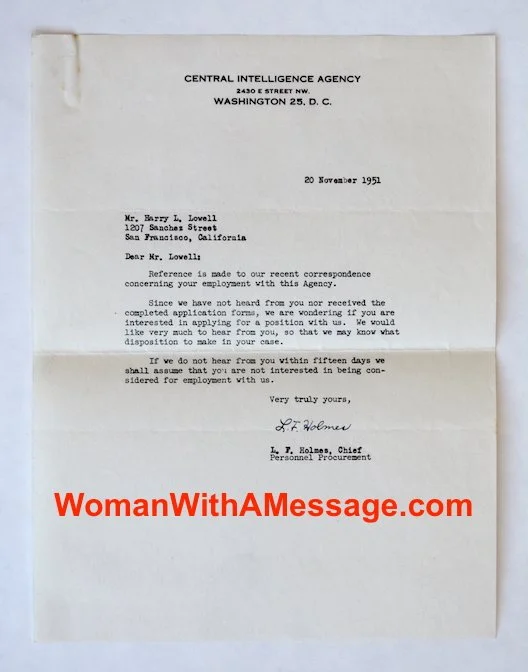
After returning from the war, Helene’s son Harry took advantage of the GI Bill (as he said he would do in his October 27th post), and graduated with a BA degree from UC Berkeley in 1951. In the spring of 1951, he worked in the UC Berkeley Engineering Library for $1.15/hour. Today we see correspondence regarding his application to work for the CIA.

20 November 1951

Dear Mr. Lowell:

Reference is made to our recent correspondence concerning your employment with this Agency.
Since we have not heard from you nor received the completed application forms, we are wondering if you are interested in applying for a position with us. We would like very much to hear from you, so that we may know what disposition to make in your case.

If we do not hear from you within fifteen days we shall assume that you are not interested in being considered for employment with us.

Very truly yours,
L.F. Holmes, Chief
Personnel Procurement


 December 7, 1951

Dear Mr. Holmes:

It is with sincere regrets that I must, at the present time, let pass up the opportunity of working with your agency.

One month before I received communication from you I obtained a very satisfactory position in public relations which I do not want to give up for the time being.

Nevertheless, I have not given up my plans of entering either your agency or Foreign Servie for which my training has prepared me. I think that public relations experience will but add to my qualifications for government service.

I have resolved to keep up my studies in the international field and not to allow my fluency in French, German, and Russian suffer in any way, although I have no opportunity to apply this part of my training to the present position.

Hoping that I shall be a more valuable man to you after having served my apprenticeship in public relations, I remain

Yours sincerely,


After graduating from college, Harry looked into a variety of possible career possibilities, including working for the California Redwood Association, as we saw in the October 31st post. In April 1951, he applied to work for the civilian branch of the army as an “Intelligence Research Analyst” in Europe, although he had been told there were no openings at the time. He tries to keep that door open in his letter to the CIA representative.

Although Harry was drawn to a job that would take him back to Europe and allow him to use his language skills, at this point his mother was living with him and he probably rethought the wisdom of his leaving her again.  

November 24

Link to Family Tree to understand family relationships.

Today we have a letter from soldier Paul Zerzawy sent to his brother Robert in Brüx, Bohemia. Although he still addresses Robert as a law student, by this time he knows that Robert has taken leave from his studies in Prague. As with letters Helene wrote in 1939-1941, family members have taken to numbering their correspondence to track whether and when letters arrive.

#3                               

Fieldpost 211, 24 November 1917

Dear Robert!

First of all, many thanks for the letter dated November 17th ( #1), which I received last night. You can see from the number of this letter that I have not written since the 9th, and here is the explanation. The last news I had of you was on the 23rd of October, almost exactly a month ago. Then, suddenly the connection stopped. Meanwhile, I received some news from everyone else a few times. But about you, I only heard indirectly from Papa’s letter, which I received on the 26th of October, that he thought you were sick. Then another letter came a few days ago from Papa,  already to this address, where he writes that he has not received any mail from you and only knows that you are in Brüx, and he is not clear about the reason for this. So, in order to be certain, I only wrote you the card from Morganda from the 2nd of November, then from Sink, from the 4th of November, and two which have been written here on the 7th and 9th of November. I wrote a detailed letter on the 14th, which I sent to Papa and I asked him to pass it on to you.

So, as you can see, I have been totally in the dark for more than a month about how and where you are, and I am still not somewhat confused about it (namely, regarding your well-being and your return to Brüx). Since I have not received your letter to Fieldpost 211 (with a card from Erich), I assume that it is most likely wandering around the 8 field companies. It would have been better if you had addressed it to Morganda. From there, everything reached me. But you were in no position to know that.

I am writing all of this in so much detail so you can picture for yourself how badly informed I am about my closest relatives. All the connections have been lost for me, and that’s why I am asking you to tell me again, starting with your enrollment in Prague, and about your current activities and plans. Have they fallen through? Are you waiting for an answer? What made you leave Prague? Are you all in a household together? I thought Anna had left by horse carriage? And now she is taking care of the housework for Grandmother? Does in fact Grandmother have any worries, since she is living with and getting her meals with Schleins? Have Käthl’s matters finally been settled?

I’m asking you such stupid questions, aren’t I? But, from those questions, you can see that I have no knowledge about the most important issues. Even though since our family has been dispersed in all directions, my letters home have tripled in number. However, the change in my position is partly to blame for this.

I am doing well in every respect. I am leading a life which is not much different from the life the officers are leading, except for the difference in pay. Every six or seven days, I am on duty as company officer of the day. Otherwise, I am lazy at the moment. With the current combat activity,or rather, inactivity, you do not have to worry about my safety for now. The Russians who are opposite us also are completely fed up with this situation.

I hope that our mail connection has been straightened out and will remain so, because in general the mail has been going okay. From Vienna, three days; from Prague, four days, from Brux and Przemyśl six days. Grandmother should excuse me for today that I only am sending her greetings through you. But in exchange, next time I will provide a grandiose description of the bombing of modern positional warfare: “Eastern Front in the Fall of 1917”.

Your loyal brother,
Paul


Paul mentions a November 2 letter sent from Morganda. He may be referring to his letter dated October 2. (see October 5th post). Perhaps he meant November when he wrote the previous letter – unfortunately I do not have the envelope with the postmark. We saw the letters Paul mentions from November 7th and November 9th in the November 9th post. I do not have the letter he mentions that was sent from Sink. Perhaps it never was forwarded from Prague with the others. In the November 16th post, we saw the “detailed letter to Papa,” stationed in Przemyśl.
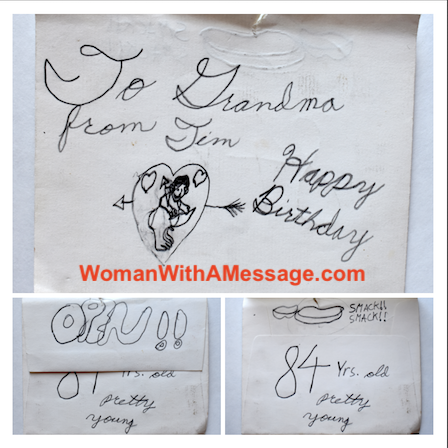
Anna was mentioned in the April 29th post that included a photo possibly taken on her wedding day in 1915. I do not know how and whether she was related, but it’s clear she was an important part of their youth. I could not find her on the Zerzawy or Löwy family tree.

Paul mentions how long it takes for mail to arrive from each of his family members – his grandmother and Käthl were in Brüx, Robert had been studying law in Prague (until he moved home to Brüx), Helene in Vienna, and his father Julius in Przemyśl. In terms of distance, Brüx is the farthest at about 750 miles, about 500 miles to Vienna, and about 400 miles to Przemyśl. Although his father Julius was nearer than the rest of the family, like Paul, he is in the military and mail takes longer to reach its destination – perhaps due to censors on both ends. Here is a map showing where family members were living:

November 23

Link to Family Tree to understand family relationships.

On Helene’s 135th Birthday

Family birthdays were the glue that held the family together. During World War I, Helene’s nephews Paul and Erich Zerzawy sent greetings to Helene and their siblings from the front and from a POW camp in Siberia; While waiting to follow their children to the U.S., Helene made sure to write special letters to each of her children on their birthdays and bought Vitali birthday gifts on their behalf. In 1942 and 1943, Helene and Vitali sent notes on Red Cross cards from Vienna when they were limited to 25 words and not allowed to write often; Helene sent greetings from Istanbul while waiting for resources to escape yet another prison; in the 1960s, Robert Zerzawy regretted that he could barely manage to send birthday acknowledgments, apologizing for writing so seldom.

Helene’s 80th birthday in 1966 was a very big deal. In the November 15th post, Robert asked Eva to buy a beautiful bouquet, because he realized he couldn’t order one for it to arrive in time. He also asked her for a family photo which we saw in the September 7th post, although one grandchild was missing from the portrait.

Below are photos of Helene with her 3 grandchildren in 1966. Her “portrait” on the wall behind her was drawn by her son Harry. It is wonderful to see her joy after all her years of sadness and loss.

Here is a card from 4 years later, drawn by Harry’s 9-year old son Tim.

November 22

Link to Family Tree to understand family relationships.

Today we have a letter to Helene’s daughter Eva from Jon Eidelson, the husband of a distant relative on my grandmother’s side.

November 22, 1996

Dear Eva,

As you know, I have been helping my father-in-law, David Levy, piece together a family tree for his mother’s side of the family. David’s mother was Elsie, the daughter of Bernhard Fulda (from Hitdorf, Germany) and Bertha Levy (from Litomerice in Bohemia, now the northern part of Czechoslovakia).

I am including a copy of the portion of this family tree that relates to your family. Hopefully you will find it interesting. I would greatly appreciate any corrections, additional information, or comments, and any photocopies of old documents you may have, and have included an envelope for your reply.

Thanks again for all your help.


Fall 1996 was the early days of email and Google did not yet exist. Research was done in libraries and by traveling to small towns in Europe to look for vital records.

In later correspondence, Jon asked some specific questions, most of which my mother couldn’t answer. I can answer many of the questions now, 25 years later, and the names and locations mean something. For example, in the November 18th post, Paul Zerzawy’s first postcard as a soldier was sent from Litomerice. 

After finding Harry’s papers, I contacted the San Francisco Bay Area Jewish Genealogical Society and joined JewishGen, an invaluable online resource. One of the first things I looked for on JewishGen was information on the Zerzawy family. By that time, I had found the Zerzawy family tree dating back to 1740 and the World War I letters from the Zerzawy brothers. As I’ve mentioned elsewhere, I didn’t think this branch of the family was important to the family story I wanted to tell, so I was hoping to find Zerzawy descendants who would find these papers interesting and useful. On JewishGen, I only found one link, and it was to the family tree made by Jon! I do not know whether there are descendants left from that family

We learned about both family trees in the February 13th post. Helene wrote about “Uncle Fulda” in a few letters although I haven’t deciphered the exact connection. As Helene and Vitali were trying to leave Vienna, she wrote to her children asking them to only ask him for financial assistance if it became absolutely necessary. I believe this is a photo of Erwin or his father Bernhard Fulda and Helene during a visit to Vienna in 1929:

This letter highlights a recurring challenge when doing genealogical research – the repetition of names, both first and last. In today’s letter, Jon talks about his father-in-law David Levy, which would lead one to believe that David was a blood relative of my grandmother Helene, whose maiden name was Löwy, which relatives changed to Levy when they came to the United States. However, Jon explains that David was related to the family on his mother’s side – David’s mother’s maiden name was Fulda; his grandmother’s maiden name was Levy.

Earlier this year, I hired a genealogist in Prague to find information about my grandmother’s parents and grandparents. According to his research, Helene’s father Adolf’s parents were both born with the surname Löwy, and in fact, both his maternal and paternal grandfathers were named Jakob Löwy!

In addition to answering Jon’s questions, my mother shared memories of the stories Helene had told her as a child. For example, she explained that her grandfather Adolf had tutored Goethe’s girlfriend. However, as we saw in the September 4th post, according to Helene, the possible Goethe connection was with Adolf’s mother-in-law who had been Ulrike von Levetzow’s milliner. As people steeped in genealogy advise, it’s always important to validate even information that seems incontrovertible by finding for additional references and evidence. As I’ve gone through my grandmother’s papers over the past few years, I have come to trust what she says and recalls. I can almost always find a newspaper article or other reference that corroborates the story she tells.